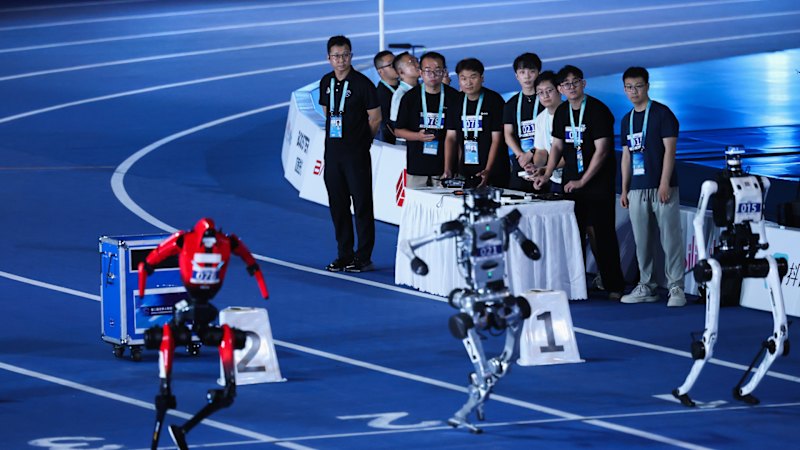
If you watched the clips coming out of Beijing's National Speed Skating Oval, you probably laughed. Bipedal androids stumbling into walls, soccer teams colliding in a tangled mess of titanium limbs, and the occasional robot losing a head mid-stride make for top-tier internet entertainment. But behind the viral bloopers of the World Humanoid Robot Games, something massive is shifting. China isn't just hosting a quirky tech expo; they're putting advanced hardware through brutal, real-world stress tests on an Olympic scale.
Let's look past the PR gloss. What's actually happening on the ground in Beijing, and why should you care about a bunch of metal athletes breaking track records?
The Record-Breaking Reality Check
On opening day, headlines exploded with claims that homegrown humanoid robots smashed human benchmarks. A machine built by X-Humanoid clocked a 100-meter sprint in 9.39 seconds, edging past Usain Bolt's legendary 2009 record of 9.58 seconds. Another entry reached a staggering 2.88 meters in the standing high jump. Meanwhile, smartphone maker Honor touted a trial run hitting 9.32 seconds.
Sounds terrifyingly dystopian, right? Not quite.
Before you panic about androids taking over the local track club, remember the context. These trials are tightly controlled, highly engineered sprints performed under optimal conditions. They don't mean autonomous machines are ready to walk down your street and navigate rush-hour traffic safely. They represent peak laboratory engineering optimized for a single, straight-line explosive movement.
Beyond the Track: The Real Engineering Grind
Over 2,000 humanoid robots from global teams descended on Beijing for more than 50 distinct events, ranging from standard soccer to complex scenario-based public emergency tasks. That's the real value of these games.
Engineering teams don't learn much when machines sit safely on a pristine lab bench. They learn when a servo motor overheats during a 1,500-meter endurance slog, or when a robot miscalculates a turn and violently face-plants into the turf. Every spill, short circuit, and mechanical failure yields gigabytes of telemetry data.
Companies like Unitree and other industry frontrunners use these high-stress environments to solve hardware durability problems that simulation software simply cannot predict. Balance control, actuator response times, and thermal management get brutally audited when you force a bipedal machine to compete under physical duress.
Geopolitical Stakes and Market Realities
You cannot separate these games from the broader economic rivalry between Beijing and Washington. China has firmly anchored humanoid robotics at the core of its national industrial strategy, churning out the vast majority of the world's hardware.
On the flip side, Western regulators are tightening the screws. The U.S. Federal Communications Commission recently placed strict import bans on foreign-made mobile robotics, citing national security concerns, while the Pentagon added prominent Chinese robotics developers to restricted lists.
Despite the political posturing, the commercial reality remains grounded. Most humanoids you see today are expensive research platforms, promotional spectacles, or early-stage prototypes. Mass real-world deployment inside factories, warehouses, and homes is coming, but it's bumping into massive bottlenecks in cost, battery density, and edge-case AI reasoning.
How to Track the Real Progress
If you want to look past the marketing hype and understand where consumer and industrial robotics are actually heading, stop watching the sprint highlights. Pay attention to three specific metrics instead:
- Battery longevity: Watch how long units can maintain untethered operations under heavy physical loads before needing a recharge.
- Payload efficiency: Measure how much weight a robot can lift relative to its own body mass during utility tasks.
- Autonomous recovery: Observe how quickly a fallen machine gets back up without remote human intervention.
The era of functional androids isn't arriving overnight via a magic software update. It's being hammered out piece by piece, failure by failure, on tracks and sports fields where machines finally learn how to stand back up.


