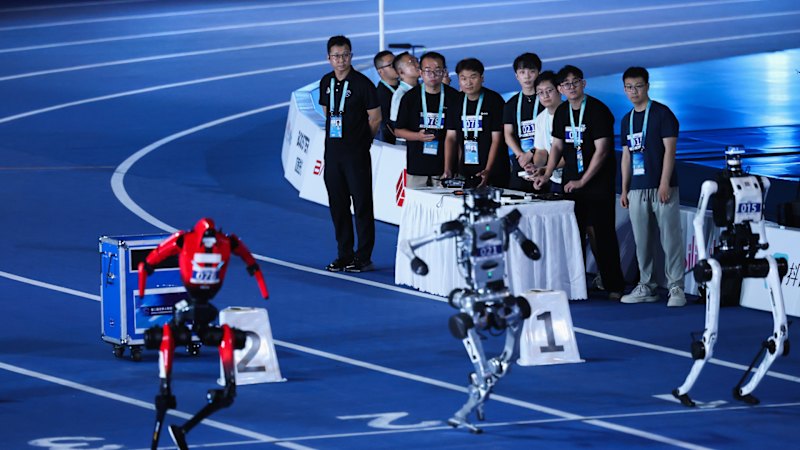
Usain Bolt's legendary 100-meter world record stood untouched for nearly two decades. Then a machine showed up in Beijing and smashed it.
At the World Humanoid Robot Games, a bipedal creation named Lightning clocked an astonishing 9.32 seconds over the classic sprint distance. Bolt ran a 9.58 back in Berlin in 2009. That human benchmark is officially history.
If you think this is just a neat party trick for engineering nerds, you are missing the entire plot.
The Mechanics Behind the Machine
Built with hardware backing from smartphone maker Honor, Lightning stands 169 centimeters tall. Engineers tweaked its design significantly ahead of the Beijing showcase, lengthening its legs to 1.05 meters to optimize stride length and frequency. During its record-setting run, the robot peaked at a blistering 14.5 meters per second.
Compare that to human biomechanics. Flesh and bone hit structural limits regarding how much force a runner can slam into the track before tendons snap or traction fails. Metal and custom actuators don't have those biological constraints. They handle explosive torque in ways our joints simply cannot absorb.
This sprint wasn't an isolated fluke either. The same machine previously finished a Beijing half marathon in 50 minutes and 26 seconds. That outpaces elite human endurance runners by a wide margin.
Why the Robot Olympics Matter Right Now
Scoff all you want at machines racing down a rubber track. Events like the Beijing competition serve as a brutal stress test for real-world robotics.
When you build a bipedal machine that can sprint at 14.5 meters per second without face-planting, you solve massive control problems. You crack the physics of dynamic balance, rapid motor adjustment, and high-speed energy distribution.
Labs across the globe are racing to commercialize general-purpose bipedal hardware. Warehouses, disaster zones, and factory floors demand machines that move dynamically. Walking slowly down a flat corridor is easy. Recovering from a slip at high velocity requires advanced artificial intelligence and reflexive hardware. This sprint proved those control loops work under extreme pressure.
The Hardware Race Heats Up
China is pushing bipedal robotics as a core strategic industry. Backing from massive tech ecosystems means hardware iterations happen in months, not decades. While Western firms obsess over software chat interfaces, hardware developers in Beijing are field-testing machines that run marathons and sprint faster than the fastest human alive.
Elon Musk recently noted that the competitive landscape in hardware and artificial intelligence is shifting rapidly, pointing directly to these milestones. When a consumer tech brand can pivot its supply chain to build a record-breaking sprinter, the barrier to entry for advanced robotics drops.
What Comes Next for Bipedal Mobility
Stop viewing robots as clumsy metal boxes that shuffle around laboratories. The shift toward high-performance actuation is moving faster than expected.
Expect to see these high-speed balance systems migrate into industrial logistics and security roles over the next few years. Speed equals efficiency in automated environments. The moment a machine can sprint across a sprawling manufacturing floor to fix a line stoppage, the economics of industrial automation change completely.
Bolt's record belonged to human peak performance. The new benchmark belongs to the machine shop.