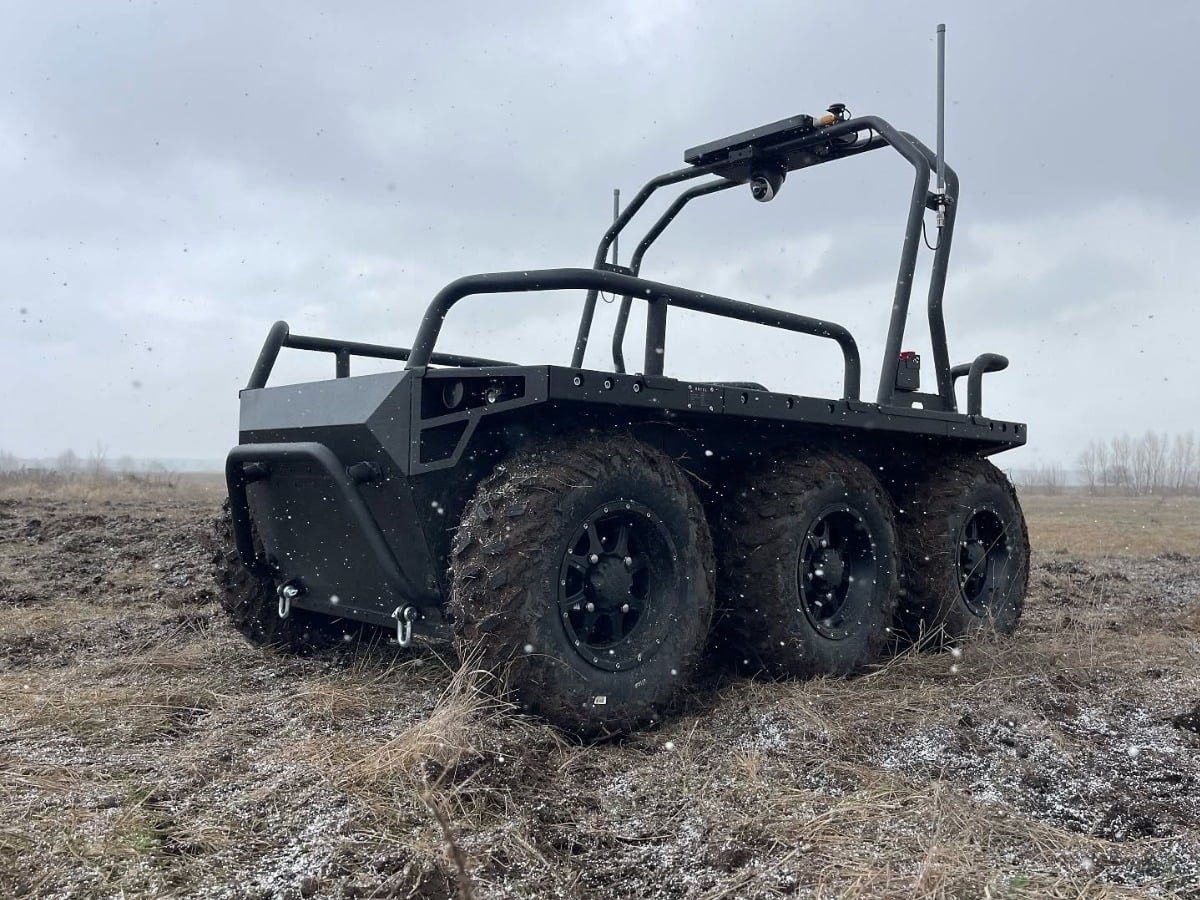
The deadliest job in modern warfare isn't rushing a trench line with a rifle. It's carrying ammunition to that trench line. Moving a 40-kilogram crate of ammunition or food across five kilometers of open, drone-poked mud under constant Russian artillery fire is basically a suicide run.
That's why the Ukrainian front line is turning into a machine landscape.
By mid-2026, Ukraine's Ministry of Defense set a hard tactical mandate. They want 100% of frontline logistics handled by robots. This isn't a glossy tech-bro press release. It's a brutal math equation. Ukraine is facing severe infantry manpower shortages. Russia's mass-meat infantry assaults keep coming. To save human blood, Ukraine is scaling a massive fleet of Unmanned Ground Vehicles (UGVs). They are hitting targets that completely dwarf previous years.
The scale of this shift is staggering. Ground robots completed 16,676 logistics and evacuation missions on the eastern front in June 2026 alone. That is a massive 122% jump since January. Ukraine’s Defense Procurement Agency (DOT) contracted over 22,000 ground drones for the first half of 2026, rushing them directly to active units using a digital marketplace called DOT-Chain.
But running remote-controlled rovers through bomb craters is entirely different from flying an aerial quadcopter.
The Mud Level Reality of Land Drones
If you've never had to pilot a machine through a ruined Ukrainian village, you probably think ground robots are like remote-controlled cars with guns. They aren't. Aerial drones have a massive advantage: line-of-sight signal paths. Ground drones operate in the dirt.
Military electronics specialist Serhii "Flash" Beskrestnov recently pointed out that connectivity is the single biggest bottleneck for UGVs. It isn't the wheels or the armor. It's the radio wave.
When a robot dips into an artillery crater, drives behind a thick concrete wall, or enters a dense tree line, the physical earth blocks the high-frequency radio signal from the operator's antenna. If the robot loses its link, it stops dead in its tracks. To solve this, Ukrainian crews have to use aerial drone relays. A hovering quadcopter acts as a floating signal tower in the sky, bouncing the operator’s commands down into the valleys and trenches where the UGV crawls.
Then there's the physical terrain. Trenches are built to keep things out. Tank traps, fallen trees, deep mud, and unexploded ordnance are everywhere. A 300-kilogram machine like the recently codified Bizon-L needs heavy-duty suspension and high-torque electric motors just to haul its cargo across the churned earth.
Despite these physics problems, the shift from experimental prototypes to routine brigade gear happened with shocking speed over the last twelve months.
Moving Beyond Human Blood
The data logged through Ukraine's DELTA battlefield management system shows exactly who is driving this transformation. In early 2026, the number of active combat units using ground robots expanded from 67 to 167.
Frontline tactical units are leading this push. The 3rd Separate Assault Brigade, the 92nd Assault Brigade's dedicated UGV company, and the 1st Separate Medical Battalion are using machines to alter their casualty numbers.
Instead of sending four infantrymen to carry a wounded soldier on a litter under heavy fire—often resulting in more casualties—units deploy tracked platforms like the TerMIT or the Rheinmetall Hermelin. These low-profile machines crawl under the Russian radar, locate the casualty via an onboard camera, allow the soldier to climb or be loaded onto the deck, and zip back to safety.
| Platform Type | Primary Examples | Tactical Function |
|---|---|---|
| Kamikaze / Mine-Laying | Ratel S | Sneaks under vehicles to detonate; lays anti-tank mines |
| Heavy Logistics | Bizon-L, TerMIT, Ardal | Hauls up to 300 kg of ammunition and food across 50 km |
| Remote Weapon Stations | Tanchik Droid 12.7, Lyut, NW Droid | Houses heavy machine guns to hold defensive lines without crew |
| Demining / Clearance | Zmiy, GCS-200, NEO-1 | Clears paths through dense minefields remotely |
The Ratel S is a tiny, four-wheeled kamikaze robot that costs around $25,000. It can slide quietly under a Russian tank or into a machine-gun nest before the operator detonates the payload. On the heavier side, the Ministry of Defense codified the Tanchik Droid 12.7 in July 2026. This platform mounts a heavy 12.7mm machine gun, allowing operators to sit in a reinforced basement miles away while the droid takes the brunt of counter-battery artillery fire.
The First Machine-Only Assaults
We are already seeing the emergence of pure robotic combat operations. In April 2026, Ukrainian forces achieved a milestone: capturing a fortified Russian trench position using exclusively unmanned systems.
The assault was a textbook example of combined-arms drone warfare. Aerial multirotors mapped out the trench lines. FPV strike drones systematically suppressed the Russian firing positions. Heavy ground robots advanced through the mud to breach obstacles, while automated weapon stations kept the enemy pinned down.
During a similar engagement run by the 3rd Assault Brigade's NC13 robotic unit, the mechanical pressure was so overwhelming that the remaining Russian troops raised a cardboard sign reading "We want to surrender." Aerial drones then guided the surrendering soldiers back to Ukrainian lines.
But don't mistake this for a sci-fi movie. Former Ukrainian commander-in-chief Valerii Zaluzhnyi and other defense experts warn that robots aren't wonder weapons. They cannot replace infantry at scale. If a small group of enemy troops slips into a ruined urban center or a complex basement network, you still need human soldiers to clear the rooms and hold the ground. Robots are force multipliers; they aren't a replacement for boots on the ground.
How the Brave1 Market Ecosystem Skips Bureaucracy
The reason Ukraine is outpacing Western militaries in UGV deployment is its decentralized, tech-startup approach to procurement. The government-backed Brave1 defense cluster now hosts over 300 ground-drone companies, up from virtually zero at the start of the full-scale invasion.
They use a gamified, data-driven system called eBaly to bridge the gap between trench soldiers and factory floors.
Combat units earn points based on their successful frontline missions. The units then spend these points in the digital Brave1 Market, ordering specific gear like Ratel rovers, FPV drones, or electronic warfare kits. The Ministry of Defense monitors this data in real time. If a specific UGV model performs poorly or breaks down constantly, its orders drop instantly. If a platform like the Bizon-L keeps saving lives in the Pokrovsk sector, its production scales immediately. This completely bypasses the multi-year procurement cycles that slow down traditional Western defense firms.
Actionable Takeaways for Defense Planners
The trench warfare of 2026 has proven that ground robotics are no longer an optional luxury. For defense tech developers, military strategists, and supply chain analysts, the data out of Ukraine points to three critical directives:
- Prioritize Electronic Resilience Over Heavy Armor: A ground robot doesn't need thick, expensive steel plates if it can be easily disabled by a $500 electronic jamming device. Focus development on frequency-hopping radios, fiber-optic tethered controls, and automated return-to-base routines that kick in when the signal drops.
- Design for Modular Utility: The chassis should be a blank slate. A winning UGV platform must be capable of switching from a casualty transport deck to a remote machine-gun turret or a mine-dropping rack in twenty minutes using basic tools.
- Build Local, Distributed Supply Chains: Moving heavy hardware across international borders is too slow for active conflicts. Do what Ukraine is doing with its international partnerships: license foreign designs but handle the final assembly, maintenance, and software iteration within domestic, secure hubs close to the action.