Hollywood is obsessed with the idea of moviegoer burnout. Executives spend millions on market research trying to figure out why people are staying away from theaters, often blaming a vague cultural tiredness with sequels.
It's a comforting myth for studios that make bad movies. But Pixar just blew that entire narrative out of the water.
Toy Story 5 didn't just win its opening weekend. It completely shattered expectations by raking in an estimated $160 million in domestic ticket sales. That easily beats Toy Story 4’s previous franchise high of $120.9 million from 2019. Internationally, the movie secured another $152 million, pushing its global haul to a staggering $312 million in just three days.
People aren't tired of franchises. They're just tired of bad ones.
The Screen Time Pivot That Resonated Globally
You'd think a fifth movie about plastic playthings would run out of creative gas. Honestly, when Disney announced this sequel, plenty of fans were skeptical. Toy Story 3 felt like a perfect ending. Toy Story 4 felt like a pretty good epilogue. What else was left to say?
Director Andrew Stanton found the answer by looking at what’s currently destroying real-world childhood playtime.
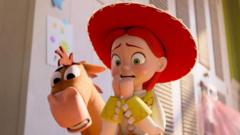
The plot pits the classic gang against a new tablet device named Lilypad, voiced by Greta Lee. Lilypad is the ultimate modern villain. She represents the glowing, dopamine-inducing screen that every parent is trying to pry away from their kids. When Bonnie gets the tablet, Woody, Buzz Lightyear, and Jessie get tossed to the side.
It’s a smart, direct confrontation with the realities of growing up in 2026. Parents are living this struggle every single day. That's why the movie connected so deeply across generations.
The audience demographics tell the whole story. Kids under 12 made up 25% of ticket buyers. The massive 25-44 age bracket, mostly parents who grew up with the original 1995 film, accounted for 42% of the crowd. Pixar didn't just sell tickets to children; they sold nostalgia and validation to the adults holding the wallets.
Breaking Down the Historic Box Office Run
This isn't a minor victory. Toy Story 5 delivered the second-highest animated opening weekend of all time, sitting only behind 2018's Incredibles 2, which hauled in $182.7 million.
Look at how the numbers stack up against other recent heavyweight animated openings.
- Incredibles 2: $182.7 million
- Toy Story 5: $160 million
- Inside Out 2: $154.2 million
- The Super Mario Bros. Movie: $146.3 million
- Moana 2: $139.7 million
- The Super Mario Galaxy Movie: $131.7 million
The movie dominated premium large formats, too. Premium screens accounted for a massive 40% of the weekend’s total gross, with Imax screens bringing in $11.5 million alone. Theater owners are breathing a huge sigh of relief. Summer ticket sales are tracking more than 14% ahead of last year, pushing the industry closer to pre-pandemic benchmarks.
How Pixar Outmaneuvered the Competition
The rest of the box office chart didn't stand a chance. Universal's sci-fi thriller Disclosure Day dropped 62% in its second weekend, pulling in just $17 million. Despite a $115 million budget and names like Emily Blunt and director Steven Spielberg, the film failed to attract younger crowds who were busy queuing up for Pixar.
Meanwhile, A24’s gritty take on folklore, The Death of Robin Hood, stumbled right out of the gate with a dismal $2.6 million. Audiences simply weren't in the mood for a depressing, low-energy historical drama. They wanted the comfort of Tom Hanks and Tim Allen, combined with a high-profile new track from Taylor Swift, "I Knew It, I Knew You," which added serious pop-culture fuel to the marketing fire.
The only other movie holding its ground was Obsession, the micro-budget horror sensation from Curry Barker. In its sixth weekend, it brought in $14.2 million, proving that theatrical audiences want either massive, trusted brand names or wildly original, cheap thrills. The middle-ground, high-budget adult drama is essentially a dead zone right now.
What This Means For Your Next Night at the Movies
If you're planning to catch Toy Story 5 over the coming weeks, expect packed houses. Word-of-mouth is stellar. The film secured a strong "A" CinemaScore from opening night audiences and currently sits at a highly fresh 93% on Rotten Tomatoes.
Book your tickets in advance if you want to catch it on an Imax or Dolby screen. The standard 2D screenings represented about 60% of the business, but the film's vibrant digital environments and tech-focused villain benefit heavily from the extra contrast and brightness of premium formats.
Pixar spent $250 million on production alone, and it shows on screen. This isn't a cheap cash-in; it's a beautifully rendered, thoughtful spectacle that proves theatrical distribution is alive and well when studios respect their audience's intelligence. Get your seats early, skip the standard digital screens if you can afford the upgrade, and prepare for a rare sequel that earns its place in film history.

:max_bytes(150000):strip_icc():focal(999x0:1001x2)/ridley-scott-6-518c8102df1c47609c578994d3604aec.jpg)

