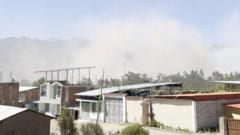
When the ground starts shaking in the high Andes, seconds make the difference between life and death. On August 20, 2026, residents near the southern town of Coracora learned this the hard way. A sharp, magnitude 6.7 tremor—recorded as high as 7.2 by local agencies—tore through the Ayacucho region. It wasn't just a news headline; for the people in those remote provinces, it was a sudden, violent interruption of daily life.
Most people don't realize how common these events are. Peru sits squarely on the "Ring of Fire," a volatile zone where the Nazca and South American tectonic plates grind against each other. While the world's eyes often focus on the capital, Lima, the most dangerous quakes frequently strike the rugged, isolated mountain regions where infrastructure is older and emergency response is significantly slower.
What actually happens during these mountain quakes
When a quake hits at a depth of 60 to 100 kilometers, as this one did, the energy dissipation is unique. You might think deep quakes are less dangerous, but in mountainous terrain, they trigger secondary disasters. Rockfalls are the silent killers here. They block the narrow roads that connect small villages to major hospitals. In this August event, officials reported immediate rockfalls near Coracora. If you are ever traveling through the Andes, understand that the road you are on can vanish in a heartbeat.
Power grids in these rural areas aren't built to modern standards. Over 9,000 customers lost electricity immediately. If you are stuck in a remote province during an outage, you lose more than lights. You lose communication, water pumping, and access to real-time weather updates. In this specific incident, 22 homes, six schools, and over a dozen healthcare facilities suffered structural damage.
The human cost vs the official numbers
Early reporting always focuses on the lack of fatalities. It feels good to say, "No deaths reported." But look closer. These numbers often obscure the real struggle. In July 2026, just a month before this Ayacucho event, a smaller 5.5 magnitude quake in central Peru resulted in six deaths and hundreds of destroyed homes. The difference? The July quake hit closer to denser population centers and had shallower energy release.
The Ayacucho quake proves that we have a massive gap in how we build. Many traditional adobe houses in the Andes simply cannot survive the horizontal force of a magnitude 6+ quake. When the walls crack, you are left homeless in a freezing, high-altitude environment. It's a humanitarian crisis that repeats itself every time the earth moves.
Lessons for those living in or visiting seismic zones
If you are planning to visit or live in regions like Ayacucho, Cusco, or Arequipa, you cannot rely on luck. You need a strategy.
- Check the structure. If you are renting or staying in a building, look for signs of structural reinforcement. Avoid staying in unreinforced adobe structures if you have other options.
- Keep a "Go Bag" ready. This sounds cliché, but it is a life-saver in the mountains. Include a headlamp, spare batteries, a satellite-capable messenger, and at least three days of high-calorie food. Cell towers go down first.
- Identify high ground and open spaces. In the Andes, the danger is rarely the ocean (tsunamis are a concern for the coast, not the mountains). The danger is falling debris from buildings and landslides from hillsides. Get to an open area away from cliffs.
- Follow local sources, not just international ones. The U.S. Geological Survey (USGS) is great for data, but the Geophysical Institute of Peru (IGP) and INDECI provide the on-the-ground reality of what roads are closed and where help is arriving.
Why the infrastructure gap persists
Why haven't these regions been modernized? It’s a mix of geography and economics. Retrofitting thousands of small, rural homes in the Andes is a logistical nightmare. The Peruvian government struggles to allocate resources to communities that are literally hours of winding road away from the nearest city.
The reality is that until there is a massive investment in disaster-resilient social housing, these regions will remain vulnerable. When you see news reports about "buildings damaged," understand that for the family living there, it means their entire life—their livestock, their storage, their shelter—is gone.
If you are currently in an affected area, stay away from damaged buildings even if they look "fine." Aftershocks are a certainty. The August 20 event was followed by aftershocks, which often finish off structures that were already weakened by the main quake. Pay attention to the authorities and move to designated evacuation points. Do not wait for someone to come knocking on your door to tell you it's time to move. Be the one who makes the decision to prioritize your safety before the next tremor hits.