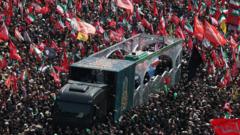
A sea of black fabric stretched for kilometers down Tehran's Azadi Street on Monday. Millions of mourners packed the boulevards, waving red banners of vengeance, pounding their chests, and demanding the death of U.S. President Donald Trump. On the surface, the multi-day state funeral for Ayatollah Ali Khamenei—assassinated in late February during devastating U.S. and Israeli airstrikes—looks like a staggering display of national unity.
The regime wants you to believe this is a triumphant show of strength. State media claims up to 20 million people will participate across a six-day, five-city marathon stretching into Iraq. But look past the carefully staged aerial shots broadcast on state TV. What you're actually witnessing isn't a regime at its peak. It's a masterclass in crisis management by a system facing an existential emergency.
The Illusions of the Grand Mosalla
The Islamic Republic knows how to put on a political theater. To maximize the optics, authorities delayed the funeral for four months following the winter airstrikes, finally launching it to coincide with the 250th anniversary of American Independence Day. They turned central Tehran into a logistical fortress. Thousands of mokebs (roadside stalls) handed out free halim soup, watermelon, and lemonade to keep the crowds moving in the suffocating 36°C heat.
The state even displayed the tiny coffin of Khamenei's 14-month-old granddaughter, killed in the same blast, explicitly to milk the personal cost of the war for maximum geopolitical leverage.
But a massive turnout doesn't automatically mean unconditional domestic support. In a country where the regime brutally suppressed massive anti-government protests just six months ago, public mobilization is tightly managed. Attendance is heavily driven by the core ideological base, military personnel, civil servants, and regional loyalists bussed into the capital. Qom Friday prayer leader Ayatollah Mohammad Saidi let the slip show when he told state media the funeral was meant to be "another referendum for the Islamic Republic."
If you have to manufacture a week-long multi-nation spectacle to prove your government is still legitimate, you aren't operating from a position of security.
The Phantom Successor Nobody Can See
The most glaring vulnerability of this entire production isn't on the streets. It's who is missing from them.
Three of Khamenei's sons made highly publicized appearances to weep over the flag-draped coffins. Yet, their brother Mojtaba Khamenei—the newly named Supreme Leader—was nowhere to be found.
State officials claim Mojtaba was wounded in the February airstrikes that killed his father, but they refuse to detail the severity of his injuries. So far, the new ruler has only communicated through brief written statements.
This creates a massive credibility problem. If the state's entire message is that the transition of power was smooth and the leadership remains unbothered, hiding the new chief executive completely defeats the purpose. Is he too physically incapacitated to stand? Is he terrified of another targeted strike? By keeping Mojtaba in the shadows, the regime accidentally highlights its own fragile state. It's tough to project absolute resilience when your brand-new commander-in-chief is a ghost.
Growing Isolation in the Global South
Tehran's spin doctors are working overtime to frame the funeral as a gathering of global powers standing against Western oppression. Don't buy it. The actual guest list tells a very different story of deep international isolation.
While regional proxies like Hamas and Hezbollah sent envoys to meet with Foreign Minister Abbas Araghchi, actual heads of state were remarkably scarce. The most senior leaders to show up came from highly specific neighbors like Pakistan, Iraq, Armenia, and Tajikistan. Russia sent Dmitry Medvedev, a deputy chairman rather than President Vladimir Putin. China merely sent a representative.
Compare this to the 1989 funeral of Ayatollah Ruhollah Khomeini, which drew genuine, spontaneous chaos from millions of Iranians and forced a halt to regional politics. Today, Western officials were entirely excluded, and traditional regional heavyweights kept their distance. The regime is forced to lean on a thin collection of Central Asian delegations and non-state militias to project a "Global South" alignment.
What Happens Next
The theatrical smoke from Tehran's streets will clear by July 9, when Khamenei is finally buried in the holy city of Mashhad. Once the cymbals quiet down, the regime faces a harsh reality check. French and British warships are already preparing to deploy to clear mines in the critical Strait of Hormuz, directly challenging Iranian leverage.
The state funeral gave the clerical establishment a brief, highly visible propaganda victory. It didn't solve their fractured economy, it didn't heal the deep scars of domestic dissent from the winter massacres, and it certainly didn't fix the glaring security holes that allowed foreign jets to eliminate their longest-serving leader in his own backyard.
Keep your eyes on whether Mojtaba Khamenei makes a public address by the end of the week. If he stays hidden, assume the internal power struggle and security panic in Tehran are far worse than the state's carefully directed cameras want you to think.