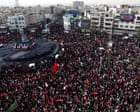
Western media loves a predictable script when it comes to the Middle East. They see a sea of people chanting in Tehran and immediately run the same old headlines about fanatical crowds and stage-managed grief. But if you think the massive funeral procession for Iran’s supreme leader Ali Khamenei is just another piece of state theater, you are missing the real story entirely.
The reality on the ground right now is far more dangerous. This is not just a goodbye to a man who ruled with an iron fist for more than 36 years. It is a highly calculated, high-stakes display of survival from a regime that just crawled out of a devastating war with Israel and the United States. Meanwhile, you can explore similar developments here: What A 2000-year-old Gold Ring Found In Thailand Tells Us About Ancient Trade.
Let's look at the actual facts. Khamenei was killed months ago, back on February 28, when a joint US-Israeli airstrike flattened his compound in Tehran. His funeral had to be delayed for over four months while bombs fell and the region burned. Now, with a fragile ceasefire holding, the Islamic Republic is using this six-day event to prove to its enemies, and its own citizens, that the state did not collapse.
If you want to understand where the Middle East goes from here, you have to look past the smoke from the burning effigies. You need to look at who showed up, who didn't, and what happens when the chanting stops. To see the full picture, we recommend the detailed article by TIME.
The Twelve Kilometer Display of Defiance
On Monday, the streets of Tehran turned into a sea of black, red, and green. The main funeral procession cut a 12-kilometer path straight through the heart of the capital. It started early in the morning on Damavand Avenue, choked the intersections at Imam Hosein and Enqelab squares, and finally ended at the famous Azadi Square.
The state truck carrying the coffins was modified to look like a holy Shia shrine. Inside were the bodies of Khamenei and four of his family members who died alongside him, including his 14-month-old granddaughter. The optics were deliberate. The regime wrapped a political assassination in the cloak of religious martyrdom.
The heat in Tehran hit 36 degrees Celsius. Fire hoses sprayed water over the crowds to keep people from fainting. Mokebs, those traditional roadside food stations, handed out watermelon, lemonade, and hot soup to millions of mourners who had traveled from all over the country.
Western analysts often claim these crowds are entirely forced to be there. That's a mistake. While the state completely shuts down offices and hands out free food, the raw anger in the streets is genuine. Thousands of men sat on the asphalt, weeping and beating their chests. Women wrapped in full-body black chadors carried posters showing the faces of US President Donald Trump and Israeli Prime Minister Benjamin Netanyahu under crosshairs.
This was not just grief. It was an organized demand for blood. Above the crowd, banners written in both Persian and English carried a blunt message. They read, "Blood will spill." Mourners even hung an effigy of Trump from a highway bridge, throwing rocks at billboards declaring that the US killed their father.
The Empty Chair and the Missing Successor
The biggest story of the funeral is not the millions of people in the streets. It is the one person who failed to show up.
Iran's political and military elite used this event to reemerge after months of hiding in deep bunkers. President Masoud Pezeshkian, Parliament Speaker Mohammad Bagher Qalibaf, and the new Revolutionary Guards chief Ahmad Vahidi all stood shoulder-to-shoulder near the coffins. Even the Quds Force commander, Esmail Qaani, made a rare public appearance.
Khamenei’s eldest son, Mostafa, stood alongside his younger brothers, Masoud and Meysam. They wept openly for their father.
But Mojtaba Khamenei was nowhere to be seen.
Mojtaba is the man who matters. Ten days after the February airstrikes, the regime quietly named him as the new Supreme Leader. Yet, he has not been seen in public for over three months. He did not even attend the funeral of his own wife last week.
Official state channels claim Mojtaba was wounded in the initial strikes that killed his father and is still recovering. The alternative explanation is much darker. Israel has made it clear that any future Iranian leader who threatens them will face the exact same fate as Ali Khamenei. Mojtaba is likely hiding in an underground facility, terrified that a drone strike will end his reign before it truly begins.
Running a country through written press releases is a terrible strategy. The longer Mojtaba stays invisible, the weaker the regime looks. His absence leaves a massive psychological void at the top of the state apparatus. Power hates a vacuum. Right now, the military commanders of the Islamic Revolutionary Guard Corps are filling that space, taking control while the official leader stays in the shadows.
The Double Game of Revenge and Diplomacy
The slogans shouted in Azadi Square were absolute. "No compromise, no surrender, only revenge," the crowds roared. But behind closed doors, the regime is playing a completely different game.
Look at the timing. This massive, six-day funeral ends on Thursday after the body passes through the holy cities of Qom, Najaf, and Karbala, before final burial in Mashhad.
Exactly two days later, on July 11, Iranian diplomats are scheduled to sit down with American officials in Pakistan to resume talks over six billion dollars in frozen assets.
Think about that contradiction. In public, the regime allows poets to stand on stages and openly ask why Donald Trump is still alive, encouraging the crowd to assassinate a US president. In private, those same leaders are sending negotiators to sit across the table from American diplomats to talk about banking systems and cash flow.
This tells you everything you need to know about the current state of Iran. The country is exhausted. Five weeks of intense, direct warfare with Israel and the US pushed the economy to the brink of collapse. The military infrastructure took massive hits. The army spokesperson recently admitted they used the current ceasefire just to repair their weapons and rebuild combat power.
The anger you see on television is real, but the leadership knows they cannot afford another round of full-scale war. They are using the funeral as a bargaining chip. By showing the world that they can still mobilize millions of angry citizens, they are trying to project strength at the negotiation table in Pakistan. They want the West to think they are crazy enough to restart the war, hoping it forces the US to lift economic sanctions.
Watch the Next Moves
The theater in Tehran is over, and the procession is moving toward the clerical hub of Qom. If you want to know what happens next in the Middle East, stop watching the crowds and start tracking these specific developments.
Keep a close eye on the burial in Mashhad this Thursday. If Mojtaba Khamenei does not show up to bury his own father, his legitimacy as the new Supreme Leader will drop to near zero. A leader who cannot face his own people during a national tragedy cannot hold a fractured country together.
Watch the July 11 meetings in Pakistan. If those talks fall apart, expect the ceasefire in the Gulf to collapse immediately. Iran has already threatened to tighten its grip on the Strait of Hormuz, which could send global oil prices through the roof.
The regime wants you to look at the millions of mourners and see an unbreakable wall of loyalty. Look closer. You will see a government that is running out of time, running out of money, and desperately trying to hide its weakness behind a massive wall of noise.