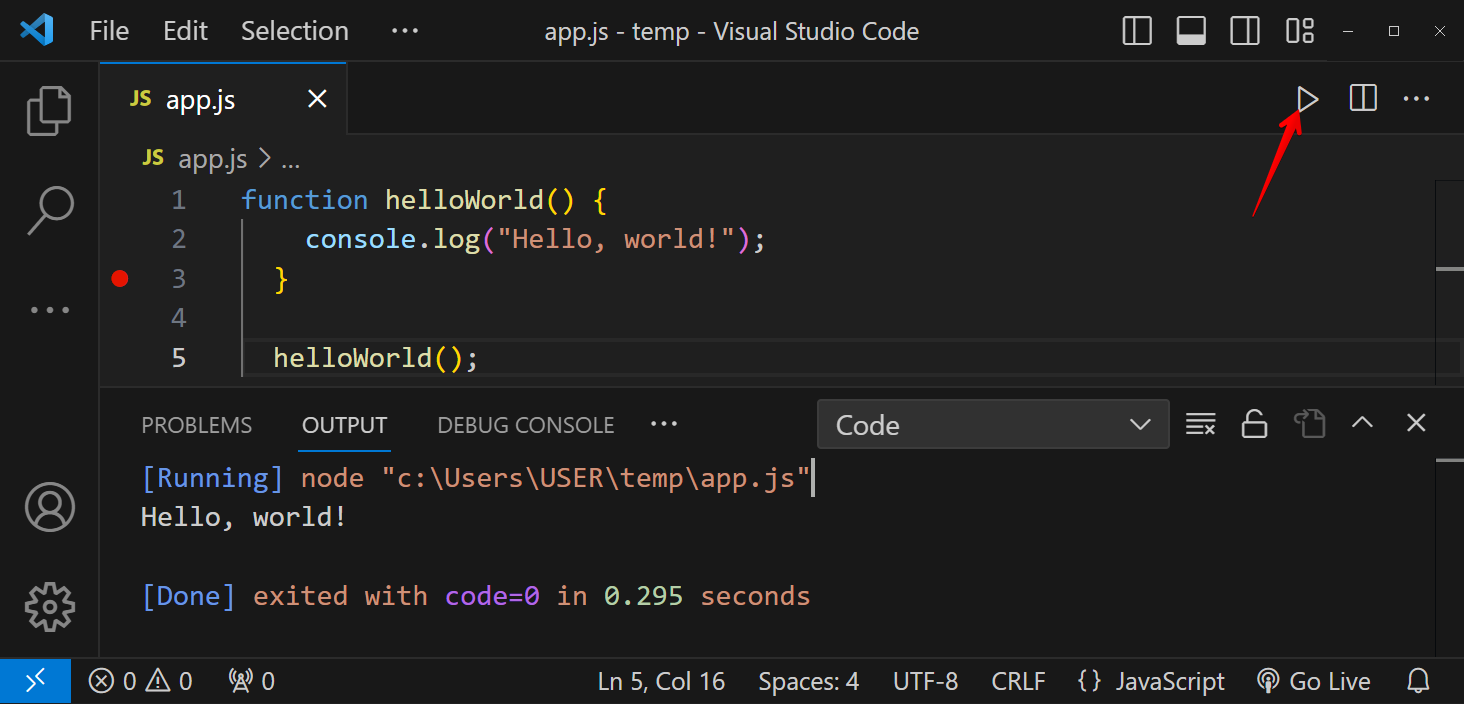
The room was stripped of everything but the blue glow of a dual-monitor setup and the rhythmic, frantic tapping of mechanical keys. It was three in the morning in a cramped apartment in Beijing, and Jun Han was tired. He was a developer at Microsoft, but in this private hour, he was just a man trying to solve a personal friction that felt like a grain of sand in a silk glove. Every time he wrote a snippet of logic, he had to navigate away from his editor, open a terminal, type out a manual execution command, and wait for the output to flicker into existence. It was a micro-disruption, a stutter in the flow of creation that lasted only seconds but felt like an eternity when the mind was moving at the speed of thought. He wanted a play button for his ideas. He wanted to see his logic breathe without leaving the sanctuary of his workspace. That night, the first lines of Visual Studio Code Code Runner were written, not as a corporate mandate, but as a bridge between a coder’s intent and the machine’s response.
The birth of this tool was a quiet revolution in the ergonomics of programming. When it first appeared on the marketplace in 2016, the landscape of software development was shifting toward lightweight, modular environments. For years, developers had been shackled to massive Integrated Development Environments that took minutes to load and consumed vast amounts of memory. Then came a new wave of editors that promised speed, but they often lacked the immediate gratification of seeing code run with a single keystroke. Jun Han’s creation filled that void. It was a deceptively simple utility that allowed a user to highlight a block of text in almost any language—C++, Python, Java, even obscure scripts—and execute it instantly. It transformed the editor from a passive digital typewriter into a live laboratory.
The human brain does not handle context switching well. Research from the University of California, Irvine, suggests that it takes an average of twenty-three minutes to return to deep focus after a distraction. In the world of programming, that distraction is often the very tools designed to help. When a developer has to stop thinking about a complex algorithm to remember the specific syntax for a compiler flag in a terminal window, the fragile architecture of their mental model can collapse. By providing a universal execution shortcut, this extension acted as a cognitive prosthetic. It allowed the builder to stay within the "flow state," that psychological zone where time disappears and the barrier between the self and the work dissolves.
The Architecture of Visual Studio Code Code Runner
To understand why this specific piece of software became a staple for over twenty million users, one has to look at the philosophy of universality. Most tools are built for a single purpose; a Python runner handles Python, a Ruby gem handles Ruby. But Jun Han’s vision was polyglot. The extension was designed to be a Swiss Army knife in a world of specialized scalpels. It leveraged a configuration map that could be customized by the user, essentially telling the editor how to speak dozens of different digital languages simultaneously. It did not matter if you were a student in Nairobi writing your first "Hello World" in C or a data scientist in San Francisco testing a complex regular expression; the interface remained the same.
The technical elegance lay in its minimalism. It did not try to be a debugger or a full-scale deployment pipeline. It was a window. When you pressed the shortcut, a panel opened at the bottom of the screen, and the machine spoke back to you. This immediacy changed the way people learned to code. Education is often a battle against discouragement. For a beginner, the terminal is a frightening place of cryptic error messages and cold, black backgrounds. By bringing the output into the warm, familiar confines of the text editor, the tool lowered the barrier to entry. It made the act of experimentation feel safe. You could fail, see the error, and fix it in the same heartbeat.
Behind the scenes, the extension grew through the power of open-source community feedback. It wasn't just a solo project for long. Developers from around the globe began contributing, adding support for more languages and refining the way the output was handled. This is the hidden heartbeat of the modern web: thousands of hours of unpaid, passionate labor dedicated to making a tool slightly better for a stranger on the other side of the planet. The statistics are staggering. On the marketplace, it remains one of the most downloaded extensions in history, a testament to a universal human desire for efficiency and the removal of friction.
The stakes of such tools are higher than they appear on the surface. We live in a world built on millions of lines of invisible instructions. The software that manages our power grids, our medical records, and our communication is written by people who are constantly fighting against the limitations of their own tools. When a developer saves ten seconds a hundred times a day, they aren't just gaining time; they are preserving mental energy. That energy is redirected toward solving the actual problems of the code—the bugs that could cause a system failure or the inefficiencies that waste electricity in a data center. The history of progress is often the history of better tools, from the flint knapper’s stone to the weaver’s loom to the programmer’s execution script.
The Global Reach of Visual Studio Code Code Runner
In a small computer lab in Mumbai, a teenager sits before a refurbished laptop. The air is thick with the scent of rain and ozone from the monsoon outside. He is teaching himself JavaScript, following along with a grainy video on a small screen. He doesn't have a high-end machine that can run heavy software suites. He has a lightweight editor and a few essential plugins. When he hits the run button, he isn't just seeing a script execute; he is seeing a door open. For him, the ability to see his work come to life without a complex setup is the difference between continuing his education and giving up in frustration.
This democratization of technology is the true legacy of the project. It leveled the playing field between the developer at a trillion-dollar company and the hobbyist in a garage. The extension’s ability to handle over one hundred languages meant that it didn't discriminate based on the technology stack. It was a piece of infrastructure as essential and as invisible as a paved road. We rarely think about the texture of the asphalt when we drive, but the smoothness of the ride determines how far we are willing to go.
The evolution of the project also mirrored the broader shift in the tech industry toward transparency. Because the source code was available for anyone to see on GitHub, it became a learning resource in itself. Young programmers could peak under the hood to see how a professional-grade extension was constructed. They could see the way it handled process execution, how it parsed paths across different operating systems like Windows, macOS, and Linux, and how it managed the delicate dance of memory usage. It became a living textbook, a piece of communal property that belonged to the people who used it as much as it belonged to the man who first conceived it in that quiet Beijing apartment.
As we move deeper into an era of artificial intelligence and automated coding, the role of the human operator is changing, but the need for immediate feedback remains constant. Even when an AI generates a block of code, a human must still verify, test, and understand it. The "play button" is more relevant than ever. It is the final check, the moment of truth where the abstract becomes concrete. The tool hasn't just survived the transition into this new era; it has become even more central to the workflow of the modern architect.
The silence of a coding session is deceptive. To an outside observer, it looks like a person staring at a screen, occasionally twitching their fingers. But internally, it is a high-speed chase. The programmer is pursuing a logic that is always trying to slip away, a ghost in the machine that only reveals itself when the conditions are perfect. Every obstacle, every slow-loading terminal, and every context switch is a chance for that ghost to escape. The reason why this extension resonates so deeply with the community is that it acts as a tether. it keeps the mind locked onto the problem, refusing to let the spark of an idea go cold before it can be tested.
There is a certain poetry in the interface of a well-designed tool. It is the poetry of the "un-noticed." When something works perfectly, you don't think about it. You don't marvel at the code that makes the code run; you marvel at the results you are achieving. You see the website you've built, the game you've designed, or the data you've analyzed. The tool disappears into the background, becoming an extension of the user's own hands. This is the highest compliment a piece of software can receive: to be so useful that it becomes invisible.
Looking back at that night in 2016, it is unlikely that Jun Han realized he was creating a permanent fixture in the digital workspace. He was just trying to save himself a few seconds. But in the world of technology, a few seconds multiplied by millions of people equals lifetimes of saved human effort. It represents millions of "aha!" moments that weren't interrupted by a loading bar. It represents countless frustrations avoided and thousands of projects finished that might have otherwise been abandoned.
The code we write is a reflection of our desire to order the world, to make sense of the chaos through logic and structure. But we are biological creatures, prone to fatigue and distraction. We need bridges between our messy, organic thoughts and the rigid, uncompromising world of silicon. We need tools that understand the rhythm of our work and the fragility of our focus. We need that single button that says, "Show me if this works."
The monitor in the apartment finally goes dark as the sun begins to rise over the city. The developer stretches, his eyes red but his mind quiet. On the screen, a small window shows a successful output—the result of a night's work verified in an instant. There is no applause, no grand ceremony. There is only the blinking cursor, steady and expectant, waiting for the next line, the next idea, and the next time the play button is pressed to bring a fragment of thought into the light of reality. The cursor waits in the silence, a tiny, glowing heartbeat on a sea of black.