The United States military recently spent 90 minutes raining precision munitions onto a tiny speck of rock in the Persian Gulf. It wasn't a mistake, and it wasn't a minor skirmish. The target was Greater Tunb Island, an isolated piece of land barely three times the size of Sydney's central business district. Yet this single location has become the epicenter of a high-stakes standoff between Washington and Tehran that threatens to upend global trade.
If you want to understand why global oil prices spike every time tensions flare in the Middle East, you don't need to look at the massive oil fields of Saudi Arabia or the refineries of Iraq. You just need to look at this small, heavily fortified island sitting right at the throat of the Strait of Hormuz. The recent American air campaign targeted Iranian coastal defense systems, cruise missile storage facilities, and launch sites built directly into the island's rock faces. For a different view, check out: this related article.
The operation reveals a stark reality. The US is actively trying to strip away Iran's ability to hold the world's primary energy choke point hostage. By attacking Greater Tunb, the US military is taking aim at a critical node in a sophisticated island fortress network that Iran has spent decades building.
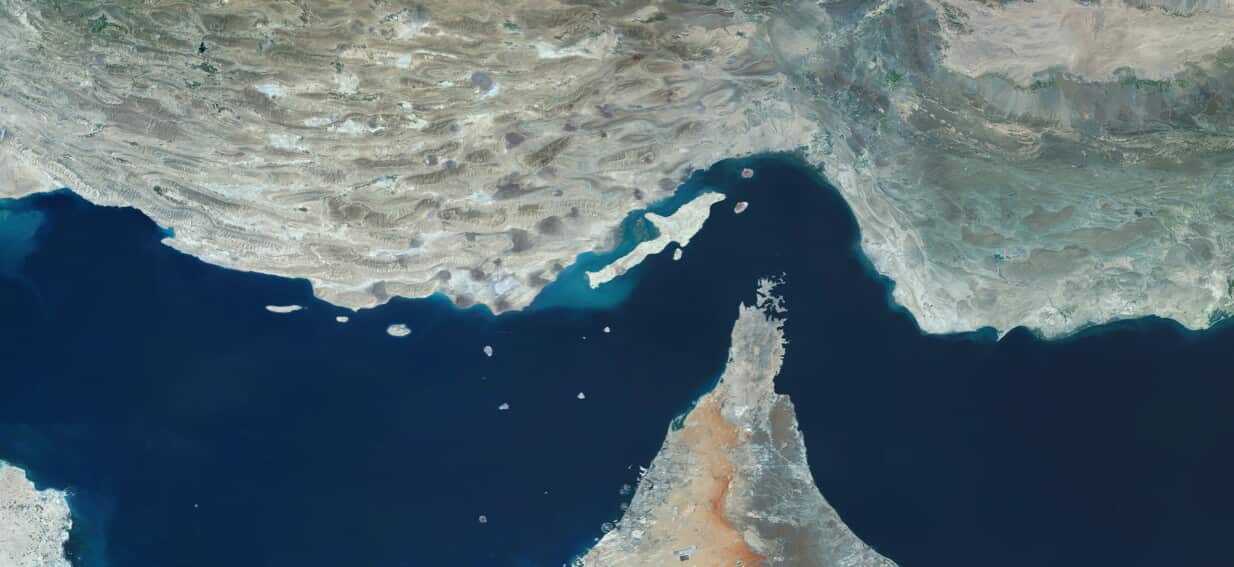
The Geography of a Choke Point
To understand why this island matters, look at a map of the Strait of Hormuz. The strait is a narrow waterway connecting the Persian Gulf to the Gulf of Oman and the open ocean. At its narrowest point, the shipping lanes are only a few miles wide. Roughly twenty percent of the world's petroleum and a massive chunk of liquefied natural gas flow through this corridor every single day. Similar analysis on this trend has been published by The New York Times.
Greater Tunb sits directly alongside the deep-water shipping channels that commercial supertankers must use to enter and exit the Gulf. It acts as a permanent, immovable observation post. Military experts frequently describe the island as an unsinkable aircraft carrier.
Iran utilizes Greater Tunb, along with nearby Lesser Tunb and Abu Musa, to project military power far beyond its mainland coast. If you position anti-ship missiles or radar systems on these islands, you don't have to scramble jets or deploy naval fleets to control the strait. You can simply track, target, and strike any vessel passing by from the comfort of a fortified bunker.
The recent strikes focused heavily on eliminating these exact capabilities. The US Central Command made it clear that the 90-minute bombardment aimed to degrade Iran's capacity to threaten civilian vessels. Commercial ships have faced increasing harassment, and Washington decided that leaving these island outposts operational was no longer an option.
How an Imperial Land Grab Formed Today's Conflict
The dispute over who actually owns Greater Tunb is not new. The current crisis is deeply rooted in a historical event that occurred over half a century ago.
In late November 1971, British colonial forces were preparing to withdraw from the Persian Gulf, paving the way for the creation of the United Arab Emirates. Sensing an opportunity, the Iranian military, under Shah Mohammad Reza Pahlavi, launched a sudden amphibious assault to seize Greater Tunb, Lesser Tunb, and Abu Musa. The local Arab police force on the islands offered minor resistance, but the Shah's forces quickly established total control.
The UAE has claimed sovereignty over these islands ever since, viewing the 1971 takeover as an illegal occupation. The historical irony here is profound. Back in 1971, the Shah was the primary security ally of the United States in the region. Washington raised no objections when its heavily armed ally grabbed these strategic islands, believing the Shah would use them to protect the shipping lanes from Soviet influence.
Everything changed with the 1979 Islamic Revolution. When the Western-backed monarchy fell, the newly formed Islamic Republic inherited the Shah's highly strategic island outposts. Instead of using them to guarantee the free flow of commerce, the new regime quickly realized that these islands provided the ultimate geopolitical leverage against the West.
Inside the Iranian Garrison
You won't find civilian tourists or beach resorts on Greater Tunb. The island is entirely a military outpost populated almost exclusively by personnel from the Islamic Revolutionary Guard Corps, or IRGC.
Over the decades, the IRGC has transformed this small piece of land into a fortress. They dug subterranean tunnels, built reinforced concrete bunkers, and installed advanced radar installations capable of tracking even the stealthiest naval assets. They also stationed fast attack boats in small, protected harbors along the island's edge. These boats are designed to swarm large commercial tankers or Western warships in coordinated, high-speed hit-and-run operations.
The real threat comes from what is hidden inside the island's hills. The IRGC deployed sophisticated anti-ship cruise missiles and air defense batteries across the terrain. Because the island sits so close to the international shipping lanes, these weapon systems have an incredibly short flight time to their targets. A tanker crew wouldn't have time to react if a missile were launched from the island's shores.
The US strikes directly targeted these hidden assets. By utilizing precision munitions, American forces smashed the missile storage facilities and disabled the tracking radars. The goal wasn't to capture the island, but to break its military teeth.
The Rebirth of the Tanker War
For older military strategists, the current conflict feels like history repeating itself. During the 1980s, Iran and Iraq engaged in a brutal, years-long conflict that eventually spilled into the waters of the Gulf. This period became known as the Tanker War.
During that conflict, Iran used Greater Tunb and its sister islands as staging bases to launch mines and attack commercial shipping vessels belonging to nations that supported Iraq. The US Navy was forced to step in, executing Operation Earnest Will to escort commercial oil tankers through the dangerous waters under direct Iranian fire.
The current escalation follows a similar pattern. Iran has repeatedly used its island network to monitor ships that turn off their transponders to avoid detection. The IRGC uses the intelligence gathered from Greater Tunb to coordinate attacks or seize vessels that violate Tehran's self-imposed rules for the strait.
The US strikes signal that Washington is willing to use direct, heavy kinetic force to prevent Iran from closing the strait. The Trump administration has reimposed a strict naval blockade on Iranian ports, and the bombardment of Greater Tunb shows that the US will systematically dismantle any military installation that interferes with this strategy.
What Happens Next for Global Shipping
If you run a shipping company or insure commercial vessels, the strikes on Greater Tunb change your entire risk assessment.
While the US military claims the strikes degraded Iran's capabilities, they haven't made the Strait of Hormuz safe overnight. Iran still possesses a massive arsenal of drones, ballistic missiles, and naval mines on its mainland. The destruction of facilities on Greater Tunb reduces the immediate threat from the island, but it also increases the likelihood of asymmetric retaliation elsewhere.
Shipping companies are facing soaring insurance premiums for transiting the region. Some operators are considering bypassing the Gulf entirely, though avoiding the Strait of Hormuz means adding thousands of miles and massive fuel costs to global supply chains.
The conflict over these small islands isn't going away. Iran treats its sovereignty over Greater Tunb as a non-negotiable point of national pride and military strategy. The UAE continues to lobby international bodies for its return. Meanwhile, the US views the island as a threat that must be actively contained.
If you want to protect your operations or understand where the global energy market is heading, stop watching the major capitals. Keep your eyes on the small, rocky outposts in the middle of the world's most dangerous shipping lane.
To prepare for the ongoing instability in the region, global logistics managers and energy traders should immediately take the following steps. First, diversify supply routes by utilizing pipelines that bypass the strait, such as the Habshan–Fujairah pipeline in the UAE or the East-West Pipeline in Saudi Arabia, where capacity allows. Second, rewrite corporate contingency plans to account for extended shipping delays of up to three weeks if the strait faces temporary operational closures. Finally, re-evaluate maritime insurance policies to ensure coverage includes acts of war and political risk specific to the Persian Gulf zone. The battle for the strait is no longer a theoretical risk scenario, it is actively playing out on the rocks of Greater Tunb.
:max_bytes(150000):strip_icc()/xochimilco_getty-56a3ea613df78cf7727fdcc0.jpg)