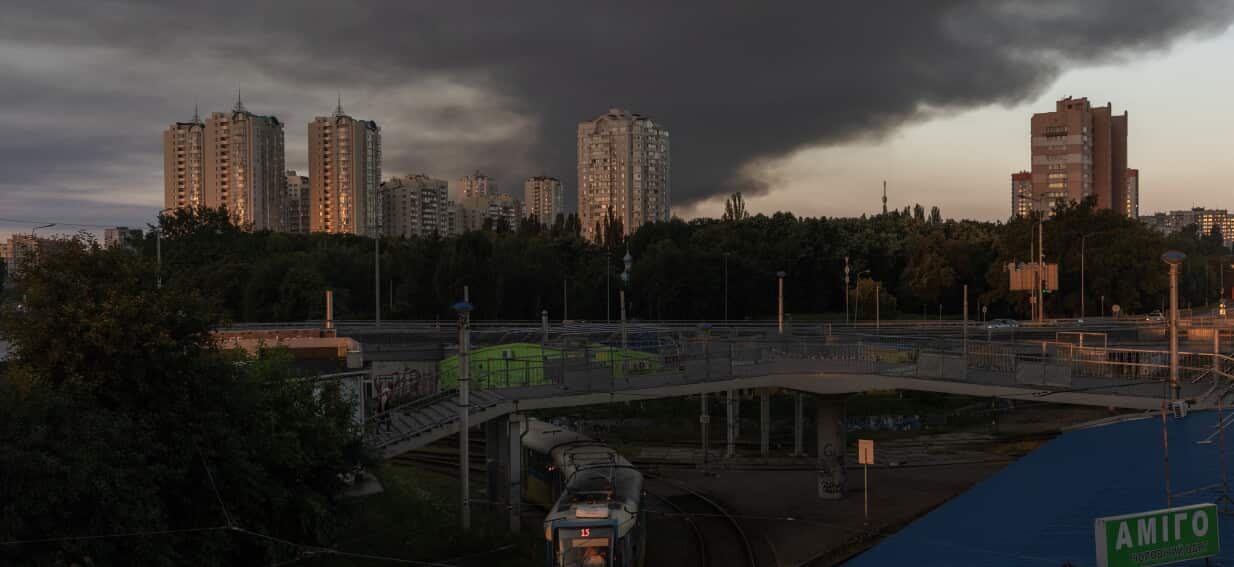
The brutal reality of the fifth year of war hit Kyiv with terrifying clarity when a massive ballistic missile barrage tore through the capital, leaving nine dead and exposing a catastrophic vulnerability. President Volodymyr Zelenskyy didn't mince words: Ukraine has completely run out of interceptor missiles for its US-supplied Patriot air defense systems. When 27 ballistic missiles and 185 drones light up the night sky and only a single missile gets intercepted because the magazines are empty, you aren't just looking at a tactical setback. You're looking at a complete collapse of the shield holding millions of lives together.
You need to understand why this moment is different from previous escalations. Ballistic missiles travel at several times the speed of sound. Without advanced systems like the Patriot, they drop out of the upper atmosphere like falling stone blocks loaded with high explosives, giving civilians zero warning time.
The Empty Silos Behind the Headlines
For months, international news cycles have fixated on the grinding 1,200-kilometer front line where Russian advances have slowed to a crawl. But focusing solely on trench warfare misses the entire strategic picture. Moscow shifted tactics, weaponizing high-speed ballistic missiles to shatter deep urban centers while Western supply chains bogged down in political hesitation.
Zelenskyy's recent meetings with Western leaders—including talks with US President Donald Trump regarding domestic production licenses for Patriot components—highlighted a desperate scramble for self-reliance. Yet, even when political agreements materialize, manufacturing complex interceptor batteries takes time that Ukrainian families simply don't have. Washington's hesitation to fast-track these licenses leaves a massive vacuum in Europe's security architecture.
The human cost of this delay is brutally visible on the ground. In Kyiv's Darnytskyi and Solomyanskyi districts, residential buildings, schools, and even foreign diplomatic missions like the Lithuanian Embassy bore the brunt of the recent strikes. Shrapnel wounds and multi-story structural collapses are the direct product of empty launch tubes.
The Strategic Counter-Offensive in Russian Skies
While the defense situation inside major cities remains precarious, Ukraine isn't sitting passively waiting for strikes. Kyiv has aggressively scaled up long-range drone and missile manufacturing, taking the fight directly to Russian logistics, oil facilities, and weapons plants.
Striking fuel depots and production hubs hundreds of kilometers inside Russia aims to choke off the Kremlin's supply chain at the source. It's a high-stakes gamble. By forcing Moscow to disperse its own air defenses to protect domestic oil refineries, Ukraine hopes to relieve some of the suffocating pressure on its own airspace.
Yet, asymmetrical drone strikes inside Russia cannot substitute for surface-to-air interceptors capable of stopping incoming Iskander or Kinzhal ballistic missiles. Drones destroy economic targets; Patriot and similar high-end systems save human lives in densely populated metropolitans like Kyiv, which houses roughly three million people.
What Happens Next in the Battle for the Skies
Diplomatic talk about peace formulas and localized ceasefires keeps stalling because the military balance on the ground remains volatile. Foreign Minister Andriy Sybiga put it bluntly: the battle for the skies dictates the entire trajectory of the conflict.
If Western allies fail to backstop Ukrainian air defenses with immediate, tangible shipments of interceptors rather than long-term promises, the humanitarian crisis will escalate exponentially before the year is out. The survival of Ukraine's urban centers depends entirely on whether allied stockpiles can reach empty launchers before the next wave hits.
Ukraine begs G7 leaders for more air defences amid Russian barrage
This archived coverage illustrates the long-running urgency behind Ukraine's appeals for advanced air defense shields against persistent Russian bombardments.
http://googleusercontent.com/youtube_content/1