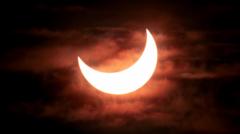
You won't see a solar eclipse like this in Britain again for decades. Grab your calendar and look past the usual hype because the skies are staging a rare show. On August 12, the Moon sweeps across the Sun to deliver the deepest partial solar eclipse the UK has experienced since August 1999.
If you remember crowding outside with flimsy cardboard glasses during the summer of '99 to watch Cornwall slip into totality, you know how rare these events feel. This time, the British Isles won't get total darkness, but the Moon will swallow up to 96 percent of the solar disc in parts of the southwest and Wales. Even northern and eastern regions will see roughly 90 percent coverage.
[Image of partial solar eclipse]
When and Where to Watch the Eclipse
Timing is everything. This partial eclipse kicks off in the early evening, running roughly from 6:20 PM BST until around 8:10 PM BST. Because it happens as the sun drops lower in the sky, your main obstacle won't just be clouds—it will be finding a clear view of the western horizon.
Head to high ground. Clear coastal spots or designated Dark Sky reserves offer the best chance of unobstructed viewing. If you're stuck in an urban area, get up to the top floor of a building or a nearby park where buildings won't block the low evening sun.
The southwest of England and parts of Wales hit the jackpot for coverage, reaching up to 96 percent. Scotland and the northeast won't miss out entirely, sitting comfortably around the 89 to 90 percent mark. The difference in coverage across the country is minor enough that wherever you stand, you'll notice the shift.
What Actually Happens During a 90 Percent Eclipse
People expect pitch-black night during a partial eclipse, but reality is different. When 90 to 95 percent of the Sun is blocked, you aren't plunged into midnight. Instead, you get an eerie, metallic twilight.
The light takes on a strange, silvery quality. Shadows sharpen. Temperatures drop noticeably as solar radiation dips. Nature gets confused, too. Birds often fall silent, thinking roosting time has arrived, only to start a mini dawn chorus as the light returns minutes later.
How to Protect Your Eyes
Staring straight at a 90 percent obscured Sun will permanently damage your vision. Don't risk it. Standard sunglasses do nothing, no matter how dark the tint looks.
You need certified eclipse glasses carrying the ISO 12312-2 international standard. If you can't find glasses in time, build a simple pinhole projector using two pieces of card stock to project the image safely onto a surface. Never look at the Sun through binoculars or camera lenses without a specialized solar filter attached to the front element.
Why You Shouldn't Wait for the Next One
Total solar eclipses are notoriously stingy with their locations. A specific spot on Earth only sees a total eclipse once every few hundred years. While parts of Europe—including parts of Iceland, Greenland, and Spain—are catching totality during this exact cycle, the UK is left with a deep partial view.
The next time the UK gets a partial solar eclipse of this sheer scale won't be until 2081, when up to 99 percent of the Sun gets blocked. If you want to wait for the next full total solar eclipse over British soil, mark your calendar for September 23, 2090.
Check your local weather forecast for the evening of August 12, pick a spot with an open western horizon, and protect your eyes before looking up.