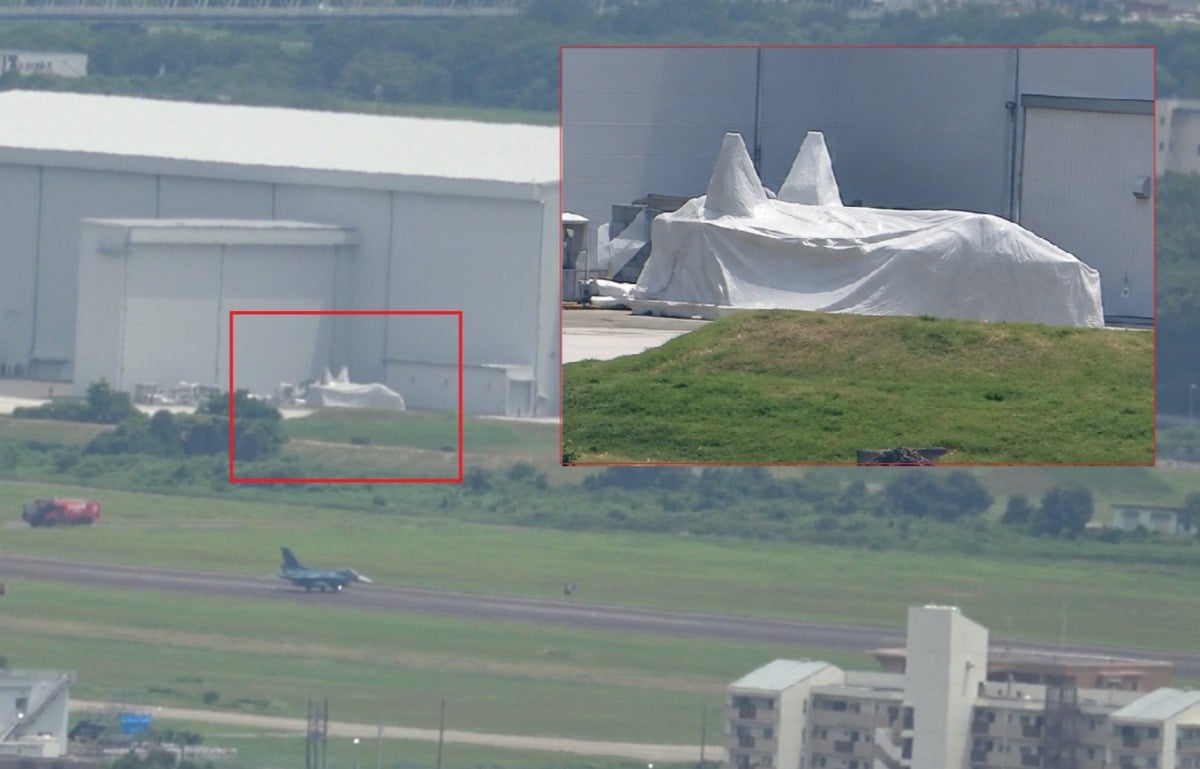
A bizarrely shaped aircraft rolled onto the tarmac at Gifu Air Base in March 2026, catching military spotters completely off guard. Covered in massive, bulbous fairings, an oversized nose radome, and strange structural pods, early rumors ran wild on social media. People called it a mystery shrouded fighter jet spotted at Japan’s top test base, speculating about a radical new stealth project or a hidden combat vehicle designed to shake up East Asian airspace.
The internet got it wrong. This isn't a nimble, supersonic dogfighter hiding in the shadows. It's something far more dangerous to Japan's regional adversaries.
The Japan Air Self-Defense Force (JASDF) officially transferred this highly modified platform, officially designated as the Kawasaki EC-2 Stand-Off Jammer, to its Air Development and Test Wing. The airframe, previously known by its serial number 18-1203, is a heavily modified variant of the massive Kawasaki C-2 tactical transport jet. This platform doesn't carry air-to-air missiles or drop precision bombs. Instead, it weaponizes the electromagnetic spectrum, built specifically to blind modern air defense networks and fry adversary radar installations from hundreds of miles away.
Behind the Strange Shapes at Gifu Air Base
Gifu Air Base sits in Gifu Prefecture as the central hub for the Air Development and Test Command. It's the place where Tokyo evaluates every piece of hardware before it enters active service. When the EC-2 first broke cover for taxi tests and its subsequent March 17 maiden flight, its disfigured appearance turned heads.
The modifications are impossible to miss. The aircraft features a massive, swollen nose radome that completely alters its aerodynamics. Two substantial, canoe-shaped fairings run along the upper fuselage like a tandem set of ridges. Two extra fairings protrude from the sides of the rear fuselage, near the tail section.
These odd structural additions aren't for show. They house complex electronic support measures (ESM) and electronic countermeasures (ECM) arrays. By spreading these sensor suites across the airframe, the EC-2 achieves wide-angle coverage to pick up, categorize, and jam hostile radio frequencies and radar signals. It also carries advanced satellite communication (SATCOM) antennas inside those dorsal humps, keeping it linked to the broader military command structure while operating under heavy electronic interference.
Why Japan Swapped a Cargo Hauler for a Electronic Warship
To understand why Tokyo spent 41.4 billion yen developing this specific platform, you have to look at what it's replacing. For decades, Japan relied on a single, aging Kawasaki EC-1 aircraft. Built on the old C-1 transport platform, that lone electronic warrior entered service back in 1986 and finally hit retirement in 2025.
The old EC-1 was deeply limited. It was tiny, carrying a maximum payload capacity of roughly 12 metric tons. It lacked the range, electricity generation, and cooling capacity required to power modern, high-energy jamming arrays.
The Kawasaki C-2 base platform completely changes that math.
- Payload capacity: The C-2 handles nearly 36 metric tons of cargo. That massive lift capacity means the EC-2 can pack heavy, high-output liquid-cooled jamming transmitters, specialized workstations for multiple electronic warfare officers, and massive power generation systems driven directly by its twin General Electric CF6-80C2K1F turbofan engines.
- Flight performance: Unlike turboprop alternatives like Europe’s A400M or the American C-130, the jet-powered C-2 cruises at high altitudes and speeds. This allows the EC-2 to reach its operational cruising zone rapidly.
- Stand-off distance: The primary goal isn't to fly over enemy territory. The EC-2 is a stand-off jammer. It stays well outside the engagement envelope of long-range surface-to-air missile systems like the Russian S-400 or Chinese HQ-9, projecting massive electronic interference across hundreds of kilometers.
The Geopolitical Tension Driving Tokyo’s Trillion Yen Electronic Push
Tokyo isn't building these complex machines in a vacuum. The East China Sea and the airspace surrounding Okinawa have seen a massive spike in military posturing. Just recently, the JASDF had to scramble fighter jets after a highly specialized Chinese strike-reconnaissance formation, consisting of a Shaanxi Y-9 electronic reconnaissance aircraft and a missile-capable Tengden TB-001 drone, zipped toward Okinawa.
Modern warfare isn't just about who has the stealthiest fighter or the fastest missile. It's about who dominates the airwaves. If you can't use your radar, your multi-million dollar stealth fighter is effectively blind, and your surface-to-air missiles can't lock onto targets.
Japan’s Ministry of Defense clearly highlighted this reality in its massive 58 billion dollar defense budget for fiscal year 2026. The ministry allocated huge sums toward intelligence collection, assigning roughly 260 million dollars directly to electronic warfare programs out of a broader 3.2 billion dollar pot for information processing. The defense ministry stated flatly that the electromagnetic spectrum has become the absolute front line of modern combat across land, sea, air, space, and cyber domains. Securing dominance in this area is a matter of survival.
Instead of sticking with just one lonely electronic warfare asset like they did with the EC-1, the JASDF plans to field a dedicated fleet of four EC-2 aircraft. These will be operated by the Electronic Warfare Operations Group, known locally as the Denshi Sakusengun, based out of Iruma Air Base in Saitama Prefecture.
Spotting the Differences in Japan's Modified C-2 Fleet
The EC-2 isn't the only weirdly shaped giant flying out of Japan's test facilities. The JASDF has a history of turning its transport workhorses into specialized intelligence gatherers. To understand exactly what observers are looking at when these planes pop up on flight trackers, it helps to distinguish between the various iterations.
Back in 2018, engineers converted a C-2 airframe into the RC-2, a dedicated signals intelligence (SIGINT) platform. That aircraft went operational around 2020. While the RC-2 features various antennas and small fairings, its primary job is passive listening—sucking up communications, radar signatures, and electronic emissions from regional adversaries to map out their defense infrastructure.
The EC-2 is an active attacker. It doesn't just listen; it actively transmits high-power energy to disrupt, blind, and neutralize those mapped networks.
There's even been testing involving the integration of the American Rapid Dragon palletized weapons system into standard C-2 cargo bays. That setup allows the cargo plane to drop pallets of long-range cruise missiles right out of the rear cargo ramp, effectively turning a transport plane into a heavy bomber.
What Happens Next for the EC-2 Program
Now that the initial prototype has moved from its basic engineering check flights into the formal custody of the Air Development and Test Wing at Gifu, the real work starts. Over the coming months, test pilots and electronic warfare specialists will push the system to its operational limits.
They will verify how the massive fairings alter the aircraft's handling characteristics during high-angle maneuvers. More importantly, they will test the integration of the onboard electronics under simulated combat conditions, ensuring the high-output jamming systems don't accidentally interfere with the aircraft's own flight controls or the radar tracking systems of friendly fighters like the F-15J and F-2B that regularly act as chase planes.
According to current JASDF schedules, the rigorous evaluation phase will run through the remainder of the current fiscal year. If the platform meets its strict performance metrics, the EC-2 is on track to achieve full operational fielding by March 2027.
If you are tracking regional security trends or aviation developments in East Asia, keep your eyes on flight tracking data surrounding Gifu and Iruma. The era of relying on simple, unescorted fighter sweeps is completely over. The future belongs to whoever controls the spectrum, and Japan just put its most powerful piece on the board.