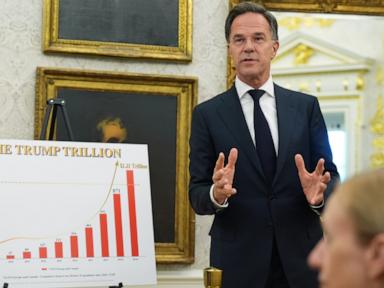
Mark Rutte walked into the Oval Office with a literal gold-lettered chart called "The Trump Trillion." He wanted to show Donald Trump that Europe is finally writing the checks America has demanded for decades. European allies and Canada pumped an extra $139 billion into their defense budgets last year alone. They even agreed to a staggering target of spending 5% of their GDP on defense by 2035.
Rutte thought he had the ultimate winning hand. He was wrong. For a closer look into similar topics, we recommend: this related article.
Trump didn't care about the numbers. He looked at the NATO Secretary-General and moved the goalposts entirely. He made it clear that America doesn't need European cash. He wants something much harder to calculate. He wants total loyalty.
As NATO leaders gather in Ankara, Turkey, for their July 2026 summit, the old playbook of managing the alliance is officially dead. The biggest threat to the summit isn't a lack of defense spending. It's the fact that Europe is trying to solve a deeply personal, political demand with cold corporate balance sheets. For broader context on this development, detailed coverage can be read at The New York Times.
The Flattery Trap That Failed
For nearly two years, Rutte has earned a reputation as the ultimate "Trump whisperer." His strategy has been simple: praise Trump publicly, show him how much money America is saving, and link European defense purchases directly to American jobs.
In the Oval Office, Rutte laid it on thick. He presented data showing a $300 billion backlog of European orders for military equipment, proving that European defense spending directly benefits US factories. He even praised Trump as the leader of the free world.
But Trump pulled the rug out from under him. He blasted the alliance on Truth Social, pointing out that the US spends $999 billion on defense while America's closest allies lag far behind. The UK sits at $90.5 billion, France at $66.5 billion, and Italy at $48.8 billion.
More importantly, Trump is furious that European allies didn't back his military campaign against Iran. To Trump, true allies don't just buy your weapons. They fight your wars. He explicitly stated that the relationship is completely one-sided because Europe wasn't there for America when it mattered.
The Rebrand Nobody Believes
To keep the US from pulling out, NATO is introducing a new strategy in its official declaration called burden shifting. It is a fancy way of saying that Europe will take over its own conventional defense while the United States steps back. Some Washington insiders are calling this NATO 3.0.
The Ankara summit communique is packed with massive promises to prove Europe can handle the load:
- A formal pledge of roughly 70 billion euros a year in military aid to Ukraine for both 2026 and 2027.
- Enshrining the new "burden shifting" framework into official alliance doctrine.
- Massive new transatlantic defense contracts to buy American capability quickly.
It looks great on paper. In reality, it is a mess.
The Pentagon recently shocked European capitals by quietly scaling back the number of US warships, aircraft, and drones earmarked for European defense if a member state gets attacked. Meanwhile, Russia is testing these exact boundaries, launching provocative drone flights right next to military bases across several European nations.
Europe is caught in a dangerous trap. They cannot produce enough military hardware on their own, so they have to buy from the US. But buying from the US means depending entirely on a president who openly questions the core promise of the alliance: Article 5. If the American president refuses to defend a member state, the treaty is just a useless piece of paper.
Internal Squabbles Over Funding
While Rutte tries to keep Trump from walking out, the European allies are busy fighting each other behind the scenes. The unity NATO likes to project to the world is cracking under financial strain.
Poland is aggressively demanding that NATO fund a $28 billion upgrade to eastern-flank infrastructure, including extending Cold War-era fuel pipelines. Yet, Warsaw is hesitant to commit more of its own funds to the broader Ukraine package.
The 70 billion euro annual commitment for Ukraine is also on shaky ground. A huge chunk of that money relies on an EU loan structure worth 30 billion euros a year, and several European capitals are trying to back out of the arrangement. They want the protection, but they don't want to hurt their budgets at home.
Then there is the host country itself. Turkish President Recep Tayyip Erdogan is using the summit to lobby heavily for his own pipeline infrastructure. The only reason Trump even showed up to the summit is his personal relationship with Erdogan. Rutte is essentially stuck managing a fragile coalition held together by transactional friendships and financial panic.
What Europe Needs to Do Next
Europe can no longer treat NATO like an insurance policy where they just pay the premium and forget about it. Flattering Trump with charts and buying American missiles will not buy security anymore.
If European leaders want to survive this shift, they have to take immediate action:
- Fund Domestic Production Fast: Stop relying entirely on transatlantic contracts. Europe must build its own integrated defense supply chains so it isn't vulnerable to shifting political winds in Washington.
- Lock in the Ukraine Aid: Stop bickering over the EU loan structure. The 140 billion euro package for the next two years must be finalized and legally insulated from individual vetoes.
- Prepare for a Less American NATO: Accept that the Pentagon's recent cutbacks on warships and aircraft are permanent. European commanders need to rewrite their strategic plans assuming less US backup on the ground.
The era of transactional alliance management is over. If Europe doesn't build a self-sustaining military apparatus right now, they will find out exactly what happens when America's demand for loyalty goes unmet.