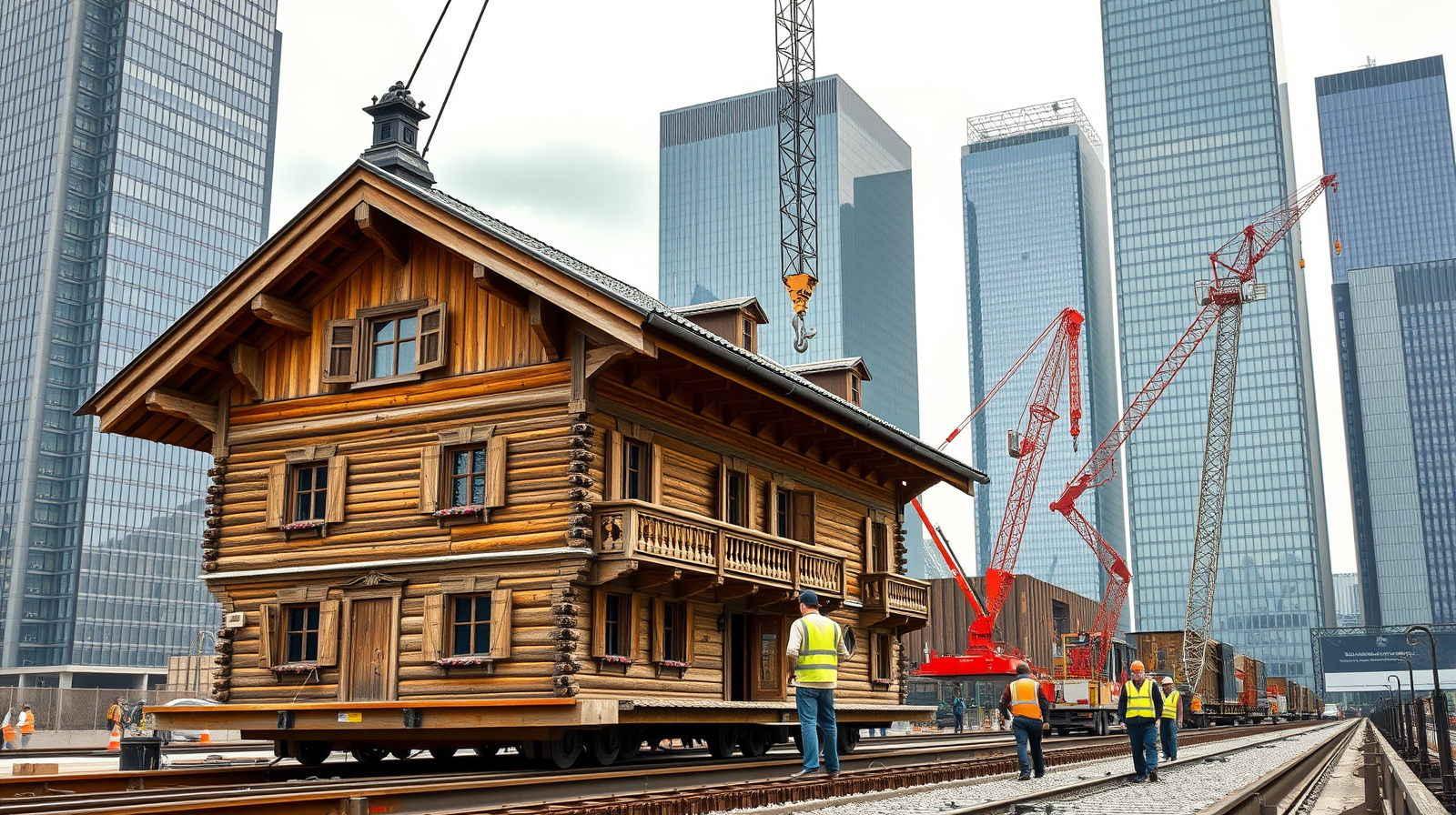
Most cities have a simple, destructive answer when an old building stands in the way of a shiny new train track or highway expansion. They bring out the wrecking ball.
Switzerland chooses a completely different path.
Instead of turning architectural heritage into rubble, Swiss engineers regularly pick up entire, multi-thousand-tonne structures and slide them down the road. It sounds like an impossible engineering stunt, but it's a practical, calculated reality. In a world obsessed with cheap demolition and fast replacement, the Swiss have proven that preserving history is often just a matter of putting it on rollers.
The real reason behind this approach isn't just sentimentality. It comes down to a mix of strict spatial planning laws, public pushback, and a unique engineering culture that treats architectural preservation as a solvable physics problem.
The Night a Six Thousand Tonne Giant Walked
Look at the Oerlikon district in Zurich. In 2012, a massive 19th-century brick building stood exactly where the Swiss Federal Railways needed to lay two new train tracks. The building was the MFO-Gebäude, the former administrative headquarters of the Maschinenfabrik Oerlikon. Built in 1889, this 80-meter-long, 12-meter-wide brick giant was a monument to the industrial birth of modern Switzerland.
The railway initially wanted to demolish it. The local community flatly refused. They viewed the brick structure as part of their identity. Instead of fighting a losing battle against public opinion or dragging out legal challenges for decades, a feasibility study was ordered.
The result was brilliant. They decided to move the entire 6,200-tonne structure sixty meters to the southwest.
It took ten months of meticulous prep work to pull it off. Workers replaced the supporting basement walls with heavy steel pillars. They poured a massive concrete slab under the structure, fitted with precision guide tracks. Then they slipped 500 steel rollers under the building, attached hydraulic engines, and began the slow crawl. Over the course of two days, the historic landmark moved at a painstaking speed of roughly four meters per hour.
It arrived at its new home perfectly intact. Not a single pane of glass shattered.
How to Roll a Historic Landmark
Moving a giant brick structure isn't about raw horsepower. It's about distributing weight so perfectly that the fragile mortar between old bricks never undergoes tensile stress. Brick handles compression beautifully, but if you bend or twist a brick wall by even a fraction of an inch, it cracks open.
The process follows a strict sequence of structural engineering steps.
First, engineers strip the building of any unnecessary weight, though they leave the structural bones fully intact.
Second, they excavate around the foundations to expose the basement. This is where the real magic happens. They cut horizontal slits into the foundation walls, inserting heavy-duty steel beams one section at a time. These beams form a rigid, temporary structural grid that takes over the job of holding up the building.
Third, they build a concrete runway underneath. This slab must be perfectly level. Even a tiny incline could cause the building to roll out of control or twist under its own weight.
Fourth, they install the rollers and tracks. Engineers place hundreds of high-grade steel cylinders between the temporary steel grid and the concrete runway.
Finally, hydraulic jacks push the building forward. These jacks are connected to a central computer system that monitors pressure and movement down to the millimeter. If one side of the building moves a hair faster than the other, the computer instantly adjusts the hydraulic fluid flow to equalize the pressure.
It's a slow, quiet, and deeply satisfying spectacle to watch.
The Hidden Economics of Preservation
Many critics look at these projects and assume they are a massive waste of taxpayer money. Moving the MFO building cost roughly 11 million Swiss francs. That sounds like an astronomical sum for a single relocation project.
Look closer at the broader financial reality.
When you factor in the cost of demolishing a historic landmark, dealing with public protests, managing years of environmental lawsuits, and building an entirely new structure from scratch, the numbers begin to shift. In Switzerland, land is incredibly scarce. You can't just expand outward into the Alps. Every square meter of urban space must be maximized.
When an infrastructure project stalls for five years because citizens are fighting to save a local landmark, that delay costs millions in lost economic productivity. Moving the building removes the bottleneck immediately. The railway gets its tracks, the public keeps its history, and the developers avoid a public relations disaster.
There is also the embedded carbon argument. New construction requires an immense amount of concrete and steel, both of which carry a heavy carbon footprint. By keeping the existing building shell alive, you avoid the environmental toll of manufacturing new materials.
Why Other Countries Simply Demolish
If shifting buildings is so effective, why don't we see it happening constantly in cities like New York, London, or Paris?
It requires a specific legal framework. Swiss spatial planning laws heavily prioritize inner-city densification and preservation. The government cannot simply seize land or destroy historic structures without facing immense institutional and public scrutiny.
Many countries lack the specialized engineering firms that possess this specific expertise. It requires specialized equipment, custom hydraulic systems, and decades of structural experience. If a city doesn't regularly invest in preserving its infrastructure, the local talent pool dries up, making the cost of bringing in outside experts prohibitive.
The Swiss have turned this niche into a standard option on the engineering menu. They don't look at a building in the way of a project as an obstacle. They look at it as a mobile object.
Your Next Steps for Analyzing Structural Preservation
If you are involved in urban planning, architecture, or local heritage preservation, don't dismiss building relocation as a fairy tale. Consider these practical actions when dealing with threatened local landmarks.
Assess the true structural composition of the building. Heavy timber frames and reinforced concrete structures are actually excellent candidates for relocation because they hold together well under lateral movement.
Calculate the cost of project delays versus relocation. Factor in the legal fees, public relations management, and time lost to community opposition. You might find the price tag of a structural move is surprisingly competitive.
Look at the soil conditions. Moving a building requires a solid, stable path for the runway slab. Soft, shifting soils will require extensive piling work, which can drive up the project budget significantly.
Preserving the past doesn't mean stopping progress. It just means you need to be smart enough to move it out of the way.