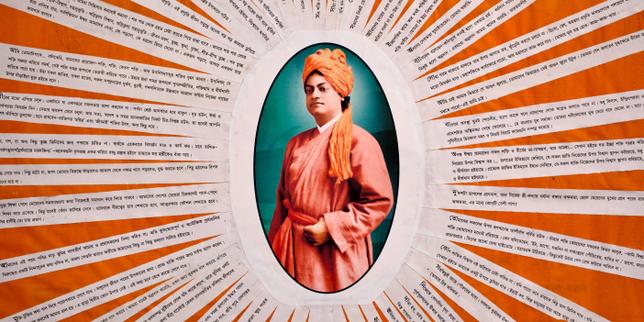
History changes course when a single voice refuses to fit the mold. In September 1893, an unknown Indian monk stepped up to a podium in Chicago and shattered centuries of cultural prejudice with just six simple words.
You've probably heard the quote. But do you actually know what happened behind the scenes at the World's Parliament of Religions? Most people think Swami Vivekananda arrived as an established celebrity. The reality is far more raw. He was an outsider with no official credentials, struggling with cold weather, nearly out of money, and completely overlooked by the conference organizers until the very last minute. Don't forget to check out our previous article on this related article.
Let's look at what actually went down in Chicago and why his message still hits hard today.
The Rough Start Nobody Talks About
Before he became a global icon, Narendranath Datta—later known as Swami Vivekananda—was just a wandering monk trying to find a way to help his impoverished homeland. India was reeling under brutal colonial rule, plagued by recurrent famines, and dismissed by Western powers as a land of backward traditions. If you want more about the history of this, Associated Press provides an in-depth summary.
When Vivekananda heard about the World's Parliament of Religions—part of the massive Chicago World's Fair—he saw an opening. He didn't go to convert people. He went to raise funds and awareness for the starving millions back home.
The journey alone was a nightmare. He didn't even have a proper formal invitation to the conference. Delegates were required to present credentials from an established religious body. Because he represented an informal order of monks following the mystic Ramakrishna, he had no official paperwork. He only got onto the stage because a prominent Harvard professor, John Henry Wright, recognized his brilliant intellect and intervened on his behalf.
Breaking the Mold with Six Words
When his turn finally came on the afternoon of September 11, 1893, the audience was tired. Dozens of speakers had already droned on for hours with dry, academic lectures about theological superiority.
Then Vivekananda walked up. He didn't open with a formal theological argument or a standard greeting like "Ladies and Gentlemen." Instead, he uttered a phrase that completely disarmed the crowd:
"Sisters and brothers of America."
The effect was instant. The crowd broke into a two-minute standing ovation. Why? Because in a room packed with rigid religious authorities pushing their own exclusive dogmas, someone finally spoke with radical inclusion.
He didn't sugarcoat his message either. In subsequent speeches during the conference, he openly criticized Western hypocrisy. He famously pointed out that while Christian missionaries were busy sending funds to convert people overseas, millions in India were dying of starvation. He told the audience bluntly that offering religion to a starving person is an insult, and that what people actually needed was bread and practical help.
The Core Philosophy Behind the Legend
Vivekananda wasn't interested in religious supremacy. His presentation of Hinduism at Chicago focused heavily on Vedanta and the concept of universal acceptance. He argued that different religions are simply different streams leading to the same ocean.
To illustrate this, he shared the famous parable of the frog in the well. A frog lived in a tiny well and believed it was the entire universe. When a frog from the vast ocean visited and tried to explain the sea, the well-frog refused to believe it and chased him away.
Vivekananda used this story to call out sectarianism. Christians sat in their wells, Muslims sat in theirs, and Hindus sat in theirs, each convinced their specific well was the whole world. His goal in Chicago was to smash those walls down.
What We Get Wrong About His Legacy Today
It's easy to sanitize historical figures into comfortable greeting-card quotes. People love to remember Vivekananda as a sweet philosopher who promoted generic peace and harmony.
That ignores his sharp edge. He was fiercely independent, deeply critical of religious fanaticism, and unapologetic about calling out systemic inequality. He didn't want Westerners to adopt yoga as a trendy lifestyle exercise; he wanted a mutual exchange of intellect and practical cooperation between the East and the West.
He warned that bigotry and fanaticism would continue to tear human society apart if people refused to look past their own dogmas. Looking around today, you can see his warnings playing out everywhere.
You don't need to study ancient texts to apply his mindset. Stop treating differing viewpoints as threats. Look past tribal labels. Focus on practical solutions for human suffering instead of getting bogged down in abstract ideological warfare.
Take a cue from that hot September afternoon in Chicago. Question your own assumptions, step out of your well, and start listening to perspectives you normally write off.