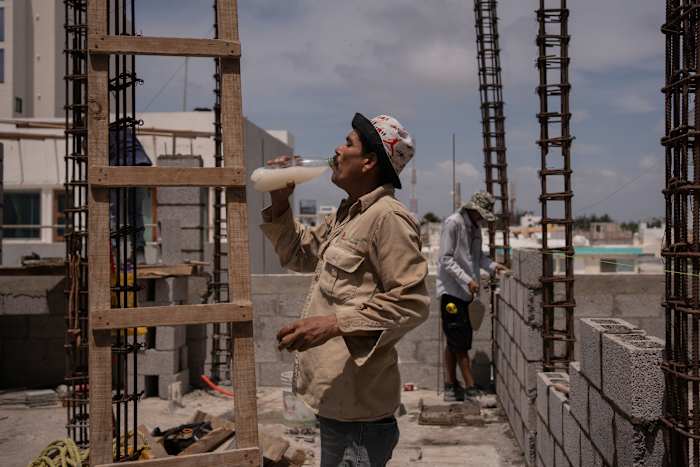
If you feel like you are spending way more of the year sweating, trapping yourself indoors, and cranking up the air conditioning, you are not imagining things. The seasons have fundamentally shifted under our feet. A major study confirms that massive chunks of the globe—including Mexico, Italy, and large swaths of the United States—now experience up to two full months of additional heat stress every year compared to the 1970s.
This is not a vague prediction about the year 2100. It is the current reality on the ground in 2026.
The research, published in the journal Nature Climate Change, bypasses simple thermometer readings to look at how weather actually punishes the human body. By tracking decades of data, scientists found that extreme feels-like temperatures, relentless tropical nights, and dangerous heat stress days have expanded their grip across almost every continent.
The Invisible Metric That Matters Most
Most weather reports focus entirely on the air temperature. If the thermostat says 92 degrees Fahrenheit, we think we know what to expect. But raw numbers lie. They leave out the hidden amplifier that makes heat genuinely dangerous, which is humidity.
The team of researchers led by Rebecca Emerton, a senior scientist at the European Centre for Medium-Range Weather Forecasts, used a sophisticated tool called the Universal Thermal Climate Index. This index models exactly how a human body responds to the surrounding environment by factoring in temperature, humidity, wind speed, and radiation.
When you look through this lens, the picture changes completely.
To make sense of the data, the study broke heat stress down into distinct severity levels based on the Universal Thermal Climate Index.
- Strong heat stress kicks in when the index hits 32 degrees Celsius or 89.6 degrees Fahrenheit.
- Very strong heat stress takes over at 38 degrees Celsius or 100.4 degrees Fahrenheit.
- Extreme heat stress climbs even higher, creating conditions where the human body simply cannot cool itself down naturally.
Your body relies on sweating to dump excess heat. When the air is choked with moisture, your sweat cannot evaporate into the atmosphere. The cooling mechanism stalls out entirely. Humid heat waves kill people much faster than dry ones because they bypass your internal defense systems. That is the exact mechanism driving the findings in this study. The atmosphere is holding more moisture as it warms, turning summer into a prolonged steam room.
Where the Calendar Has Shifted the Most
The expansion of the hot season is not happening equally everywhere, but the worst-hit regions are seeing their local climates rewrite themselves at terrifying speeds.
Mexico and Central America
Parts of Mexico and Central America are bearing some of the heaviest burdens. These regions are dealing with roughly 50 more days per year of at least strong heat stress than they did in the 1970s. That is nearly two months of extra strain on agricultural workers, power grids, and local water supplies.
Southern and Eastern Africa
Countries like Namibia, Angola, Tanzania, Kenya, and Uganda have seen their hot seasons stretch by a similar margin. The addition of 50 extra days of heat stress creates massive food security challenges, as crops wither and livestock face prolonged environmental pressure.
Southern Europe
If you look at the Mediterranean basin, the numbers are equally stark. Southern Spain, Italy, Greece, and Turkey are tracking up to 40 additional days of strong heat stress per year compared to a few decades ago. Much of Southern Europe is now forced to cope with an entire extra month of oppressive conditions annually. This shifts tourism seasons, strains old infrastructure, and alters daily life.
The United States
The US is not escaping this trend. Most of the country now handles at least 15 more days of strong heat stress each year. If you look at the southern tier of the country, the situation worsens significantly. States like Texas and Florida are absorbing close to 25 or more extra days of very strong heat stress. This explains why regional power grids are constantly hovering on the brink of failure during extended summer stretches.
The Nightmare of Hot Nights
One of the most troubling details exposed by the study is that the planet is not getting a chance to cool off at night. The warmest nights of the year are heating up significantly faster than the warmest days.
According to the data, the feels-like temperatures on the ten warmest nights of each year have increased by 0.32 degrees Celsius or 0.58 degrees Fahrenheit per decade. Compare that to the ten warmest days, which grew by 0.27 degrees Celsius or 0.49 degrees Fahrenheit per decade.
The researchers defined a tropical night as one where the minimum temperature never drops below 20 degrees Celsius or 68 degrees Fahrenheit. When the sun goes down and the air stays hot, humans lose their ability to recover from daytime heat. Your heart rate stays elevated, your sleep quality plummets, and your cardiovascular system remains under constant pressure.
Jennifer Francis, a climate scientist at the Woodwell Climate Research Center who was not involved in the study, pointed out that this analysis shows exactly how humidity and temperature work together to create a trap. When the night remains humid and hot, the built environment holds onto that thermal energy. Concrete and brick buildings turn into literal radiators, pumping heat back into homes long after midnight.
The Human Toll of an Expanded Summer
The shifting climate translates directly into an exploding population of vulnerable people. The study highlights that one billion more people face at least one day of extreme heat stress every single year compared to the baseline of the 1970s.
This is no longer an issue restricted to communities that have historically been hot. The most alarming trend noted by lead author Rebecca Emerton is that heat stress is creeping into territories that used to be completely immune. Regions with cooler climates lack the infrastructure, architectural design, and cultural habits to survive severe heat events. A town in northern Europe or the northern US rarely has widespread residential air conditioning, meaning a sudden spike in the index becomes an immediate medical crisis.
When a billion extra people are exposed to these conditions, the strain on global healthcare systems spikes. Heat stroke, acute kidney injury from dehydration, and worsened respiratory issues drive massive waves of emergency room visits.
Practical Action Items for a Hotter Reality
We can no longer treat extreme heat as a rare, temporary disruption. It is now a fixed block of the calendar. Adapting to this shift requires shifting how we manage our homes, our health, and our daily routines.
Audit your home insulation instead of just buying a bigger AC
Most people think the answer to hot weather is a more powerful cooling unit. If your home leaks cool air, you are wasting money and straining the power grid. Focus on sealing gaps around windows, adding weatherstripping to doors, and ensuring your attic is properly insulated. Keeping the heat out is far more efficient than trying to pump it out after it enters.
Shift your heavy physical activity to early morning
Because nights are staying warmer longer, evening workouts or outdoor projects can be a trap. The ground and surrounding buildings have spent the whole day absorbing solar radiation, meaning late afternoon and early evening can actually present the highest heat stress levels. Aim for the window right around sunrise when the thermal index hits its lowest point.
Track the wet bulb temperature, not the standard forecast
When planning outdoor work or heavy exercise, look at local wet bulb globe temperature readings or heat index charts rather than the basic temperature. If the index crosses into the strong heat stress zone, cut your outdoor time in half and double your water intake.
Implement a passive cooling strategy during blackouts
If the grid fails during a heat wave, do not open all your windows during the heat of the day. Keep windows closed and blinds pulled tight on the sunny sides of your house. Open them only at night if the outside air drops below the inside temperature, and use battery-powered fans to create cross-breezes.
The data shows our world has changed permanently since the 1970s. Pretending summers are the same length they used to be is a fast track to heat exhaustion. Protect your body by treating the thermal index as a serious safety boundary.