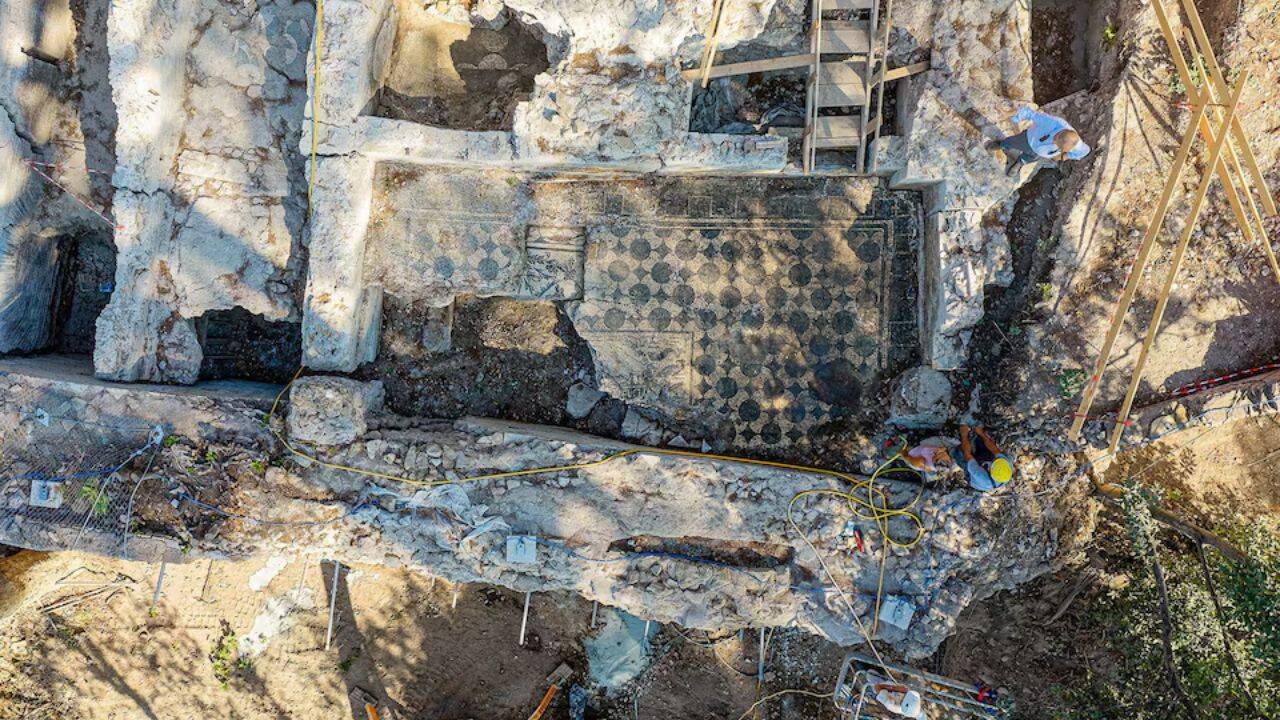
Digging a routine trench in a historic public park rarely yields a groundbreaking historical puzzle, but Rome always plays by its own rules. Workers trying to fix a crumbling retaining wall inside Villa Celimontana accidentally exposed a second-century imperial structure just footsteps from the Colosseum. Five of its eight rooms have emerged from the dirt on the Caelian Hill, revealing bright frescoes, marble-clad walls, and a stunning marine-life mosaic.
Experts from Rome's Special Superintendency stared at a floor featuring a lobster, a crab, a fish, and a dolphin circled around a two-handled vase. That precise iconography immediately sparked a fiery debate. It matches motifs found inside an ancient fire station at Ostia, the port city thirty kilometers away. Could this lavish subterranean space actually be a lost barracks of the Vigiles, the elite corps of imperial firefighters who kept ancient Rome from burning to the ground? Or is it just another wealthy aristocrat's hidden mansion?
The Mystery of the Caelian Hill
Finding ruins in Rome is Tuesday afternoon business. Finding ruins that rewrite military logistics is entirely different. The Caelian Hill was a major hub of imperial activity. Water networks ran heavily through this zone, tapping straight into local aqueducts to service large complexes.
The Vigiles weren't just guys with buckets. Created by Emperor Augustus to handle chronic urban infernos, they were militarized units with police powers who patrolled the dark streets at night. They needed space, water access, and strategic positioning near dense population centers like the Colosseum valley.
If this newly unearthed complex belonged to the Fifth Cohort of the Vigiles, historians have to rethink the physical footprint of Rome's emergency services. Standard military housing wasn't usually known for high-end interior design. Yet, Roman urban forces often integrated luxurious quarters or shared administrative spaces depending on who funded the construction.
Luxury Home or Military Outpost
Archaeologists are refusing to rush to judgment, and for good reason. The site features incredible decorative ceilings adorned with large red and blue circles alongside intricate floor patterns. Aristocratic domus structures discovered across the Caelian Hill routinely display this level of artisan craftsmanship. Wealthy Romans loved aquatic themes because water symbolized status, trade dominance, and leisure.
A high-ranking commander of the fire watch might have lived on-site in luxury. Alternatively, a patrician family could have owned the land before the state repurposed it later during third-century renovations. Rome's architectural layers are notoriously messy. Buildings changed hands, functions shifted, and walls were knocked down constantly.
Daniela Porro, Rome's special superintendent, pointed out that unearthing these spaces forces a complete reassessment of how imperial blocks were organized. Funding from Italy's post-COVID economic recovery initiatives (PNRR) is driving these modern digs, allowing teams to peel back centuries of overgrowth. They aren't just brushing dirt off old tiles; they are running chemical analyses on mortar and mapping spatial layouts to settle the barracks debate once and for all.
What Comes Next for the Dig
The remaining three rooms still wait under heavy layers of sediment. Technicians are currently cataloging fragments of wall plaster and analyzing ceramic shards recovered from floor joints to pin down exact construction timelines.
Keep an eye on the official updates from the Italian Ministry of Culture over the coming months. As interior walls are fully cleared, inscriptions or stamp marks on bricks will likely provide the smoking gun needed to confirm whether ordinary firefighters or wealthy elites once walked these colorful floors.