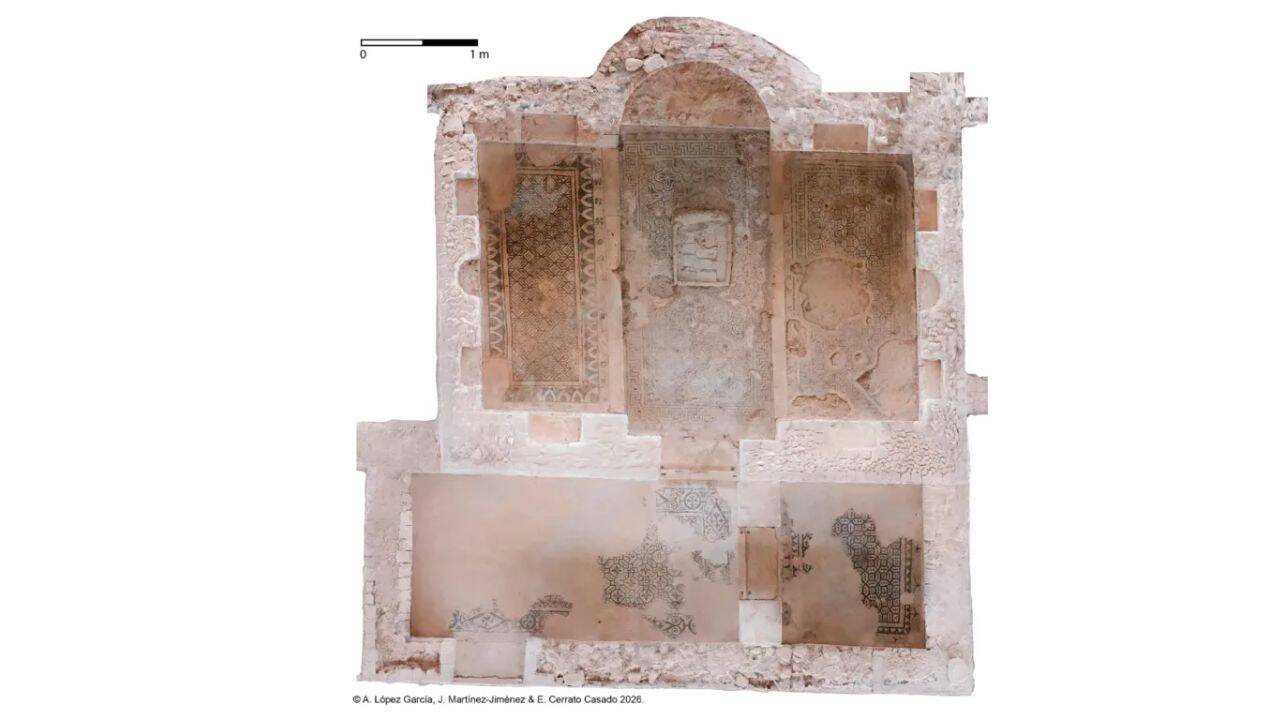
For decades, researchers thought a specific room inside a sprawling rural estate in southern Spain was a sanctuary dedicated to a mystery cult. They were entirely wrong. Recent findings published in the Journal of Mediterranean Archaeology reveal that Room 10 at the Fuente Álamo Roman villa in Puente Genil, Córdoba, was actually the oldest confirmed private library on the Iberian Peninsula.
It is also the westernmost documented library in the entire Roman Empire.
If you visit archaeological sites expecting neat signs and preserved books, you will be disappointed. Ancient libraries do not survive intact. Papyrus rots, parchment turns to dust, and wooden cabinets vanish over centuries. What remains are empty rooms, silent stone foundations, and architectural layouts that require forensic skill to decode. Antonio López García and Javier Martínez Jiménez from the University of Granada, alongside Eduardo Cerrato Casado from the University of Córdoba, managed to solve this puzzle not by digging up scrolls, but by reading the walls.
Why Everyone Thought It Was a Cult Shrine
For a long time, the space was catalogued as a mithraeum—a shrine to the god Mithras. Soldiers, merchants, and imperial officials loved the cult of Mithras across the Roman world, and sanctuaries built for him followed a strict architectural formula. They featured long narrow naves lined with raised benches where initiates sat for communal meals, terminating in a cave-like sanctuary at the back.
Room 10 at Fuente Álamo had none of those features. Instead, it possessed structural quirks that completely baffled local historians until they applied a design analysis technique called "shape grammar".
Shape grammar breaks down architectural ruins into a distinct vocabulary of forms. When the research team mapped the room's proportions, they found an apse, a raised podium, semicircular niches meant for statues or busts, and rectangular wall niches sized precisely to match standard Roman wooden book cabinets. Coupled with adjoining spaces meant for quiet study and storage, the geometry pointed away from dark religious rituals and straight toward classical scholarship.
The Inverse of Herculaneum
Most people know about the Villa of the Papyri in Herculaneum, where the eruption of Mount Vesuvius buried thousands of carbonized scrolls. That site gave us the texts, but crushed the buildings.
Fuente Álamo offers the exact opposite. You won't find a single legible letter or surviving papyrus fragment here. Instead, you get an pristine architectural shell. Dating back roughly to the fourth century AD, the villa sits in the heart of Baetica—a wealthy Roman province famous for its olive oil, grain, and high-status cultural integration.
Owning a library in a rural villa wasn't about casual reading. It was a massive flex. During the turbulent later centuries of the Western Roman Empire, maintaining a private collection of texts signaled that a provincial elite family wanted to stay connected to elite Mediterranean networks of philosophy, law, and literature. It was a statement of intellectual survival amidst political decay.
The Ghost of the Villa Owner
One of the most fascinating aspects of this discovery is a potential link to a 19th-century artifact. Decades ago, a stone coffin known as the Declamatio sarcophagus was unearthed at the nearby Villares del Carril site. Now housed in the Museum of Málaga, the sarcophagus features carvings of figures reading and teaching.
One particular carved figure holding a scroll and a codex bears a striking resemblance to a mosaic portrait found right here at Fuente Álamo, which researchers previously identified as the villa's master. While archaeologists are careful to note this connection remains unproven, the possibility is tantalizing. It hints that we might actually be looking at the face of the owner who built Spain's oldest known library.
If you plan to visit the Fuente Álamo archaeological site in Puente Genil today, local authorities are already working to update museum paths and visitor displays to reflect this monumental reattribution. Don't go looking for dusty bookshelves. Look at the masonry, trace the curves of the wall niches, and recognize that you are standing in the footprints of the farthest-reaching reading room the ancient Roman West ever built.