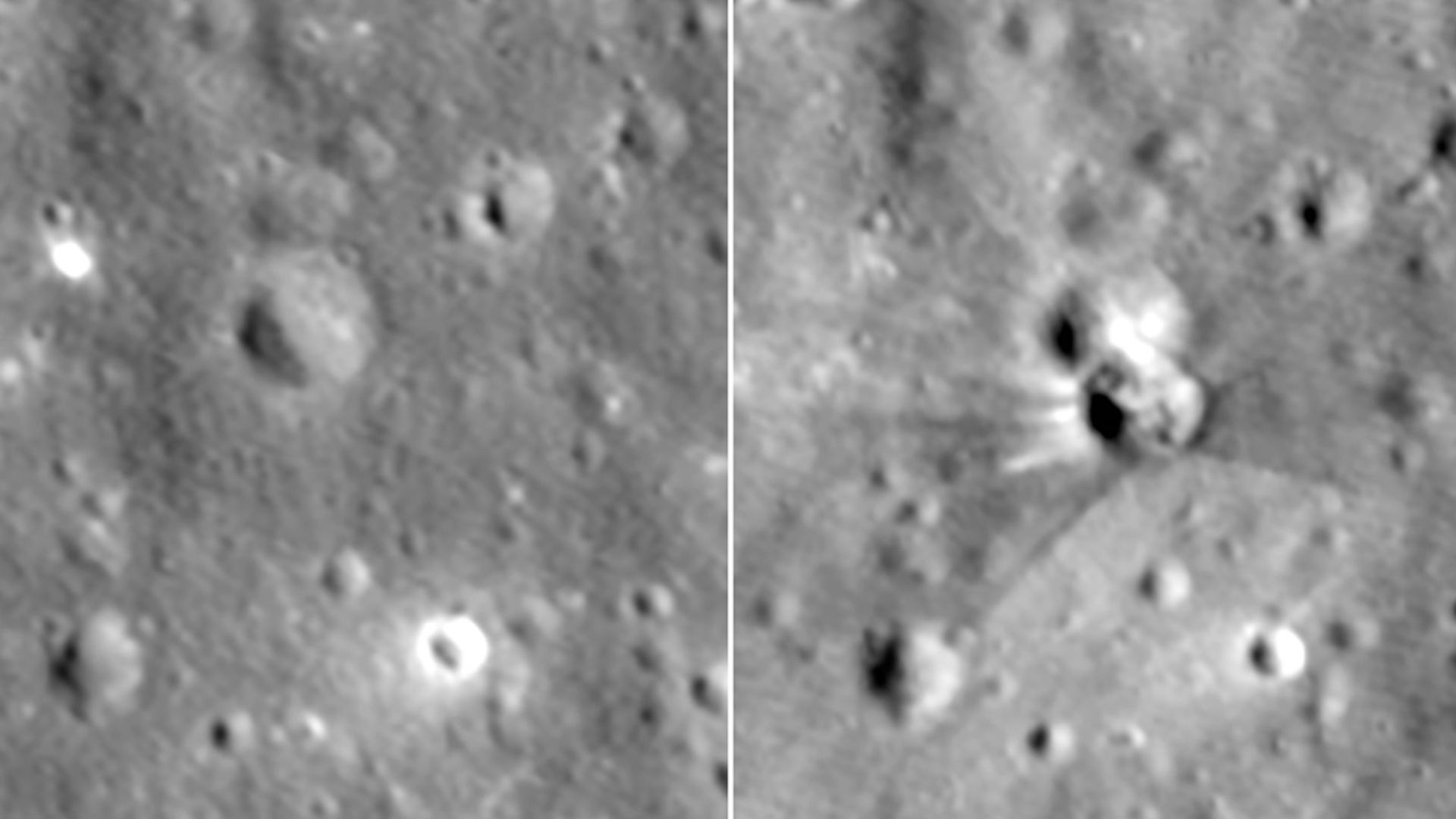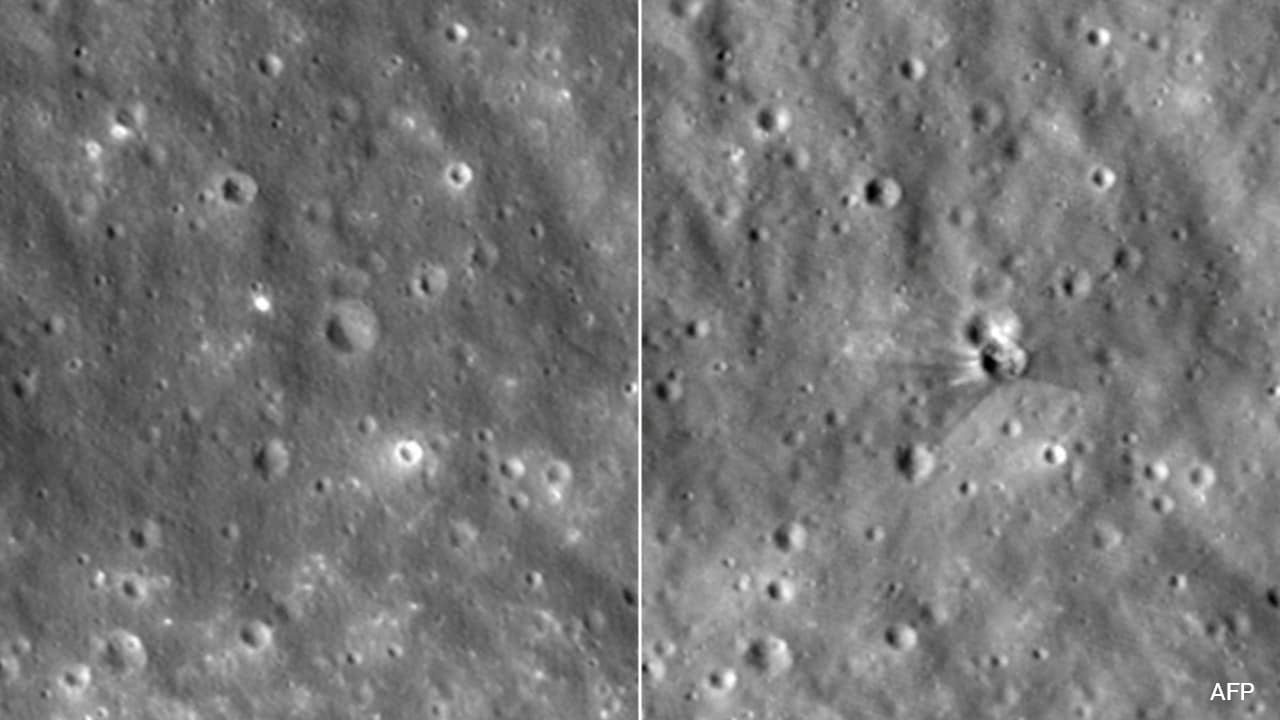
You’ve probably heard about the SpaceX rocket that slammed into the moon. Headlines make it sound like a disaster or some kind of reckless negligence. Honestly, it’s mostly just a reminder of how messy space exploration gets when we start treating the space between Earth and the moon like a bustling highway.
NASA recently released imagery from the Lunar Reconnaissance Orbiter showing the fresh scar left behind by a Falcon 9 upper stage. It hit the lunar surface on August 5, 2025, after helping launch Firefly Aerospace’s Blue Ghost 1 lander. The result? A 60-foot-wide crater. You might also find this related coverage interesting: The Truth About Why Russia Modified Its S-400 Systems.
It sounds huge until you realize the moon is basically a giant target that’s been hit by asteroids and debris for billions of years. This wasn't a failure of engineering so much as a reality of high-velocity space flight. When you dump an upper stage in deep space, gravity eventually settles the score.
Why the images are actually a big deal
Most people assume NASA has cameras pointed at every inch of the moon all the time. That’s not how it works. The Lunar Reconnaissance Orbiter (LRO) has been circling the moon since 2009. It’s an old workhorse. Mapping a specific, small impact site requires an incredible amount of precision. As extensively documented in detailed reports by Mashable, the effects are significant.
Think about trying to photograph a specific pebble from a moving car while driving 60 miles per hour, but the car is in orbit and the pebble is on a rotating globe. The LRO team had to wait for the crater to rotate into the right position and then tilt the entire spacecraft to get the angle. NASA admitted that missing the target by just ten seconds would have shifted their view by ten miles.
They nailed it. The images aren't just cool photos; they provide data. Scientists are using these streaks of material—the darker stuff thrown up from deeper underground and the brighter, fresher material—to understand what’s actually beneath the lunar surface. It’s a bit of cosmic geology for free.
The international scramble to find it
One of the most interesting parts of this story isn't the crash itself, but how we found the spot. It wasn't just NASA acting alone.
The Korean space agency was actually the first to publish pictures, thanks to their Danuri orbiter. The process was a massive collaboration involving NASA’s Center for Near Earth Object Studies, which refined the trajectory math, and the Korean team, who used that data to target their camera.
This is the future of space exploration. It’s not just one government entity controlling the narrative. It’s a mix of private companies like SpaceX, independent aerospace players like Firefly, and a global network of space agencies sharing coordinates and data. If you’re waiting for one agency to handle everything, you’re missing the point. The industry is decentralizing.
What happens to all the other junk up there
The SpaceX impact brings up an uncomfortable question. What about the rest of the debris? We have spent decades leaving upper stages, spent fuel tanks, and discarded equipment floating in orbit. Most of it eventually falls back into Earth's atmosphere and burns up. But the further out we go, the more the moon becomes a graveyard for our old gear.
Is it a problem? From a purely scientific perspective, every impact is a chance to see what’s under the moon’s skin. From a sustainability perspective, it’s a mess.
If you want to track this stuff, don't look for flashy government reports. Check out the amateur astronomers and hobbyists. They are often the ones tracking these trajectories long before official agencies get the cameras ready. They don’t have the budget, but they have the obsession.
Moving forward
We are going to see more of these "crashes" as lunar traffic increases. The goal shouldn't be to avoid hitting the moon at all costs, but to track where it happens so we can learn from it.
If you’re interested in how this affects future missions, watch how private companies handle their upper-stage disposal. Some are looking at fuel margins to de-orbit their gear safely back into Earth's atmosphere, while others are essentially using the moon as a trash can.
Stop thinking of this as a random accident. It’s a predictable outcome of an industry moving faster than its cleanup protocols. Keep an eye on the commercial lunar landing schedule for the rest of 2026. The more gear we send up there, the more craters we are going to document. That isn't a bad thing, provided we pay attention to what those craters tell us about the moon.
Check the LRO mission pages regularly if you want to see the latest lunar surface mapping. It’s a great way to see how we’re slowly turning the moon into a well-documented map rather than a mysterious white orb in the night sky.