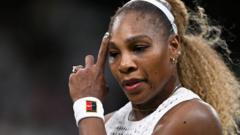
Serena Williams pulling out of the Wimbledon 2026 doubles draw isn't just another standard medical update on the tournament notice board. It's a gut punch to anyone who spent the last week believing in the impossible. Watching a 44-year-old legend step back onto the grass after nearly four years away from professional tennis felt magical, like catching lightning in a bottle twice.
Then reality hit. Hard. Learn more on a related issue: this related article.
On Saturday, July 4, 2026, the dream of seeing the Williams sisters command the lawns of the All England Club one more time evaporated. A stubborn right knee injury, picked up during a grueling first-round singles match, forced Serena to make the tough call. She broke the news herself on Instagram, sharing raw, unfiltered proof of what it takes to try to compete at this level in your mid-forties. We didn't just get a PR statement. We saw photos of heavily wrapped joints and syringes filled with fluid drained from her knee.
It was graphic, honest, and deeply frustrating for tennis fans worldwide. More analysis by NBC Sports highlights related perspectives on this issue.
The withdrawal completely derails what was supposed to be a historic reunion with her sister Venus. The pair accepted a wildcard entry and were scheduled to face the unseeded duo of Camila Osorio and Solana Sierra in the opening round. Instead, the South American pair advances via a walkover, and tennis enthusiasts are left wondering if we've seen the absolute final chapter of the most dominant sister act in sports history.
The Brutal Reality of the Modern Grass Court Comeback
You can't cheat time, no matter how many Grand Slam trophies sit in your living room. Serena's return to tennis started with a lot of promise earlier in the summer at the Queen's Club Championships, where she teamed up with young Canadian prospect Victoria Mboko. They looked sharp. They beat the third-seeded team of Erin Routliffe and Nicole Melichar-Martinez in straight sets, 7-6 (2), 6-2. Serena admitted she felt the butterflies, noting she got nervous about 30 minutes before stepping out but managed to let it go and just have fun. She graded her performance a modest C-minus, but the tennis world graded it an A for entertainment value.
Grass courts change the calculation completely. The surface demands incredibly low center-of-gravity movement, abrupt stopping, and constant micro-adjustments that place immense pressure on the patellar tendon and knee joints.
When Serena stepped onto the Wimbledon grass for her singles match against 20-year-old qualifier Maya Joint on Tuesday, June 30, the physical toll became obvious. It wasn't a quick blowout. It turned into a grueling two-and-a-half-hour marathon. Joint, born years after Serena had already completed her first "Serena Slam," ran the veteran ragged. Serena fought like hell, dropping the first set 3-6, clawing back to take a tense second-set tiebreak 7-6 (6), before her body began to fail her in the decider, losing 3-6.
That match is exactly where the knee gave out.
The sheer intensity of chasing down groundstrokes from a player half her age forced Serena's right knee to balloon with fluid. She spent the next four days working behind the scenes to fix it.
Draining Syringes and Defying the Doubters
People love to question the commitment of veteran athletes. Social media critics spent days wondering why the tournament organizers kept delaying the scheduling of the Williams sisters' doubles match. Rumors swirled that Serena was just stalling or holding up the draw for attention.
Her social media post silenced those critics instantly.
She posted clear evidence of the medical interventions she underwent to try and make the Saturday afternoon match time. The image of the syringes filled with amber fluid told the whole story.
"I'm heartbroken to have to withdraw from doubles," Serena shared. "Coming back to compete again has been a gift, and the opportunity to play alongside Venus once more meant the world to me. I did everything I could to be ready, but unfortunately my knee just isn't ready to compete."
She went out of her way to thank tournament director Jamie Baker and the medical staff for bending over backwards to give her every possible window to recover. Baker delayed the match scheduling as long as the rules allowed, hoping the swelling would subside.
The medical reality is straightforward. When a joint produces that much excess synovial fluid, it's a defense mechanism against severe friction or structural irritation. Draining the fluid provides temporary relief and reduces pressure, but as soon as you try to push off for a serve or explode into a lateral sprint, the joint fills right back up. Playing through that risk doesn't just mean losing a match; it means risking permanent structural damage that could impact her quality of life long after tennis.
The Statistical Greatness We Missed Out On
To understand why this withdrawal leaves such a massive void in the 2026 tournament, you have to look at what these two sisters accomplished on the lawns of London. They aren't just good singles players who occasionally played doubles together for fun. They form one of the most lethal doubles teams to ever play the game.
Consider these historical facts:
- The Williams sisters have won 14 Grand Slam doubles titles together.
- They hold a perfect 14-0 record in Grand Slam doubles finals.
- Six of those titles were won right here at Wimbledon (2000, 2002, 2008, 2009, 2012, and 2016).
- They also possess three Olympic gold medals in women's doubles (2000, 2008, 2012).
Every single time Venus and Serena stepped onto a doubles court at a major, they brought an unmatched aura of intimidation. Their combined serving power, aggressive net coverage, and telepathic understanding of each other's positioning made them virtually unplayable during their peak years.
This 2026 appearance was supposed to be their first competitive outing together since the 2022 US Open. The nostalgia factor was off the charts. Fans paid thousands of pounds for show court tickets just for the chance to see the iconic duo hit their trademark synchronized power volleys one last time.
The Real Winner of the Withdrawal
While tennis fans mourn the loss of a legendary matchup, we have to look at the other side of the net. Camila Osorio of Colombia and Solana Sierra of Argentina get a massive break.
Stepping onto a packed court to face the Williams sisters at Wimbledon is one of the most terrifying assignments in tennis. The crowd noise alone can break a young player's concentration. Instead of facing that psychological firestorm, Osorio and Sierra get a free pass into the second round, completely fresh and rested.
For young players trying to climb the WTA rankings, a walkover like this is bittersweet. You miss the chance to tell your grandkids you shared a court with Serena and Venus, but you gladly accept the prize money and the ranking points that come with an automatic advancement.
Can Serena's Body Handle the American Hardcourt Summer?
The silver lining in this heartbreaking announcement came at the very end of Serena's message. She didn't announce a permanent retirement. She didn't say her body was completely finished with tennis.
Instead, she dropped a massive hint about the upcoming North American hardcourt swing, leading up to the US Open in late August.
"All I can say is stay tuned to a city near you," she teased.
That single line ignited the tennis community. It means the competitive fire still burns hot, and she's already looking past the grass season toward the concrete courts of New York, Toronto, or Cincinnati.
Switching from grass to hard courts is a double-edged sword for a player with knee issues. Hard courts don't require the extreme low lunging that grass demands, which might make hitting groundstrokes a bit more comfortable for her lower back and knees. The ball bounces truer, and the footing is far more predictable.
The downside is the sheer impact shock. Concrete offers zero forgiveness. Every hard stop sends a jarring shockwave straight up the ankle, into the knee, and through the hip. If Serena's knee is struggling to cope with the softer, more yielding surface of grass, grinding through best-of-three-set matches on scorching hot asphalt in August will require a monumental physical effort.
She noted that the good news from her medical team is that the knee shouldn't continue to collect massive amounts of fluid now that the acute trauma of the singles match has passed. The bad news remains that the recovery timeline was simply too short for the quick turnaround required at SW19.
How to Follow Serena's Next Move
If you want to keep track of this ongoing comeback story and see if she actually makes it to the hardcourt season, you need to watch the tournament entry lists closely over the next few weeks.
First, keep an eye on the wildcard announcements for the Canadian Open and the Cincinnati Open. These tournaments happen in early August and serve as the primary warm-up events for the US Open. If Serena intends to play in New York, she will almost certainly need to test her knee in at least one of these events to get match-ready.
Second, monitor her social media feeds directly rather than relying solely on secondary sports news networks. As she proved this weekend, she prefers to control her own medical narrative and share the unvarnished truth of her training directly with her fanbase.
Third, adjust your expectations. A comeback at 44 isn't about winning seven matches in a row to hoist a trophy. It's about celebrating the longevity of an athlete who has given over two decades of greatness to the sport. Enjoy the moments we get, because they are incredibly rare.
Pack your bags for the hardcourt season, keep your fingers crossed for that right knee, and get ready for the next stop on this unpredictable tour.