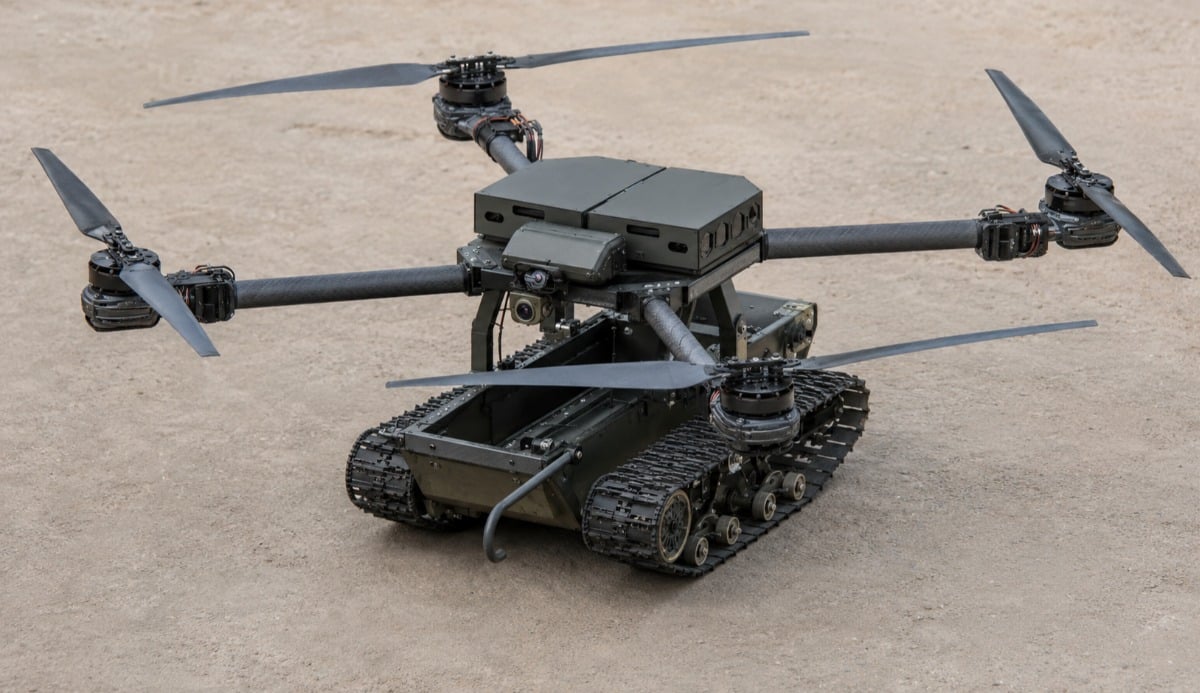
The concept of a miniature tracked vehicle launching its own aerial eye in the sky might sound like a plot point from a futuristic video game. But it's exactly what just popped up in a newly published Russian patent. The blueprint outlines a small robot tank that carries, launches, and automatically recovers a quadcopter drone directly from its own chassis.
If you look at the reality of modern trench warfare, it makes perfect sense why engineers are drawing up these designs. Ground robots, often called Unmanned Ground Vehicles (UGVs), face a massive problem. When you're sitting only a few feet off the ground, your vision is terrible. You can't see over hills, you can't see behind walls, and you definitely can't spot an enemy soldier waiting around the corner with a rocket launcher. By giving a ground robot its own personal drone, you instantly fix that blind spot.
Let's break down how this patented system actually works and look at the real engineering challenges behind it.
The Mechanical Details of Russia's Drone Carrying UGV
The patent shows a relatively compact, tracked platform designed to navigate rough terrain. What makes it unique isn't the tracks or the electric motors; it's the automated docking station built into the top deck.
The system relies on a mechanical launcher that acts as both a garage and a helipad. When the ground robot encounters a blind spot or needs to scout a path forward, it opens a protective hatch and releases a small quadcopter. This drone isn't just flying blindly. It connects to the ground vehicle's main processing unit to relay real-time video, mapping data, and targeting coordinates back to the human operator or the tank's internal computer.
What happens when the drone runs low on battery? That's where the clever part comes in. The patent outlines an automated recovery sequence. The quadcopter uses a mix of visual sensors and local signals to align itself perfectly over the moving or stationary UGV. It descends onto the docking platform, locks into place, and immediately starts recharging its battery from the ground vehicle's larger power reserve.
The Battle Against Signal Jamming
The biggest hurdle for any modern military drone is electronic warfare. If an enemy turns on a high-powered jammer, the radio link between the drone and the controller snaps, turning a sophisticated piece of tech into a useless brick.
Russia's new patent addresses this by creating a highly localized ecosystem. The aerial drone doesn't need to broadcast a massive signal back to a base station miles away. It only needs to talk to the robot tank sitting directly underneath it.
Furthermore, earlier Russian UGV experiments, like the Marker robot, utilized tethered options where the drone stayed physically connected to the tank via a power and data cable. While a physical wire limits how high or far the drone can fly, it makes the communication link 100% immune to electronic jamming. It also means the drone can hover indefinitely because it's sucking power directly from the tank's main generator. Whether this new patent relies on a thin physical wire or a localized short-range wireless frequency, the goal remains identical: keep the system operational when electronic warfare units are actively frying the airwaves.
Why Building This Is Harder Than It Looks
Patents are easy to write, but building rugged military hardware that actually works in mud, snow, and rain is a nightmare. Russia has a rocky history when it comes to autonomous ground armor.
Remember the Uran-9? It was hyped up as a heavily armed combat robot ready to revolutionize the front lines. When tested under real combat conditions in Syria, it failed spectacularly. The radio signal constantly dropped whenever the vehicle went behind buildings, the suspension kept breaking, and the automated targeting systems couldn't reliably identify threats.
This new drone-carrying mini-tank faces similar hurdles:
- Mud and Debris: A landing pad covered in battlefield mud or wet snow can easily disrupt the charging pins or jam the mechanical locking arms.
- Sensor Blindness: Dust kicked up by the tank's tracks can blind the tiny cameras the drone uses to guide itself back to the landing dock.
- Weight vs Power: Carrying a full docking mechanism, a heavy battery bank, and an aerial drone adds weight to a small tracked vehicle, which reduces its overall range and speed.
What This Means For The Future Of Land Warfare
Don't expect to see swarms of these automated robot tanks rolling across the landscape tomorrow morning. A patent is simply a legal stake in the ground, a declaration that an engineering team figured out a specific way to solve a problem.
What this patent does prove is that military designers realize that standalone ground robots are too blind to survive on their own. The future of mechanized scouting isn't just a bigger tank or a faster drone. It's a hybrid system where ground units and aerial units function as a single, interconnected team.
If you want to track how these technologies evolve from paper concepts into real metal, keep an eye on international patent registries and field test videos emerging from defense exhibitions. The real test won't be how well the system looks in a digital rendering, but how it handles a field full of thick mud and heavy electronic interference.