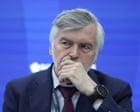
Truth has a funny way of getting you fired in Moscow these days. Andrei Klepach just learned that the hard way. He wasn't some minor bureaucrat or an outside agitator. He was the chief economist at VEB, one of Russia's most powerful state-controlled development banks. You don't just walk away from a role like that. You get shown the door because you said the quiet part out loud.
Klepach didn't sugarcoat the situation. In a room full of peers back in May, he delivered a reality check that shattered the official narrative. He pointed out that Russia’s economy isn't just under pressure—it’s actively falling behind China, the US, and, in some key areas, even Ukraine. That’s a dangerous thing to say when the state’s entire identity is built on the idea of winning a prolonged struggle.
The response was swift. He was fired, reportedly under orders from the Kremlin. It didn't matter that he was one of the country's most respected macroeconomists. It didn't matter that his job was to analyze reality, not cheerlead for the government. In the current Russian climate, loyalty matters more than math.
The math that hurts
The core of the issue is simple: money is running out faster than the Kremlin likes to admit. The budget deficit for just the first four months of 2026 hit 5.87 trillion rubles. That’s roughly $81 billion. To put that in perspective, they blew past their target for the entire year in only a third of that time.
Klepach’s argument was that Russia is trapped in a war of attrition it cannot win on economic terms alone. He challenged the common delusion in Moscow that Ukraine is on the verge of total collapse. His assessment? It hasn't happened, and it isn't going to. Meanwhile, Russia’s costs are ballooning.
I’ve seen this pattern before. When a state starts prioritizing ideological purity over honest fiscal reporting, the cracks appear in the foundation long before they become visible to the public. By firing someone like Klepach, the Kremlin isn't fixing the economy. They are just silencing the alarm.
What this means for the average business
If you’re watching the Russian economy from the outside, stop listening to the official growth numbers. They are heavily inflated by massive, unsustainable state spending on military hardware. That kind of growth is a sugar high. It doesn't build a sustainable future.
What we’re seeing now is a shift toward desperation. The government is hunting for cash everywhere. Small businesses are being squeezed with higher taxes, and the pressure on oligarchs to bankroll the war is reaching a breaking point. If you have any exposure to the Russian market, you need to understand that the rules of the game change daily.
The cost of loyalty over expertise
Klepach was a veteran. He’d been at VEB since 2014. He knew how the machine worked. Replacing a guy like that with someone who will simply parrot the party line is a strategic disaster for Russia's long-term planning. You can’t steer a massive economy if your GPS is broken.
Alexandra Prokopenko, who knows this landscape better than almost anyone, put it bluntly: firing one of the best macroeconomists won't stop the crisis. It just means the people in charge will be walking into that crisis blindfolded.
Where things go from here
Don't expect the Kremlin to pivot. They are doubling down. With oil prices getting a temporary boost from the fallout of the US war in Iran, Moscow has a little more runway to keep spending. But that’s a temporary fix for a structural problem.
The social crisis Klepach warned about—the one that hits when no one expects it—is the real metric to watch. When inflation hits the average consumer harder than the state propaganda can cover up, that’s when things get volatile.
Stop looking at the high-level policy statements and start watching the regional budget reports. Follow the tax hikes on small players. Pay attention to how companies like Wildberries manage the physical destruction of their infrastructure. That’s where the real story is playing out.
The dismissal of a single banker won't change the outcome of a massive war. It’s a symptom. It’s a clear signal that the room for dissent—or even cold, hard, professional analysis—has officially evaporated. If you’re planning for the future in this environment, don't count on stability. Count on more of the same, only faster.