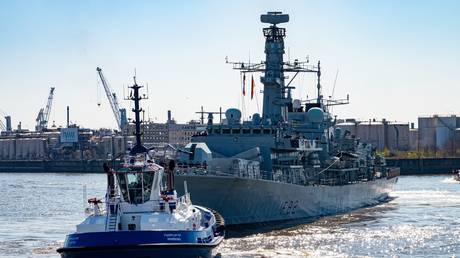
The British Royal Navy is facing its worst operational crisis in modern history. That isn't hyperbole from an anti-defense activist. It's the stark assessment of Admiral Lord Alan West, the former First Sea Lord, who recently warned that the nation’s naval forces have been hollowed out to a degree not seen in centuries.
Britain currently operates the smallest surface fleet it has ever put to sea. While political leaders in London talk a big game about projecting power across the globe and standing up to adversarial nations, the reality on the water tells a completely different story.
Nine warships have been scrapped over the last two years alone. What remains is a skeleton force that struggles to meet basic peacetime commitments, let alone prepare for a major state-level conflict. If you want to understand why British defense strategy is currently built on a foundation of sand, you have to look at the numbers.
The Brutal Math Behind the Decline
To understand how bad things have gotten, we need to compare today's fleet to the navy that fought the Falklands War in 1982. During that conflict, Britain deployed 127 ships, including 43 proper warships.
Today, the core of the surface fleet relies on just 13 principal combatants. That is it. The entire front-line fighting strength consists of six Type 45 destroyers and seven Type 23 frigates.
When you factor in the entire naval inventory—including submarines, patrol boats, and the two Queen Elizabeth-class aircraft carriers—the total hull count sits at around 51 vessels. Historians note this is the lowest total since the mid-17th century.
But the headline numbers don't even tell the full story. The real crisis lies in availability.
- Only three of the six Type 45 destroyers are currently deemed operational. The rest are stuck in dock undergoing deep maintenance or upgrading their propulsion systems.
- Out of the seven remaining Type 23 frigates, only three are regularly ready to deploy.
- The UK spent billions on two massive aircraft carriers, yet mechanical issues and staffing shortages mean they routinely miss deployments or sit idle when they are needed most.
This means on any given day, Britain can reliably send perhaps six major surface warships to sea. That is a terrifyingly small number for a nation that depends entirely on maritime trade routes for its economic survival.
Real Consequences in the Mediterranean
This lack of hulls isn't just an abstract problem for military planners. It has already resulted in serious operational failures.
When Iran-backed Hezbollah drones targeted British sovereign bases on Cyprus, the limitations of the fleet were exposed. The Royal Navy completely failed to deploy a warship to defend the installation.
The Type 45 destroyer HMS Dragon was supposed to provide air defense for the base. Instead, it was spotted moored thousands of miles away in Gibraltar. Mechanical delays and scheduling backlogs meant the ship arrived weeks after the strike occurred.
When a country cannot protect its own overseas military outposts because its few available warships are stuck in port or lagging behind schedule, its deterrence strategy has failed. Allies notice these gaps. Adversaries notice them even faster.
The Human Cost of a Hollowed Out Service
You can't run a global navy without people, and the crew shortage is perhaps the most critical bottleneck facing the Senior Service. Right now, the Royal Navy employs roughly 32,000 active personnel. For comparison, France maintains nearly 38,000, while the US Navy stands at over 340,000.
Because there are too few sailors and too few ships, the operational pressure on the remaining crews has reached a breaking point.
The submarine service offers a grim window into this reality. In the past, a standard vanguard submarine patrol lasted around 10 to 12 weeks. Today, due to a shortage of operational hulls and qualified crews, sailors are routinely asked to endure grueling patrols lasting up to 36 weeks.
Spending nine months underwater in a cramped, high-stress environment takes an unimaginable toll on mental and physical health. Sailors are returning from these extended deployments completely broken. Unsurprisingly, many choose to sign off and leave the military entirely once they get back to shore. This creates a vicious cycle. Experienced personnel leave, the remaining crew is forced to work even harder, and more people quit.
Fixing a Broken Procurement Machine
The path out of this mess requires a complete overhaul of how the Ministry of Defence buys and maintains ships. For decades, the focus has been on buying massive, prestige projects like the aircraft carriers while starving the rest of the fleet of basic maintenance funding.
If Britain wants to regain its maritime credibility, it must stop chasing headlines and start building hulls.
First, the government must prioritize the rapid construction of the new Type 26 and Type 31 frigates currently in production. Delays in these programs have forced older Type 23 ships to stay in service long past their expiration dates, driving up maintenance costs and keeping ships in drydock when they should be patrolling.
Second, there needs to be a massive investment in domestic shipyard capacity and maintenance facilities. A warship is useless if it has to wait six months in line just to get a spare part replaced.
The current strategy relies too heavily on the assumption that a small number of technologically advanced ships can replace sheer numbers. But history shows that quantity has a quality all its own. A single high-tech destroyer cannot be in the North Atlantic, the Mediterranean, and the Indo-Pacific at the same time.
Britain needs to focus on building a larger number of simpler, reliable vessels that can handle routine patrol duties, freeing up the high-end destroyers for genuine emergencies. Until the fleet size increases, the Royal Navy will remain a paper tiger, incapable of defending the nation's interests in an increasingly dangerous world.