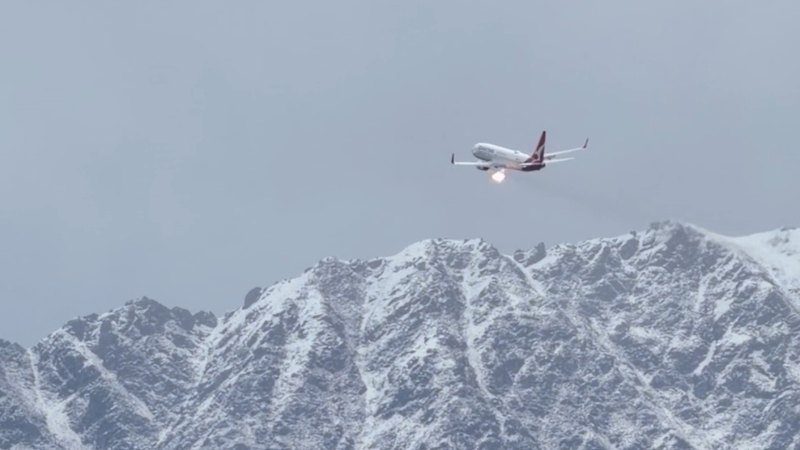
Planes turn around all the time. But when it's a Qantas flight over New Zealand airspace, people pay attention.
A Qantas flight traveling from Queenstown to Sydney had to divert to Christchurch following a suspected engine issue. If you've ever tracked a flight mid-air and watched the path suddenly hook toward the nearest tarmac, you know the immediate spike of anxiety passengers feel.
Let's look at what actually goes down during an incident like this, why airlines handle diversions the way they do, and what you need to know about modern commercial aircraft safety protocols.
The Queenstown to Sydney Route and Why Diversions Happen
Queenstown Airport is notorious among pilots. It's surrounded by steep, dramatic mountains and features challenging weather patterns that demand strict technical precision. When a flight leaves Queenstown heading across the Tasman Sea toward Sydney, flight crews run through extensive safety checks constantly.
If a pilot suspects an engine anomaly, they don't gamble. They divert. Christchurch International Airport serves as a major diversion hub in the region for a good reason. It has long runways, exceptional maintenance facilities, and emergency infrastructure ready to support wide-body and narrow-body commercial jets alike.
Standard operating procedure for a suspected engine issue involves powering down the affected engine if necessary and flying safely on the remaining powerplant. Modern twin-engine jets are engineered to fly and land securely on a single engine.
How Commercial Aviation Protocols Protect Passengers
You might wonder how pilots decide where to go during an emergency. It's not a guessing game. Aviation authorities enforce strict safety baselines.
- Redundancy: Aircraft systems feature backups for almost everything. Dual engines mean losing one doesn't spell catastrophe.
- Diversion Airports: Flight plans map out potential safe havens along the entire route before the wheels even leave the ground.
- Crew Training: Pilots spend hundreds of hours in flight simulators practicing engine-out scenarios until reactions become second nature.
When an alert lights up in the cockpit, the flight deck crew initiates a checklist. Communication with air traffic control happens fast. Passengers might notice a change in engine pitch, a sudden turn, or an announcement from the captain.
Transparency from the flight crew matters. Panic spreads fast in a confined cabin when passengers are left in the dark. Experienced captains will brief the cabin clearly, explaining that the diversion is precautionary.
What Passengers Should Expect On the Ground
Landing after a diversion isn't the end of the journey. It's the beginning of a logistical puzzle for the airline.
Once the plane touches down safely in Christchurch, airport emergency services typically escort the aircraft to a secure stand as a precaution. Passengers usually disembark normally once engineers clear the aircraft or buses arrive to take everyone to the terminal.
Airlines face massive scheduling hurdles after unexpected stops. Ground crew members have to arrange hotel accommodations if replacement aircraft aren't available immediately. Alternatively, they source engineering teams to inspect the engine cowl, run diagnostics, and clear the jet to resume service.
If you're ever on a flight that diverts, keep your seatbelt fastened, follow crew instructions, and remember that safety protocols exist precisely to keep unexpected mechanical hiccups from turning into major disasters.
Check flight status pages directly through your airline's app rather than relying on third-party aggregators for real-time updates during a schedule disruption.