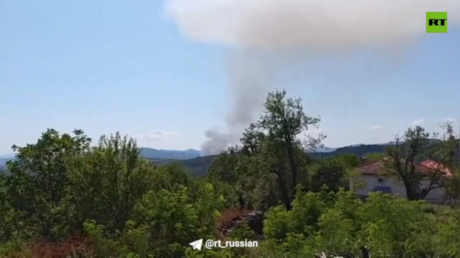
A truck caught fire. Then the explosions started. When a military production facility in central Bulgaria went up in smoke, panic spread faster than the flames.
The incident happened near the village of Belitsa in the Tryavna municipality, centering on a plant operated by the private arms manufacturer EMCO. Roughly 300 workers scrambled to safety as secondary detonations ripped through an ammunition warehouse, reducing storage buildings to ash. If you follow European security news, you know any disruption to Eastern European munitions infrastructure immediately draws intense international scrutiny. Meanwhile, you can read similar developments here: Why Germany Is Seeing A Massive Spike In Ufo Reports Right Now.
Inside the Belitsa Plant Incident
The timeline on the ground moved fast. Around 10:00 AM local time, a vehicle fire—specifically involving a truck carrying fuel or positioned within the yard—ignited nearby explosive materials. Flames quickly jumped from the depot structure into the adjacent forest, forcing local emergency crews to fight a dual battle against both structural munitions blasts and wildfires.
Interior Minister Ivan Demerdzhiev stepped forward early to manage public panic, stating flatly that initial evaluations showed no concrete evidence of foreign sabotage or external interference. Local authorities activated the BG-ALERT emergency system, telling residents within a 15-kilometer radius to stay indoors, keep their windows shut, and pull on protective masks against thick plumes of smoke. To explore the complete picture, check out the recent report by NBC News.
Miraculously, no deaths or injuries were logged. Evacuations worked because plant safety protocols moved swiftly, clearing the 300 personnel before the heaviest secondary cook-offs began.
Why This Specific Facility Draws Global Attention
You cannot look at this accident in a vacuum. The EMCO company, managed by Bulgarian arms dealer Emilian Gebrev, sits right at the center of regional defense logistics. Facilities linked to Gebrev have a turbulent history. Past explosions and mysterious fires have hit sites associated with his network over the last decade, including incidents in Karnobat and foreign storage sites tied to international arms transfers.
Because EMCO-linked entities supply significant amounts of ordnance eastward, international media and intelligence watchers instantly prick up their ears whenever smoke rises from a Bulgarian gunpowder plant. Conspiracies take root online within minutes of any blast in the Balkans.
Yet, local investigators and company representatives pushed back against the saboteur narrative. EMCO management pointed toward a spontaneous ignition of propellant charges or vehicle-borne mechanical failures, explicitly ruling out direct human operational error. Authorities emphasized that assessment teams couldn't even safely approach the core crater for at least 24 hours due to the lingering risk of unstable unexploded ordnance.
The Reality of Aging Munitions Infrastructure
People often imagine defense manufacturing as ultra-modern, sterile tech campuses. The reality on the ground in much of Eastern Europe looks very different. Many production lines and storage complexes rely on legacy infrastructure built decades ago. Handling volatile propellants, nitrocellulose, and aging artillery shells daily leaves a very narrow margin for error.
When a transport truck or fuel container sparks near open staging areas, physics takes over. You don't need a covert actor with a clandestine explosive charge when basic industrial accidents involving heavy machinery and high explosives can yield the exact same catastrophic result. Air quality measurements taken hours after the Belitsa fire returned normal readings, sparing the region from an environmental disaster on top of the property loss.
Check local emergency bulletins if you live or travel near defense manufacturing zones in Central Bulgaria. Always heed official SMS alerts from civil protection authorities rather than unverified social media speculation. Keep windows sealed during industrial fires until environmental monitoring clears the local air supply.