In July 1962, the United States military strapped a 1.4-megaton thermonuclear warhead onto a Thor rocket and shot it 250 miles above the Pacific Ocean. Then they blew it up. This wasn't a secret test tucked away in some hidden desert. It was highly publicized, and people in Hawaii watched from their beach chairs as the night sky flashed bright white and then bled into an artificial, eerie blood-red hue.
The project was called Starfish Prime.
If you look up why the US exploded a nuclear bomb in space, you usually get a sanitized answer about basic scientific curiosity during the Cold War. That is only half the story. The real driving force was panic mixed with strategic hubris. The military wanted to see if they could use an artificial radiation belt to fry the electronics of incoming Soviet intercontinental ballistic missiles. They also wanted to know if a high-altitude blast could blind Soviet radar networks. They got their answers, but they also accidentally crippled their own tech, knocked out infrastructure nearly a thousand miles away, and permanently changed how the world treated outer space.
Why the military sent a nuclear bomb into space
By the early 1960s, the Cold War was hitting a boiling point. The Soviet Union had just shattered a nuclear testing moratorium. In response, the US launched Operation Dominic, a massive series of atmospheric tests. Tucked inside this operation was a sub-series called Operation Fishbowl, entirely dedicated to high-altitude explosions.
The military planners weren't just guessing in the dark, but their models were completely inadequate. Renowned physicist James Van Allen had recently discovered the natural radiation belts surrounding Earth, which now bear his name. The US military thought they could add a temporary layer to these belts by injecting high-energy fission electrons straight into the magnetosphere.
They hoped this artificial shield would neutralize any incoming Soviet nuclear threat before it hit American soil. They also desperately needed to know how their own military communications would handle the atmospheric ionization.
The night Honolulu turned orange
The launch happened on July 9, 1962, from Johnston Atoll, a tiny speck of land about 900 miles southwest of Hawaii. A previous attempt in June had ended in a spectacular disaster when the Thor rocket suffered an engine failure, forcing the range safety officer to blow it up mid-air and rain radioactive debris back down on the island. The second attempt went perfectly.
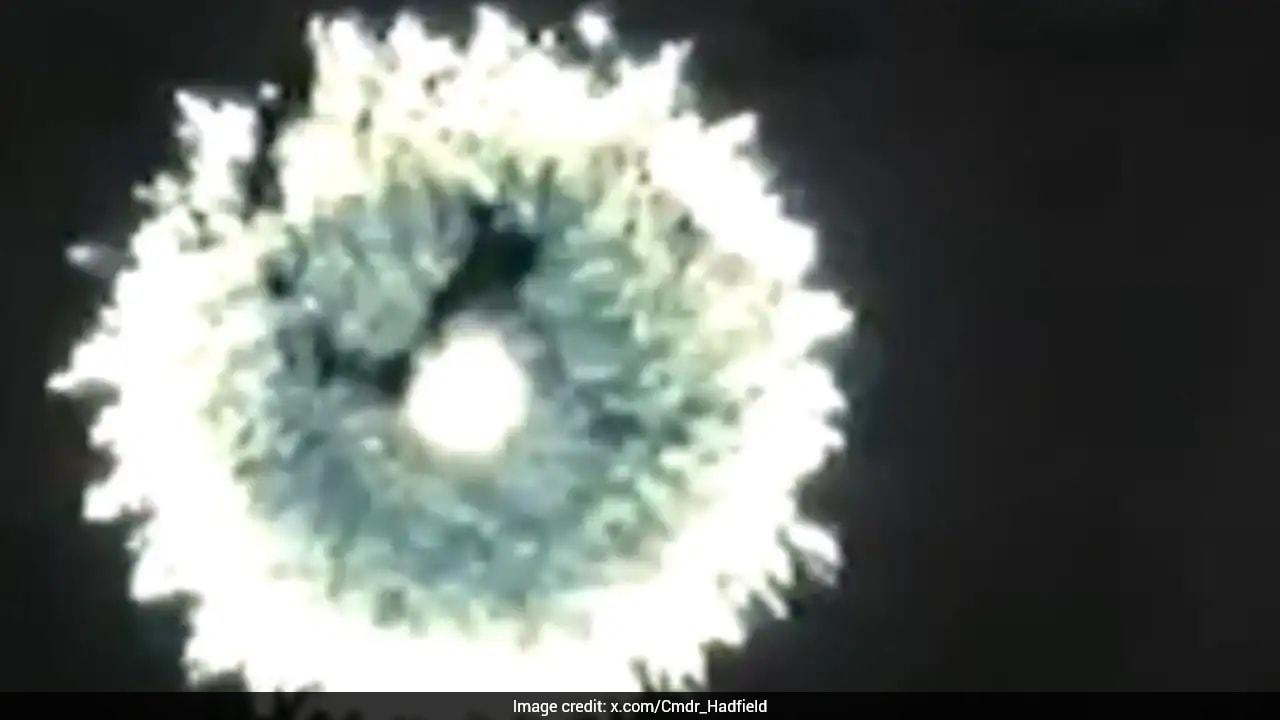
When the bomb detonated at an altitude of 250 miles, the physical reaction was nothing like an explosion on the ground. There is no air in space. Without an atmosphere, you don't get the iconic mushroom cloud or a crushing shockwave. Instead, you get a blinding, spherical release of pure energy and light.
People sitting on beaches in Honolulu saw a brilliant white flash that illuminated the ocean like the midday sun. Within seconds, that white ball expanded into a green, irradiated sphere. As the high-energy electrons collided with oxygen particles in the upper atmosphere, the sky transformed. A massive, synthetic aurora borealis painted the tropical sky in deep shades of magenta and burning red. The display was visible for over a thousand miles, stretching across the equator all the way down to New Zealand.
But the light show was just the visual side effect of a much more destructive invisible force.
The collateral damage in low Earth orbit
The engineers knew the blast would create an electromagnetic pulse, or EMP. They just didn't realize how massive it would be. The pulse from Starfish Prime completely blew past their instruments, driving the measuring needles right off the scales.
In Hawaii, the consequences were immediate. The EMP tripped burglar alarms all over Oahu, knocked out a telephone microwave link, and extinguished roughly 300 streetlights. While the ground disruption was relatively minor because electronic infrastructure in 1962 was still heavily reliant on rugged vacuum tubes, the story in space was catastrophic.
The explosion injected a staggering number of energetic electrons into Earth's magnetic field. Instead of dissipating harmlessly over a few days, these particles got trapped, creating a fierce, highly radioactive belt that lingered for years.
This artificial radiation zone turned into a minefield for early space technology. Telstar 1, the world’s first commercial relay satellite designed to broadcast television across the Atlantic, was launched just a day after the blast. It was quickly cooked by the trapped radiation and failed within months. Ariel 1, the United Kingdom's very first satellite, suffered a similar fate when its solar panels were systematically destroyed by the lingering electrons. In total, the radioactive aftermath of Starfish Prime knocked out about a third of all satellites operating in low Earth orbit at the time.
Moving forward from the brink
The sheer unpredictability of the Starfish Prime test chilled both Washington and Moscow. Scientists quickly realized that if a single 1.4-megaton blast could accidentally blind a third of the world's satellites and disrupt ground grids from hundreds of miles away, an actual high-altitude nuclear war would completely destroy the global upper atmosphere.
It forced a rare moment of sanity during the Cold War. Just over a year later, in August 1963, the United States, Great Britain, and the Soviet Union signed the Limited Test Ban Treaty, which banned all nuclear detonations in the atmosphere, underwater, and in outer space. This was later reinforced by the 1967 Outer Space Treaty, ensuring that space remained a weapons-free zone.
If you want to understand the real legacy of Starfish Prime, look at your smartphone. Today's microchips and digital infrastructure are infinitely more sensitive to electromagnetic disruption than the electrical grids of 1962. A similar detonation today would completely wipe out modern GPS constellations, destroy weather tracking networks, and instantly fry thousands of commercial satellites, plunging our hyper-connected world into absolute chaos.
To keep exploring this piece of history, look up the unclassified declassified films of Operation Fishbowl or read the personal memoirs of Glenn Seaborg, the Chairman of the Atomic Energy Commission during the test, who openly detailed how the results defied every single official prediction.