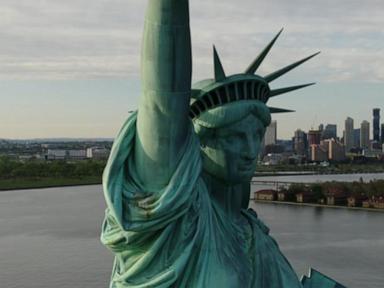
You think you know her story. She stands in New York Harbor, a massive green sentinel welcoming tired immigrants to America's shores. You probably assume she was always meant to be a beacon for the huddled masses. You might think the French just handed her over out of pure, unselfish love for American democracy.
Almost everything about that romanticized version of history is slightly off.
The real story of the Statue of Liberty isn't a neat tale of international friendship. It's a messy saga of French political maneuvering, radical anti-slavery activism, massive crowdfunding failures, and an engineering crisis that almost left 350 copper puzzle pieces rotting in wooden crates on an island in New York. If you want to understand what this icon actually stands for, you have to look past the postcard image and look at the gritty, dramatic reality of how she got here.
The Radical Abolitionist Roots We Forgot
Let's start with the origin. The statue didn't begin as a generic celebration of American independence. The idea sparked at a dinner party in 1865 at a country estate near Versailles. The host was Édouard René de Laboulaye. He wasn't just a fan of America; he was the president of the French Anti-Slavery Society and a prominent scholar of the U.S. Constitution.
The timing mattered immensely. The American Civil War had just ended. The Union had won, Abraham Lincoln had been assassinated, and the 13th Amendment had abolished slavery. Laboulaye and his fellow French liberals were ecstatic about the destruction of slavery. They saw it as the ultimate proof that a democratic republic could survive its darkest trials and live up to its foundational promises.
Laboulaye wasn't just looking at America. He was playing a clever game of chess with his own government. France was living under the authoritarian regime of Emperor Napoleon III. By proposing a massive monument to American liberty, Laboulaye found a way to praise democracy without getting thrown in prison by the French emperor. He wanted to hold up a giant mirror to the French public, showing them what a free society looked like so they might demand the same freedom at home.
He turned to his friend, a young, ambitious sculptor named Frédéric-Auguste Bartholdi. Bartholdi had a thing for the colossal. He had already tried and failed to convince the ruler of Egypt to fund a massive statue of a robed peasant woman holding a torch over the newly opened Suez Canal. When that project fell through, Bartholdi took his grand sketches, repurposed the design, and shifted his focus to New York.
If you look closely at Lady Liberty's feet today, you'll see the most significant clue to this history. She isn't just standing there. She is actively stepping forward, her left foot lifting off the ground. Beneath her robes lie broken shackles and chains. Most visitors miss them completely because they're hidden from the ground, but those chains were explicitly put there to celebrate the abolition of slavery and the end of the Civil War.
The Crowdfunding Nightmare on Both Sides of the Atlantic
The popular myth says the French government gifted the statue to the American government. That's completely false. Neither government wanted to pay for it.
Instead, the project became one of the first major international crowdfunding campaigns in human history. The deal was simple. France would pay for the statue itself, and America would pay for the massive granite pedestal it stood on.
Raising the money in France took over a decade. Laboulaye formed the Franco-American Union to drum up donations. They organized charity banquets, put on special theatrical performances, and even ran a national lottery. Wealthy elites chipped in, but a huge portion of the money came from ordinary French citizens, including school children and factory workers who saved up copper coins. Bartholdi started construction before the full budget was secure, using public exhibitions of the statue's completed parts to keep the cash flowing.
If the French campaign was difficult, the American campaign was a downright disaster.
When Bartholdi arrived in New York to scout locations, he immediately fell in love with Bedloe's Island. It was a tiny piece of land in the middle of the harbor, meaning every single ship entering the gateway to the New World would have to pass it. It was the perfect stage.
The American public didn't care.
Outside of New York, people viewed the statue as a New York project. Politicians in Washington refused to allocate federal funds for it. Citizens in Boston, Philadelphia, and Chicago openly mocked the idea of sending hard-earned money to build a "New York lighthouse." Even rich New Yorkers turned up their noses. By 1885, the statue was fully built, disassembled into 350 pieces, packed into 214 wooden crates, and sitting on a French ship in New York Harbor.
The pedestal was barely started. The American committee was completely broke.
How Joseph Pulitzer Saved the Day with Trash Journalism
Enter Joseph Pulitzer, a Hungarian immigrant who owned a newspaper called The New York World. Pulitzer realized that the failure to build the pedestal was a national embarrassment. He also realized he could use the crisis to sell a massive number of newspapers.
Pulitzer launched a brilliant, aggressive marketing blitz. He printed scathing editorials blasting the rich for refusing to open their wallets, and he criticized the working class for letting a gift from France sit in crates.
Then came his stroke of genius. He promised to print the name of every single person who donated to the pedestal fund in the pages of The New York World, no matter how small the donation.
The response was staggering. Pennies, nickels, and dimes flooded into the newspaper offices from across the country. Children sent in money they had saved for the circus. Women sent in cash they had earned from selling baked goods. A total of more than 120,000 people donated through Pulitzer's campaign. The average donation was less than one dollar.
Pulitzer raised over $100,000 in five months, cementing the final funding needed to build Richard Morris Hunt's massive granite pedestal. Without a sensationalist newspaperman utilizing public shaming and the promise of a tiny bit of fame, the Statue of Liberty might have been shipped right back to France.
The Secret Eiffel Engineering That Keeps Her Standing
We talk about Bartholdi because he designed the art, but the statue would have collapsed into New York Harbor within a week if not for Alexandre-Gustave Eiffel.
Originally, Bartholdi hired an architect named Eugène Viollet-le-Duc to figure out how to make a 151-foot copper statue stand up against the brutal Atlantic winds. Viollet-le-Duc's plan was to fill the inside of the statue with heavy brickwork. When he died unexpectedly in 1879, Bartholdi brought in Eiffel. This was years before Eiffel would build his famous tower in Paris.
Eiffel threw out the brick plan immediately. He knew that a rigid, heavy structure would crack and fail under the pressure of severe harbor storms.
Instead, Eiffel designed a brilliant, lightweight skeletal system. He built a massive central iron pylon, wrapped it in a flexible skeletal framework, and attached the copper skin using flexible iron flat bars called "armatures."
The copper exterior of the statue is incredibly thin, just 2.4 millimeters, which is roughly the thickness of two pennies stacked together. Eiffel's flexible interior structure allows that thin copper skin to move independently from the core. When high winds hit the harbor, the statue doesn't resist the pressure by staying completely rigid. She sways. The body can sway up to three inches, and the torch can sway up to six inches.
Eiffel essentially invented the concept of modern curtain-wall construction, a structural engineering method used to build skyscrapers today.
The Myth of the Green Color and the Altered Torch
When the Statue of Liberty was officially unveiled on October 28, 1886, she didn't look anything like she does now. She wasn't green. She was the bright, metallic color of a fresh copper penny.
For the first few decades, the statue slowly transformed. The salty air, rain, and pollution of New York Harbor caused the copper to oxidize. By 1906, the brilliant penny color had been entirely replaced by a pale green patina.
Government officials were initially horrified. They thought the green coating meant the statue was rotting away, and Congress actually allocated money to paint the entire monument. The public rebelled against the idea, and scientists stepped in to explain that the patina was actually a protective layer that shielded the underlying copper from further corrosion. The paint plan was dropped, saving her signature look.
The torch has gone through an even more radical transformation. Bartholdi's original design featured a solid copper flame covered in gold leaf so it would catch the sun during the day.
Shortly before the dedication, engineers decided they wanted to light the torch from the inside so it could function as a real lighthouse. They cut rows of windows into the copper flame to let light shine through. It didn't work well; the light was barely visible from a distance.
Over the decades, subsequent caretakers kept messing with the design. In 1916, an architect cut away 250 pieces of the original copper and replaced them with amber-colored cathedral glass. This modification let rain leak inside the structure, rotting the iron skeleton over the next seventy years.
During the massive restoration project in the 1980s, engineers realized the original torch was too damaged to save. They removed it completely and replaced it with an exact replica of Bartholdi's original vision, a solid copper flame covered in 24-karat gold leaf. You can still see the damaged, glass-paneled original torch on display inside the Statue of Liberty Museum on the island today.
The Accidental Evolution of Her Meaning
The most fascinating part of the statue's history is how her meaning shifted completely over time.
Laboulaye and Bartholdi never intended for her to be a symbol of immigration. They named her Liberty Enlightening the World. She was supposed to face outward, projecting the light of democratic liberty back across the ocean to the oppressed peoples of Europe.
That original intent changed because of a poet named Emma Lazarus. In 1883, she was asked to write a poem for an art auction raised to fund the pedestal. Lazarus, who worked with refugees fleeing anti-Semitic pogroms in Eastern Europe, wrote a sonnet called The New Colossus.
She completely reframed what the statue stood for. Lazarus wrote that this giant woman wasn't just a symbol of power, but a "Mother of Exiles" who cried out with silent lips: "Give me your tired, your poor, your huddled masses yearning to breathe free."
The poem was largely forgotten after the auction. But as millions of European immigrants streamed past Bedloe's Island on their way to the processing center at Ellis Island, they looked up at the statue and saw exactly what Lazarus had described. She became the first physical sign of hope in their new lives.
In 1903, a friend of Lazarus successfully campaigned to have a bronze plaque containing the poem mounted inside the statue's pedestal. That single plaque permanently overwrote the original intent of the creators, turning a monument about political theory and abolition into a universal symbol of human refuge.
What to Do Before You Buy a Ticket
If you're planning to visit the statue yourself, don't just book the first boat tour you see online. A lot of private tour companies use deceptive marketing to trick tourists into buying expensive tickets for boats that just circle the island without actually letting you step foot on it.
Here is exactly how to handle it:
- Book through the official concessioner. Statue City Cruises is the only ferry service authorized by the National Park Service to bring visitors to Liberty Island and Ellis Island. Don't buy tickets from vendors on the streets around Battery Park.
- Decide on your access level early. General admission gets you onto both islands and into the museums. If you want to go inside the pedestal or climb the 162 narrow steps up to the crown, you must book those specific tickets months in advance, as they sell out fast.
- Skip the lines by going early. The security screening at Battery Park in Manhattan or Liberty State Park in New Jersey can take over an hour during peak times. Catch the first ferry of the morning to beat the crowds and give yourself at least four to five hours to explore both islands thoroughly.