Ask any history buff when the Second World War started, and you will almost certainly get the same confident answer: September 1, 1939. That was the day Nazi Germany marched into Poland, triggering British and French declarations of war two days later. It is a neat, tidy date taught in every school textbook.
It is also wrong.
The conventional timeline treats the global conflict as a sudden explosion, ignoring the fact that the fuse had been burning fiercely for years. If you want to understand the actual opening act of the Second World War, you have to look exactly 90 years ago today. On July 17, 1936, a right-wing military coup erupted in Spain against the democratically elected Second Spanish Republic. What followed was not just a localized conflict; it was the true ideological and military flashpoint where the major global powers first drew blood.
The Spanish Civil War was the real beginning of the Second World War. This is not revisionist history for the sake of being provocative. It is a reality backed up by the sheer scale of foreign intervention, the testing of terrifying new military doctrines, and a series of shocking diplomatic betrayals that directly set the stage for the devastation of the 1940s.
The London Flight That Handed Franco to Hitler
Every major historical catastrophe has its weird, understated turning points. For the Spanish Civil War, it happened at a now-forgotten airfield in South London.
In July 1936, General Francisco Franco was essentially exiled. The Republican government knew he was dangerous, so they stationed him out of the way in the Canary Islands to keep him from plotting with other mutinous generals. He was trapped, thousands of miles from the elite Spanish Army of Africa based in Morocco. He needed a lift.
Enter a British-registered de Havilland Dragon Rapide aircraft, chartered from Croydon Airport. Paid for by wealthy Spanish nationalists and organized with the help of British sympathizers, the plane flew Franco from the Canaries to Morocco.
For decades, this flight was treated as a bizarre footnote, a rogue exploit by a British pilot named Cecil Bebb. But recent historical research paints a far darker picture. Emerging evidence shows that the British Foreign Office and MI6 were almost certainly fully aware of this operation and chose to look the other way. Portugal, a staunch British ally, even provided refueling facilities for the flight.
Once Franco landed in Morocco, he took command of Spain’s most brutal, highly trained colonial troops. But they were still stuck on the wrong side of the Strait of Gibraltar. Franco did not have the navy to transport them across. He sent an urgent plea to Berlin. Adolf Hitler immediately saw an opportunity and sent Junkers Ju 52 transport planes.
This resulted in the first massive military airlift in global history. Nazi aircraft ferried thousands of Franco’s troops directly into southern Spain. Without that British plane getting Franco to Morocco, and without Hitler’s immediate aerial intervention, the coup might have fizzled out in days. Instead, it became a globalized nightmare.
A Brutal Weapons Lab for the Luftwaffe
You cannot separate the tactics used in World War II from the experiments conducted on Spanish soil. Hitler did not send aid to Franco out of pure generosity. He used Spain as a live-fire laboratory.
Germany deployed around 19,000 military personnel over the course of the conflict. This was primarily the Condor Legion, a specialized unit of the Luftwaffe, alongside tank crews and infantry instructors. Hermann Göring, the head of the Luftwaffe, openly admitted during his later trial at Nuremberg that he saw Spain as a perfect chance to test his young air force and give his pilots actual combat experience.
The results were horrific. Before the Blitz of London or the destruction of Warsaw, there was Guernica. On April 26, 1937, German and Italian bombers completely obliterated this defenseless Basque town, slaughtering hundreds of civilians. It was a deliberate experiment in terror bombing and carpet bombing, designed to see how civilians would react to total aerial annihilation.
It was not just the planes. The Germans tested their Messerschmitt Bf 109 fighters, their Heinkel bombers, and their lethal 88mm anti-aircraft guns, which later became the bane of Allied tanks in World War II. They perfected the "Rotte" and "Schwarm" flying formations—tactics that gave German pilots a massive tactical advantage during the Battle of Britain.
Benito Mussolini’s Italy went even further, sending roughly 80,000 troops, hundreds of aircraft, and dozens of submarines to aid the fascist rebellion. On the other side, the Soviet Union sent thousands of military advisors, tanks, and aircraft to support the Republic. The T-26 tanks sent by Moscow battled German Panzers across the Spanish countryside.
This was not a prelude to a world war. This was the world war, just contained within a single peninsula.
The Fear of Bolshevism and the Policy of Blindness
The biggest mistake people make when analyzing this era is assuming that Western democracies were just passive, helpless observers. They were not. Britain and France actively chose a policy of non-intervention that practically guaranteed Franco’s victory and emboldened Hitler.
Why did they do it? The answer boils down to deep-seated anti-communism and economic self-interest.
The British establishment, led by Prime Minister Stanley Baldwin and Foreign Secretary Anthony Eden, looked at the Spanish Republic and saw a dangerous mix of socialists, anarchists, and communists. They were terrified that a Republican victory would lead to a Soviet-style state in Western Europe. British businesses also had massive financial stakes in Spain, particularly in Rio Tinto’s iron mines. They believed Franco would protect their private property; they feared the left-wing Republic would nationalize it.
When the legitimate, democratically elected Spanish government begged Britain and France for the right to buy weapons to defend itself, the Western powers refused. They forced a strict arms embargo through a Non-Intervention Committee.
It was a total farce. While Britain and France strictly blocked aid to the Republic, Germany and Italy completely ignored the agreement and flooded Franco with high-tech weaponry. The British government knew this was happening. They chose to ignore it because they viewed fascism as a useful shield against the spread of communism.
This spineless diplomacy taught Hitler a dangerous lesson. It showed him that the Western democracies were so terrified of war, and so paranoid about the Soviet Union, that they would let fascist aggressors tear up international law without lifting a finger. The road to the Munich Agreement in 1938, and the eventual invasion of Poland in 1939, was paved by the cynical abandonment of Spain in 1936.
Blood and Idealism on the Iberian Front
While governments played cowardly diplomatic games, ordinary people around the world saw the crisis for exactly what it was: the definitive global showdown between democracy and fascism.
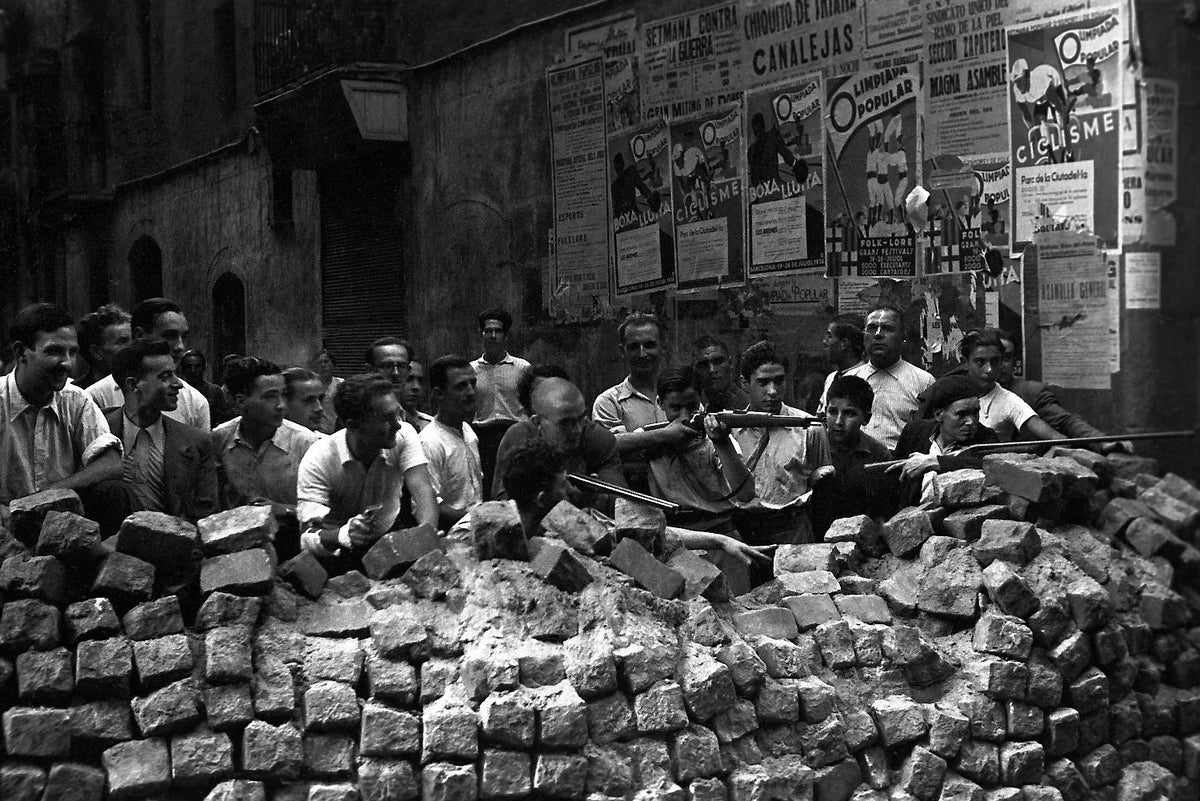
More than 30,000 foreign volunteers from over fifty countries bypassed their own governments' bans to travel to Spain and fight for the Republic. Organized as the International Brigades, these volunteers included factory workers, writers, intellectuals, and political exiles.
Among them were famous names like George Orwell and Ernest Hemingway, alongside thousands of regular citizens. Some of the first British volunteers to die fighting fascism in Spain were Jewish tailors from London’s East End, who knew exactly what a Nazi-backed regime meant for their future.
The war was incredibly brutal, claiming up to 900,000 lives. It was characterized by savage reprisals on both sides, though Franco’s forces carried out a systematic, organized campaign of terror designed to completely purge the country of leftist thought.
When the war ended in April 1939 with a Nationalist victory, the global chessboard was perfectly set. Five months later, the wider European theater officially ignited. The volunteers who had survived the Spanish battlefields returned home, only to be branded as dangerous subversives or "premature anti-fascists" by their own governments. Many were thrown into prison or watched by intelligence agencies, despite having been the very first people to take up arms against Hitler’s proxy forces.
How to Apply This History Right Now
If you want to move past the superficial textbook summaries and genuinely understand the roots of modern global conflicts, you need to shift your historical perspective. Here are the practical steps to rethink how global wars actually begin.
Look for the proxy conflicts. Major world wars rarely start when the first official declaration is signed. They start when major powers begin fighting each other through third parties in smaller nations. Pay attention to where weapons are being tested and where foreign militias are gathering.
Examine the diplomatic blind spots. History shows that appeasement and political inaction are just as influential as active aggression. When democracies abandon international law or democratically elected allies for the sake of short-term economic stability or political comfort, it always blows up in their faces later.
Stop treating September 1, 1939, as the hard starting line. For the people of Guernica, for the Jewish volunteers who died in the trenches outside Madrid, and for the families of the hundreds of thousands of Spaniards who perished, the Second World War did not start in Poland. It started right on their doorstep, exactly nine decades ago today.