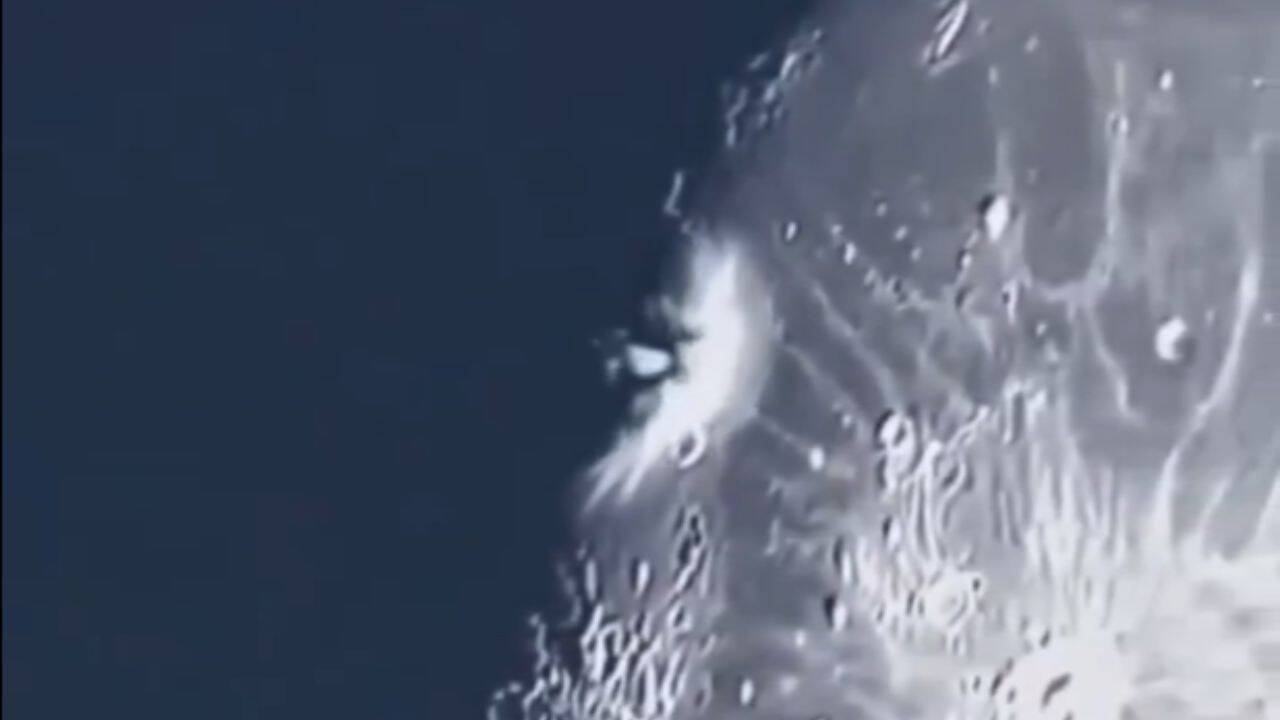
A four-ton hunk of space hardware just carved a massive hole into the lunar landscape.
A discarded SpaceX Falcon 9 upper stage smashed into the Moon near the Einstein Crater. Traveling at roughly 5,400 miles per hour—about seven times the speed of sound—the school-bus-sized metal cylinder hit with the kinetic energy of about three tons of TNT.
The internet is predictably losing its mind. Headlines scream about explosions, space debris crises, and accidental lunar impacts. But if you look past the panic, the reality of this event is far more fascinating and a lot less apocalyptic than you think.
The Physics of the Impact
Let's talk about what actually happened up there. This rocket stage originally launched in January of last year, carrying a pair of lunar landers on a high-energy trajectory. Once it finished its job, it drifted into deep space.
SpaceX didn't intentionally target the Moon. According to company representatives, they followed standard disposal protocols. However, over eighteen months, a chaotic cocktail of solar activity and gravitational tugs from the Sun, Earth, and Moon slowly altered its orbit.
When it hit the lunar surface at 8,700 kilometers per hour, it didn't just dent the dust. It triggered a massive kinetic explosion. Telescopes like the European Southern Observatory's Very Large Telescope watched closely. They caught spectral lines in the resulting dust plume, capturing distinct signatures of sodium and lithium gas. Scientists believe the sodium came from the churning of the lunar soil itself, while the lithium traces likely originated from the remnants of the rocket stage.
NASA estimates the crash carved out a crater roughly 60 feet wide and over 10 feet deep. Some independent projections suggest it could stretch up to 100 feet across.
Why Everyone Is Overreacting to Space Junk
People love a good space hazard story. The phrase "school-bus-sized debris" sounds terrifying. But context matters.
The Moon gets pelted by natural meteoroids on a daily basis. NASA data shows that space rocks carrying the exact same amount of kinetic energy as this rocket stage slam into the Moon roughly every six days. The lunar surface is a heavily scarred wasteland devoid of an atmosphere to burn things up. Another 60-foot crater changes nothing about the Moon's structural integrity.
This is only the second time in history that human-made debris has accidentally struck the lunar surface. The first happened back in 2022 when a Chinese rocket stage hit the far side. Contrast that with intentional impacts. NASA deliberately crashed empty Saturn V stages into the Moon during the Apollo program to gather seismic data, and did it again in 2009.
The collision poses zero threat to Earth. It happened a quarter of a million miles away.
The Real Silver Lining for Science
Instead of treating this solely as an embarrassing traffic accident in orbit, planetary scientists are treating it as an unexpected laboratory experiment.
Space agencies are already pivoting to make use of the wreckage. NASA's Lunar Reconnaissance Orbiter and South Korea's Pathfinder Lunar Orbiter are scheduled to image the impact site. By analyzing the fresh crater and the behavior of the ejecta in a low-gravity environment, researchers gain rare empirical data on hyper-velocity impacts.
We rarely get to watch a controlled—or in this case, semi-controlled—heavy impact on an airless body with modern spectroscopic instruments watching live. Planetary scientists get a clean look at how subsurface material reacts when blasted into a vacuum.
What Needs to Change Next
While the Earth is safe and the Moon doesn't mind the new hole, this event highlights a growing blind spot in aerospace engineering. As commercial spaceflight ramps up and nations plan permanent lunar bases under programs like Artemis, keeping track of high-energy orbital stages needs an upgrade.
Disposing of upper stages safely becomes much harder when deep-space solar weather shifts trajectories in unpredictable ways. Space agencies and private operators are already talking about tightening tracking protocols for cislunar space—the region between Earth and the Moon.
Don't panic about falling sky debris. Do expect tighter rules on how space companies clean up after themselves as we push deeper into the solar system.