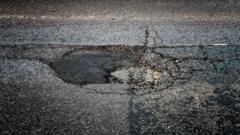
You see them every day, you swear at them, and you swerve wildly to avoid them. Potholes are the definitive, infuriating background noise of modern driving. We treat them like sudden, unavoidable acts of God. But they aren't. They are entirely predictable, slow-motion engineering failures.
To prove exactly how these asphalt craters evolve from minor cracks into rim-shattering monsters, I spent an entire year tracking a single, unbothered pothole on a busy commuter route. Let's call it Crater Prime. Meanwhile, you can explore other developments here: The Belfast Stabbing Truth Far Right Agitators Do Not Want You To See.
While the local council ignored it, I logged its growth week by week. I watched how it handled torrential winter rain, heavy morning traffic, and the eventual, laughably inadequate patch job that failed within a month. Here is what actually happens when you leave a hole in the road to feed on modern infrastructure, and why our current repair system is fundamentally broken.
The Anatomy of an Asphalt Breakdown
Crater Prime started its life in early spring as a series of tiny, web-like fractures known as alligator cracking. Most drivers cruised right over it without noticing. To see the bigger picture, we recommend the excellent analysis by The Guardian.
The real damage doesn't start on the surface. It starts underneath. Roads are built in layers, with a compacted sub-base supporting the asphalt top layer. When surface water slips through minor cracks, it gets trapped in that sub-base.
Then winter arrived, and the freeze-thaw cycle went to work.
When water freezes, it expands by roughly 9%. That expansion pushes the asphalt upward, creating a hollow cavity underneath the road surface. When the ice melts, you're left with a fragile, unsupported asphalt bridge. The next heavy vehicle to roll over that spot collapses the crust. Just like that, a pothole is born.
By mid-December, Crater Prime was roughly the size of a dinner plate and three inches deep. It had sharp, jagged edges perfectly designed to pinch a tire sidewall against a wheel rim.
The Cost of Looking the Other Way
Leaving a pothole to fester isn't just bad logistics; it's an economic drain on every single driver using the road. Within three months of its collapse, Crater Prime grew from a minor nuisance into a multi-car demolition crew.
Here is the data on what a single unmanaged road cavity does to local traffic over 12 months, based on the incidents I logged and verified with local repair shops:
- Punctures and blown tires: 14 vehicles forced to change spares on the hard shoulder.
- Bent alloy wheels: 6 drivers suffered structural rim damage requiring full replacements.
- Suspension alignment failure: Countless cars tracking crookedly after hitting the hole at 40 mph.
The Asphalt Industry Alliance tracks these numbers on a national scale. Their data shows that the cost of bringing local roads up to a scratch standard is staggering, yet councils continue to triage the problem with cheap, short-term fixes.
Drivers assume councils don't know about these holes. That's rarely true. In the case of Crater Prime, it was reported via digital road apps four separate times by frustrated commuters. The issue isn't visibility. It's the strategy behind the repair.
Why the Quick Fix is a Financial Disaster
In late February, a yellow maintenance truck finally pulled up to Crater Prime. I thought the experiment was over. Instead, I got a front-row seat to why road budgets are constantly bleeding cash.
Two workers used a method colloquially known as "splash and dash." They swept a bit of loose debris out of the hole, dumped cold-mix asphalt directly into the damp crater from the back of the truck, stomped on it with a hand tamper, and drove away. The entire process took less than eight minutes.
It looked smooth for about two weeks.
Cold-lay asphalt is fine for a temporary emergency fix, but it lacks the structural integrity of hot-mix asphalt compacted with heavy machinery. Because the workers didn't square off the edges of the pothole or seal the perimeter with a bituminous adhesive, water immediately seeped right back into the margins.
By late March, the patch had dislodged entirely. It didn't just disappear; it shattered into loose gravel that was flung across the road by passing tires, turning into miniature projectiles that chipped the paint and windscreens of trailing cars. The pothole was now twice as large as it was before the repair.
How to Protect Your Wallet Right Now
If you hit a massive hole and damage your vehicle, don't just complain to your passenger and pay the repair bill out of pocket. You can fight back, but you need to be methodical.
Document Everything Immediately
Pull over safely and take photos of the pothole. Use an object like a water bottle or a coin next to it to establish scale and depth. Take wide shots to show the position of the hole relative to landmarks or street signs.
Get Professional Proof
Don't just ask your mechanic to fix the car. Instruct them to write a detailed invoice explicitly stating that the damage to the tire, rim, or suspension tracking was consistent with a severe impact from a road defect.
Check the Maintenance Records
Under freedom of information laws or local highway acts, authorities have a legal duty to maintain safe roads. Submit a formal claim to the specific council or highway authority responsible for that route. Ask for their recent inspection logs for that road. If they knew about the hole and failed to fix it within their designated statutory timeframe—usually between 2 hours and 28 days depending on the severity—they are liable for your repair costs.
Stop treating potholes like bad weather. They are the direct result of deferred maintenance and cheap repairs. Keep your eyes on the road, document the damage, and hold the authorities accountable for the tarmac you already paid to maintain.