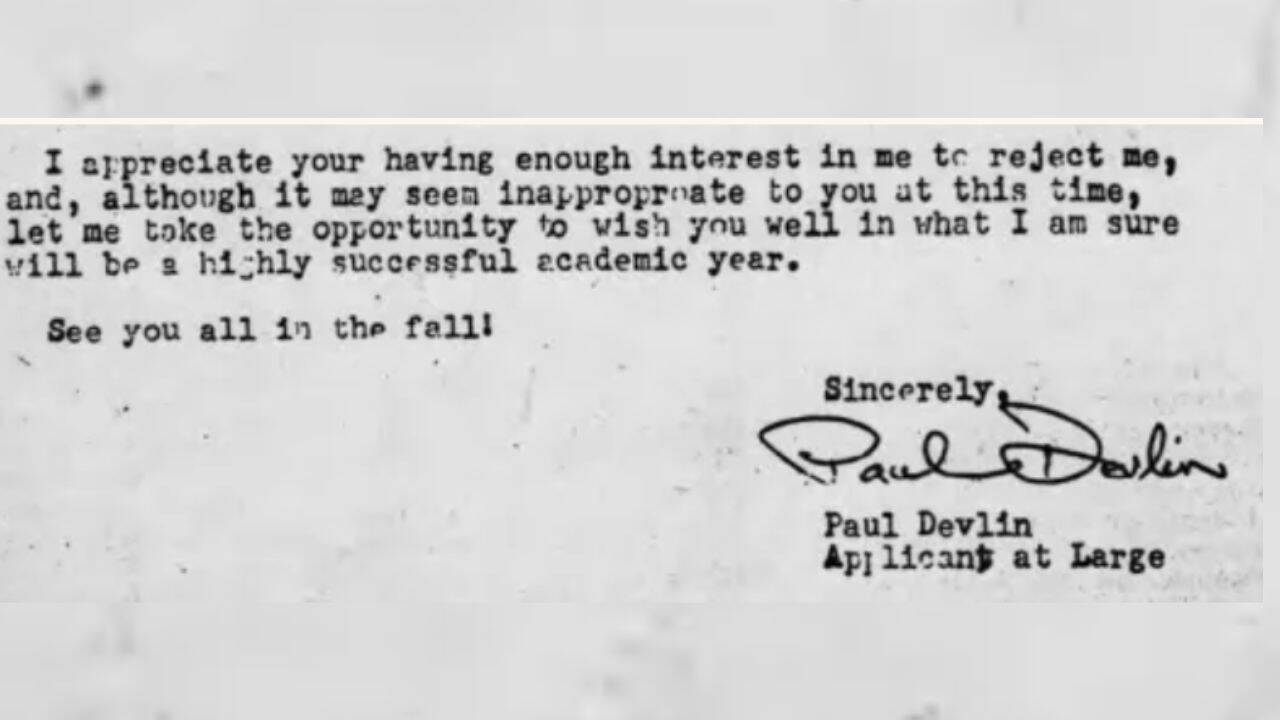
Getting rejected by an Ivy League school hurts. Most teenagers slink away, hide the thin envelope, and pretend they never wanted it anyway. In 1981, high school senior Paul Devlin took a completely different route. He found a typo in Harvard's rejection letter and decided to reject their rejection.
It sounds like internet folklore, but it actually happened. Long before viral culture existed on social media, Devlin’s clever paperwork maneuver made it into print. It is the ultimate blueprint for handling institutional arrogance with pure wit.
The Typo That Started a Rebellion
Back in the spring of 1981, rejection letters arrived by mail in droves for college applicants. Devlin, a student from New Jersey, opened his disappointing news from Cambridge. Instead of just feeling bummed out, he read the fine print with a fine-toothed comb and spotted a grammatical error.
That tiny slip-up opened a window. Devlin realized that elite universities took themselves far too seriously. So, he fired off a response written in the exact bureaucratic, condescending tone admissions offices loved to use.
Instead of accepting his fate, he informed Harvard that he was unable to accept their rejection at that time. He noted that he had received an especially fine crop of rejections that season, but because his capacity was limited, he had to turn many of them away.
Flipping the Script on Admissions Bureaucracy
Devlin didn't just stop at a clever opening line. He committed entirely to the bit.
In his reply, he explained that every rejection letter had been reviewed carefully and on an individual basis. He factored in the size of the institution, student-faculty ratios, location, costs, and social atmosphere. He even expressed sympathy for the disappointment his decision might bring to the Harvard admissions department, noting the time and effort they spent trying to reject him.
He closed the letter with a cheerful sign-off: "SEE YOU IN THE FALL!" followed by his signature as an "Applicant at Large".
It was petty. It was brilliant. And it completely punctured the aura of untouchable authority that elite colleges relied on.
How the Story Blew Up Before the Internet
You might wonder how anyone outside of Cambridge or New Jersey ever found out about a teenager's prank response. Enter family loyalty.
Devlin's mother, Nancy, recognized gold when she saw it. She sent a copy of the correspondence to The New York Times, which published it in the New Jersey section on May 31, 1981.
Years later, history almost repeated itself in a hilarious twist. When The New York Times Magazine ran a major cover story about the intense psychological toll of college rejections on modern students, Nancy Devlin re-submitted her son's old letter. The paper printed it again, accidentally accusing Devlin of plagiarism before realizing they had already published it decades earlier.
Why This Legacy Endures
Today, Paul Devlin is an Emmy-winning documentary filmmaker and sports editor, but people still ask him about a piece of high school stationery he mailed out over forty years ago. The letter has been read on stage by actors at events like London's Letters Live, proving that audiences love seeing rigid systems get mocked.
Institutions rely heavily on compliance. They expect applicants to bow down to their prestige, accept arbitrary verdicts in silence, and question their own worth. Devlin’s response reminds us that formal power structures are often propped up by nothing more than paper and ink—and sometimes, they cannot even get the grammar right.
Next time life hands you an automated rejection, remember Paul Devlin. Check the spelling, flip the script, and don't let anyone else dictate your value.