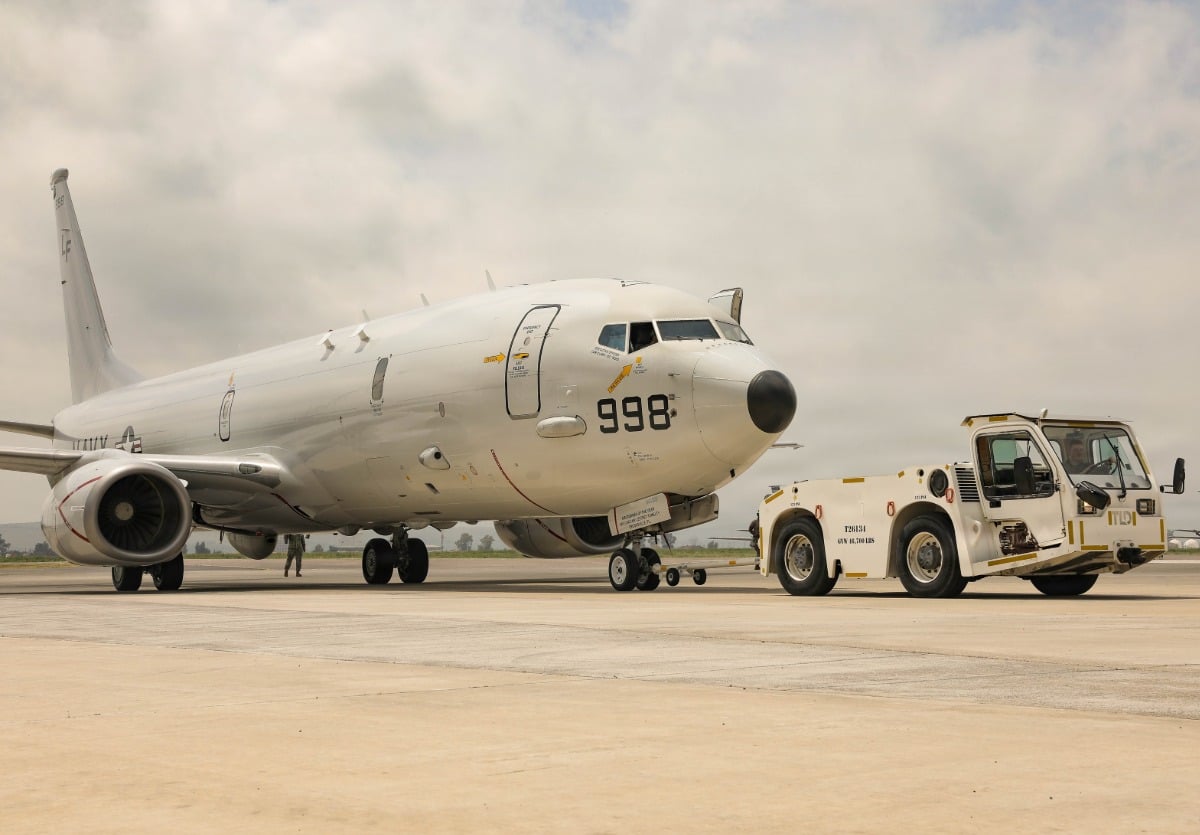
Submarines are getting quieter, faster, and much harder to track. That's why the U.S. Navy and the Royal Australian Air Force just doubled down on their premier airborne sub-hunter.
Boeing locked in a $121.2 million cost-plus-fixed-fee contract modification through the Naval Air Systems Command. This isn't a flashy deal for brand-new planes. Instead, it's a cold, calculated move to pack more lethal capabilities into the existing P-8A Poseidon fleet.
If you think maritime patrol is just about dropping sonobuoys and staring at radar screens, you're missing the real shift in modern naval strategy. This modification funds what the military calls Increment 3 Block 2 modifications under Engineering Change Proposal Six.
Here's exactly what this $121 million deal buys, why Australia is footin' part of the bill, and what it tells us about the rapidly changing state of underwater warfare.
Breaking Down the $121 Million P-8A Upgrade Deal
The contract lays out a clear roadmap for the defense giant. The funding will buy nine retrofit "A-kits." Six of these kits will head directly to U.S. Navy P-8A aircraft. The remaining three are destined for the Royal Australian Air Force, or RAAF.
Beyond just shipping parts, the contract covers the actual installation of three complete retrofit A-and-B-kit packages onto U.S. Navy planes. It also throws cash at non-recurring engineering. That's military code for fixing supply chain headaches, dealing with obsolete parts, and tackling material shortages before they ground aircraft.
U.S. Navy Funding Contribution: $92,809,039 (FY2026) + $8,272,791 (FY2024)
Royal Australian Air Force Contribution: $20,113,211
Total Contract Modification Value: $121,195,041
Projected Completion Date: May 2029
The physical work won't happen at a single site. Boeing will spread the tasks across three primary locations:
- Jacksonville, Florida (80% of the work)
- St. Louis, Missouri (11% of the work)
- Mesa, Arizona (9% of the work)
By keeping the vast majority of the work in Jacksonville, Boeing relies on its established maintenance, repair, and overhaul hub. It's a smart logistical play that minimizes transit time for active military hardware.
Why the Navy is Rushing to Install Increment 3 Block 2 Kits
The P-8A Poseidon is basically a heavily modified Boeing 737-800ERX commercial airliner packed with sensors, weapons bays, and workstations. But a commercial frame needs serious internal upgrades to handle modern anti-submarine warfare.
The Increment 3 Block 2 upgrade brings major structural and electronic changes. Technicians will pull out old wiring and install new routing systems, heavier power delivery mechanisms, and fresh external antennas.
This infrastructure lays the groundwork for better communication networks. The upgraded planes will process massive amounts of tracking data in real time, sharing target coordinates instantly across the fleet. If a drone or a surface ship spots a faint acoustic anomaly, the Poseidon can act on that data immediately.
There's a massive hardware upgrade hidden in this deal too. The Block 2 package optimizes the airframe to carry advanced anti-ship weaponry, most notably the Lockheed Martin AGM-158C Long Range Anti-Ship Missile, or LRASM.
The integration of LRASM means the P-8A can transition from a passive hunter into a terrifying offensive platform. It can strike surface vessels from far outside the range of enemy air defense systems.
The Indo-Pacific Reality driving the US-Australia Alliance
Look at the map and the funding split makes perfect sense. Australia isn't just a casual buyer here; they're an active co-development partner. The RAAF contributed more than $20 million directly to this specific contract modification.
The waters of the Indo-Pacific are crowded and tense. Foreign submarine activity in the South China Sea and the Pacific has spiked over the last few years. Both Washington and Canberra know that traditional surface fleets can't monitor these massive expanses of ocean alone.
By aligning their hardware configurations, the U.S. Navy and the RAAF ensure absolute interoperability. An Australian P-8A can land at a U.S. base in Guam or Japan, use the same diagnostic tools, swap the same spare parts, and talk to the same data networks as an American plane.
It creates a unified, seamless sub-hunting web across the Southern and Northern Hemispheres. It's a massive headache for any adversarial submarine captain trying to slip through deep water undetected.
Moving Past the Supply Chain Bottlenecks
You can't talk about defense contracts in 2026 without talking about supply chains. Boeing has faced intense scrutiny over its commercial manufacturing, but its defense sector remains a vital pillar for Western militaries.
A significant portion of this $121 million contract targets "diminishing manufacturing sources and material shortages." Military tech ages quickly. A microchip or sensor array designed a decade ago might not even be in production today.
By dedicating funds to non-recurring engineering, Boeing engineers can redesign circuit boards, source alternative materials, and update component specifications. This keeps the older planes in the air without sacrificing performance. It's an unglamorous but necessary part of keeping a fleet functional through the end of the decade and beyond.
Next Steps for Defense Analysts and Watchers
If you track naval procurement or defense stocks, this contract shows that electronic upgrades are taking priority over building brand-new airframes. The focus is on squeezing every ounce of capability out of existing investments.
Keep an eye on the Jacksonville facility over the next three years. The pace of these installations will signal how urgently the Navy views the current underwater threat environment.
Also, watch for other global P-8A operators. Countries like the United Kingdom, Norway, New Zealand, Germany, and South Korea run similar airframes. Don't be surprised if these nations step forward with their own multi-million dollar modernization contracts to mirror the U.S. and Australian configurations.