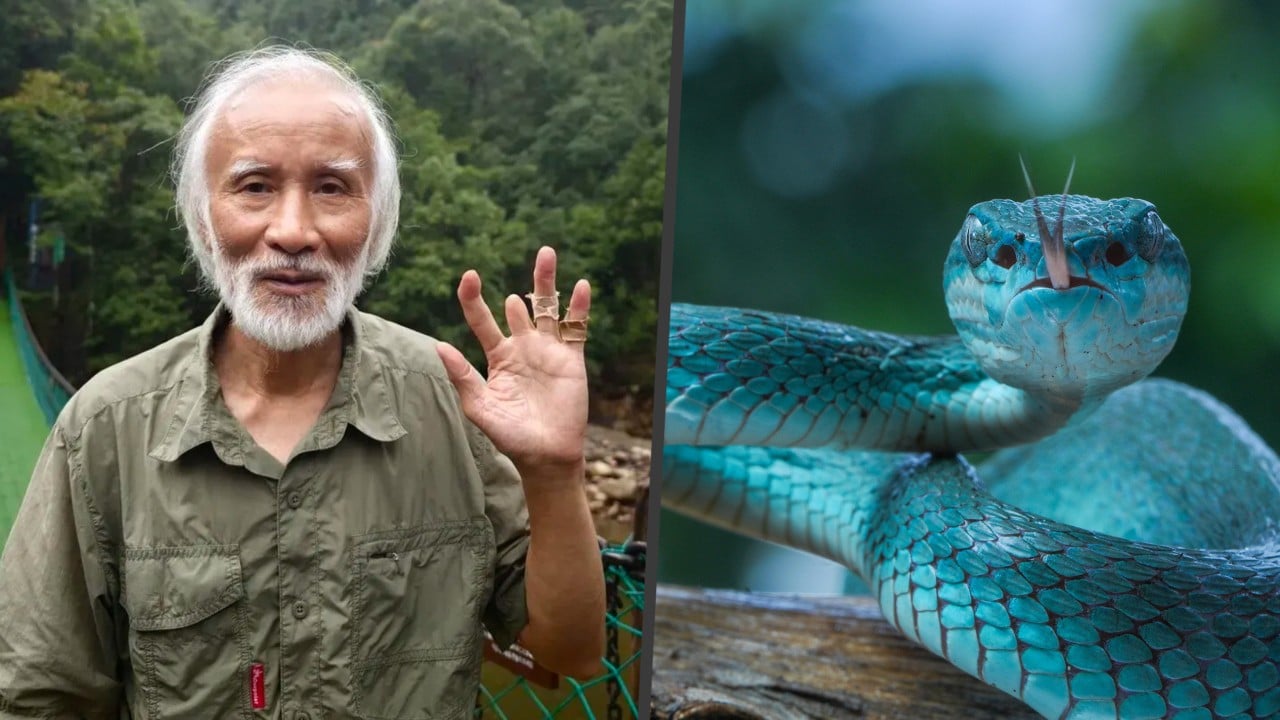
Most people run away when they see a venomous snake. Chen Yuanhui did the exact opposite. Over the course of four decades, this self-taught researcher dedicated his entire existence to protecting the Mangshan pit viper—a rare reptile often called the "little green dragon". His obsession cost him part of his finger, subjected him to nine separate venomous bites, and nearly destroyed his marriage. Yet, he never backed down.
Discovering the Little Green Dragon
Back in the early 1980s, Chen was working in China's Hunan province. When a local snakebite research center closed down in 1982, he refused to drift away into a conventional medical career in the city. Instead, he stayed close to the rugged mountains of Mangshan.
Rumors floated around local villages about a massive, uniquely patterned green viper that didn't match any known scientific books. Driven by sheer curiosity, Chen spent five exhausting years tracking down rumors, talking to locals, and searching the dense undergrowth.
His big break came when a forestry worker captured a nest of unusual snakes. Broke and desperate, Chen spent three years of family savings—about 400 yuan—to buy the snakes, hiding the purchase from his wife. He packed them up, traveled to Chengdu to meet prominent zoologist Zhao Ermi, and officially introduced the world to Protobothrops mangshanensis in 1990.
The Brutal Price of Conservation
Discovering a new species is one thing. Keeping it alive is another. When black-market prices for the rare viper soared past 150,000 dollars following international conservation listings, poachers started circling. Chen turned down every single offer, choosing instead to bring the snakes directly into his 51-square-metre home to protect them from thieves.
Living with dozens of highly venomous snakes in a cramped residential space created constant friction. His wife threatened divorce multiple times. Only after watching his unyielding dedication did she back down.
The physical toll was even worse. Chen survived nine separate bites from the Mangshan pit viper. After his eighth encounter, he sat down and wrote his final wills and testaments, expecting the end.
The ninth bite proved to be the most grueling. Instead of rushing to apply first aid during the critical golden minutes, Chen chose to photograph his own wound for scientific documentation. He slipped into unconsciousness for three full days and nights. Medical teams saved his life, but the venom necrosis forced them to amputate part of his left middle finger.
What We Can Learn from Chen Yuanhui
At 77 years old, Chen's legacy goes far beyond a missing digit. He didn't just discover a snake; he pulled an endangered population back from the brink of total extinction. Through careful captive breeding programs, he and his team successfully hatched and released over 160 vipers back into their native mountain habitat.
Conservation isn't always comfortable or clean. It requires a level of grit that modern culture rarely witnesses. While internet trends come and go, real preservation happens because individuals like Chen decide that a rare species matters more than personal safety, comfort, or financial gain.
Protecting fragile ecosystems means looking past the immediate danger and investing decades into work that nobody else wants to touch. Chen’s story proves that true impact demands total commitment.