Don't let the polite diplomatic statements fool you. The announcement that Washington and Tehran just established a direct crisis hotline to manage the Strait of Hormuz isn't a sudden outbreak of geopolitical friendship. It's a raw, transactional panic button.
Qatar and Pakistan announced the deal after marathon 18-hour sessions near Lake Lucerne in Burgenstock, Switzerland. The agreement sets up a telephone hotline and an operational coordination center to stop the world's most critical maritime choke point from blowing up the global economy. This temporary mechanism ties directly to a wider 14-point Memorandum of Understanding. Under it, the stakes are massive. Iran gets path access to $12 billion in frozen assets and potential relief from crippling oil sanctions. In return, western commercial vessels get a fragile promise of safe passage through the strait without arbitrary transit fees for a 60-day negotiation window.
But if you think this completely clears up the maritime gridlock, you're missing the real story.
On the water, confusion rules. Just hours before the Swiss breakthrough, Iran's Fars News Agency reported that the Islamic Revolutionary Guard Corps Navy refused to issue transit permits, effectively keeping the strait locked down. They claimed it was a direct response to continued Israeli strikes in Lebanon and what they viewed as Washington's failure to enforce regional stability. Meanwhile, President Donald Trump threw fuel on the fire during a Fox News interview, threatening to completely take over the strait or obliterate anyone who contested American control.
This is the chaotic reality behind the high-stakes diplomacy. To understand where global shipping, oil prices, and Middle Eastern stability go next, we have to look past the official press releases.
The Reality on the Water vs the Swiss Diplomacy
Walk into any maritime operations room right now and you'll find pure anxiety. The hotline is designed to stop accidental shooting matches between the US Navy and the IRGC. Yet, commercial operators don't know who is actually running the waterway from one hour to the next.
Iranian lead negotiator Mohammad Bagher Ghalibaf made it clear upon returning to Tehran that things have permanently shifted. He stated bluntly that the administration of the strait will never return to how it was before the recent conflict. Ghalibaf insists Iran will operate within international law, but his words signal a new era of aggressive Iranian regulatory oversight in the waterway.
The immediate operational details of the deal reveal just how fragile this arrangement is.
Under paragraph five of the Swiss memorandum, Iran has 30 days to start active demining operations to clear the shipping lanes. For the 60-day negotiation block, commercial ships are supposedly allowed free transit. But shipping giants aren't rushing back in blindly. Data from maritime brokers show an extreme lag between diplomatic breakthroughs and actual traffic normalization.
When the negotiators initially hinted at an opening, outbound tanker traffic briefly surged as stranded ships scrambled to leave the Persian Gulf. Nineteen major tankers carrying over 34,000 deadweight tons rushed out over a single weekend. Only five entered. Then came the sudden IRGC closure rumor, and traffic immediately dried up.
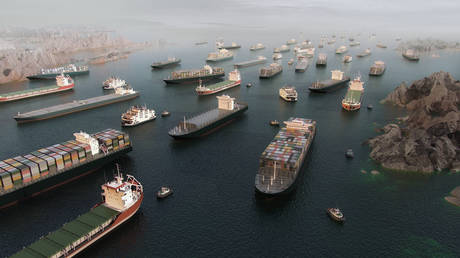
Right now, dozens of Very Large Crude Carriers are sitting idle off the coast of Oman. They are literally waiting in the southern Indian Ocean, pointing their bows toward the Gulf but refusing to cross the line until the hotline proves it actually works. Western shipowners are pulling their vessels away, diverting them along longer, vastly more expensive routes around Africa. Only Greek operators seem willing to play the high-risk, high-reward game of entering the Gulf under the current conditions.
What the Hotline Tells Us About the True State of US Iran Power
This isn't the first time adversaries have built a direct line to prevent nuclear or conventional catastrophe. The Cold War gave us the famous Washington-Moscow teletype. This new Hormuz link operates on the exact same premise. Neither side trusts the other, but neither side wants a misunderstanding to kick off an uncontrollable war.
The US delegation in Switzerland showed a fascinating shift in execution. Led by Vice President JD Vance, special envoy Steve Witkoff, and presidential adviser Jared Kushner, the American team had to navigate intense internal friction. The negotiations almost collapsed entirely when Trump issued his public warnings to bomb Iran or seize the strait. The Iranian delegation viewed the statements as a deliberate insult and briefly walked out of the room to consult with Qatari mediators.
The fact that both teams returned to the table to hammer out the coordination center proves how desperate both capitals are for a breathing room.
For Tehran, the motivation is purely financial. The Iranian economy is suffocating under heavy sanctions. Accessing $12 billion in frozen foreign funds gives the regime an immediate economic lifeline. Discussing the normalization of oil exports is the ultimate prize they can't afford to walk away from.
For the White House, the focus is keeping global energy prices stable and saving a crumbling ceasefire in Lebanon. The Swiss talks explicitly included a mandate to build a secondary deconfliction cell involving the Lebanese government. This proves the Americans know you can't separate the security of the Strait of Hormuz from the rocket fire in the Levant.
The Economic Burden Shifting to Global Supply Chains
While politicians argue over sovereignty and frozen funds, global businesses are paying the literal price for this crisis. The establishment of a hotline does nothing to immediately lower insurance premiums or clear underwater mines.
Major banking institutions like HSBC have already warned corporate clients that shipping normalization will take months, regardless of how well the Swiss talks progress. The market requires a durable, long-term treaty, verified mine clearance, and a massive reduction in maritime war-risk insurance costs before consumer goods and crude oil flow smoothly again.
Consider what happens to a standard tanker route when the Strait of Hormuz faces even a temporary blockade or persistent threats.
When ships divert around the Cape of Good Hope, it adds roughly 10 to 14 days to a standard transit to Europe or North America. This burns millions of dollars in extra bunker fuel per voyage. It ties up global container and tanker capacity, effectively shrinking the number of available ships worldwide and driving up spot freight rates across completely unrelated trade lanes.
If the 60-day Swiss negotiation roadmap fails, we aren't just looking at a localized Middle Eastern problem. We are looking at an immediate spike in global inflation. Energy costs will rise, hitting manufacturing sectors in Europe and Asia within weeks.
How Maritime Logistics Experts Are Navigating the Next 60 Days
If you manage supply chains or energy assets, you can't rely on political promises. The next two months will be a masterclass in risk mitigation. Experienced operators are already executing specific, practical strategies to protect their cargo and bottom lines.
First, successful logistics managers are aggressively diversifying their lifting zones. Relying solely on ports inside the Persian Gulf right now is an operational gamble. Companies are shifting short-term contracts to supply hubs in West Africa, the US Gulf Coast, and the North Sea to guarantee supply continuity, even if those options carry higher initial premiums.
Second, legal teams are rewriting force majeure clauses in maritime contracts. The legal ambiguity surrounding whether the strait is technically open, closed, or under hostile threat has triggered massive disputes over who covers the cost of delayed cargo. Standard contracts are being replaced with ironclad language that explicitly defines what constitutes a safe transit window under the new Iranian rules.
Finally, operators are demanding real-time tracking transparency. No one is trusting the official state media reports from either Washington or Tehran. Instead, companies are leaning heavily on independent satellite tracking and private maritime security intelligence firms to verify actual ship movements before ordering a vessel to enter the Omani gulf.
The establishment of this hotline is a necessary step to prevent a catastrophic military error. But don't mistake a tactical pause for a permanent peace. The underlying friction remains completely unresolved. The clock on the 60-day roadmap is ticking right now.
To get a clearer sense of how this situation plays out on the water, you can watch this breakdown of the Iran-U.S. Hormuz Hotline Agreement, which details the exact statements made by the negotiators regarding the 30-day demining window and the real-time operational structure of the new coordination center.