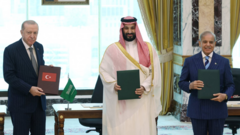
The traditional security architecture of the Middle East is cracking. Saudi Arabia, Turkey, and Pakistan just signed a landmark trilateral defense agreement in Mecca, vowing that an attack on one will be treated as an attack on all three.
If you are wondering why this alliance matters right now, look at the map and the headlines. The region is reeling from the fallout of the US-Israeli war with Iran, ongoing Houthi missile strikes on Saudi energy facilities, and a growing consensus that traditional Western security guarantees can no longer be trusted blindly.
Breaking Down the Mecca Joint Defence Agreement
Signed by Saudi Crown Prince Mohammed bin Salman, Turkish President Recep Tayyip Erdoğan, and Pakistani Prime Minister Shehbaz Sharif, this pact brings three heavyweights together under one security umbrella.
You are looking at a combination of distinct strengths. Saudi Arabia brings unmatched economic power and capital. Pakistan provides a battle-hardened military and the Muslim world's only nuclear deterrent. Turkey contributes Nato's second-largest standing army alongside a rapidly expanding defense manufacturing sector known for advanced drone technology.
The core text of the agreement is direct: any armed attack against any one of the three states shall be regarded as an attack against them all. This mirrors collective defense clauses found in traditional military alliances, establishing a clear regional deterrent against external aggression.
Why This Alliance Was Inevitable
For months, regional dynamics have shifted aggressively. The United States has signaled a strong preference for regional burden-sharing rather than direct intervention. At the same time, direct threats from Iran-backed Houthi rebels targeting Saudi infrastructure in the Red Sea have created an acute sense of vulnerability in Riyadh.
Saudi Arabia and Pakistan already signed a bilateral mutual defense pact last September. That deal saw Pakistan deploy tactical assets and air defense systems to the kingdom earlier this year. Bringing Turkey into the fold expands this bilateral arrangement into a broader security architecture.
Ankara has increasingly leaned into its "regional solutions to regional problems" doctrine. By bridging the gap between Gulf petrodollars and Turkish-Pakistani military hardware, the three nations are building an indigenous framework to manage local conflicts without relying on Washington.
The Real Implications for Regional Stability
Critics and regional observers are already debating the long-term fallout. Some analysts within Iran have voiced concern that the trilateral pact alters the balance of power, effectively increasing the likelihood of direct Turkish and Pakistani military involvement if Gulf states face further aggression.
On the other side, officials from the participating nations insist the pact is strictly defensive in nature and not aimed at building a sectarian bloc. Turkish sources have confirmed that the alliance is designed to remain open for other regional states to join over time.
The immediate test for this alliance will likely play out in the Red Sea and Yemen, where Houthi maritime embargoes and drone attacks continue to disrupt trade and threaten energy supplies. If joint naval and air assets from Turkey and Pakistan coordinate directly with Saudi forces, it will mark a massive shift in how Middle Eastern security crises are handled.
The message from Mecca is unmistakable. Regional powers are no longer waiting for outside capitals to secure their borders. They are drawing their own lines in the sand.


