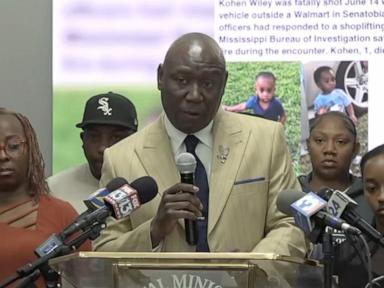
A box of diapers. That is what triggered the police response that ended with a dead one-year-old boy in a Mississippi parking lot. On June 14, 2026, an officer with the Senatobia Police Department pulled his weapon and fired into a silver sedan outside a local Walmart. The bullets tore through the vehicle, critically wounding an adult driver and killing one-year-old Kohen Kartier Wiley.
The official line from law enforcement came fast. The Mississippi Bureau of Investigation claimed the driver accelerated toward officers, threatening their safety. But that official story is facing massive pushback from the family, their legal team, and a furious community.
Civil rights attorney Ben Crump and Memphis attorney Van Turner have stepped in. They aren't waiting around for the state's investigation to wrap up in six to nine months. The family is taking matters into their own hands, initiating an independent autopsy to challenge the narrative that police had no choice but to shoot.
Breaking Down the Fight for Medical Evidence
When a police department controls the crime scene and the initial medical examination, families are left in the dark. Kohen’s mother, Vellesiya Wiley, noted that her son's body was quickly transported to the Medical Examiner’s Office in Jackson, Mississippi. She was informed she could not see him until he was returned for the funeral.
This isolation is why independent autopsies have become a necessity in high-profile police shootings. State-run forensics offices face intense pressure, and their timelines rarely give grieving families quick answers. In this case, the state's preliminary findings are not expected until June 30, days after the child’s scheduled funeral.
An independent medical examination changes the dynamic. It offers a second, neutral look at the physical evidence before the body is buried. A private forensic pathologist will focus on the trajectory of the bullets, the exact entry and exit wounds, and the distance from which the weapon was fired.
The Trajectory Tells the Real Story
The core dispute boils down to geometry. Was the car moving toward the officer as a weapon, or was it driving away?
The Senatobia Police Department claims the vehicle drove directly at an officer, almost striking him. Crump argues that the physical entry wounds on the boy's body will immediately prove or disprove this claim.
If the independent pathology report shows that the bullets entered the side of the vehicle and traveled laterally through the child's body, the official justification evaporates. A bullet coming from the side means the officer was not in the direct path of the oncoming vehicle. He was standing safely to the side when he chose to open fire on a moving car containing a baby.
Firing into a moving vehicle is widely considered a dangerous and outdated policing tactic. Most progressive law enforcement agencies across the country ban or heavily restrict it because disabling the driver turns a heavy vehicle into an unguided missile. In this instance, the stakes were even higher because a toddler was inside.
Demanding the Receipts from Walmart and Body Cameras
The physical evidence from the autopsy is only half the battle. The Wiley family is demanding the immediate release of all video footage, including Senatobia police body cameras, dashboard cameras, and Walmart’s exterior surveillance tapes.
Public Safety Commissioner Sean Tindell has indicated that no footage will be released while the state investigation is active. This delay tactic is fueling local outrage. A small snippet of cellphone video recorded by a bystander has already circulated online, showing the silver sedan driving away from the scene, not toward police.
The lack of official transparency has broken what little trust existed between the community and local law enforcement. Two days after the shooting, a peaceful protest of over 200 residents outside the Walmart grocery entrance was met with police in gas masks who deployed tear gas on the crowd. Snipers were spotted on the roofs of downtown buildings during a rally at City Hall.
The unnamed officer who fired the fatal shots was placed on administrative leave by the mayor and Board of Aldermen. Public records later revealed that Sergeant Hunter Foster was present at the scene, though heavy redactions mean the public still does not know exactly who pulled the trigger.
Moving Past the Shoplifting Distraction
Law enforcement statements heavily emphasized the shoplifting call to justify their arrival. Family members have denied that any theft occurred. But even if shoplifting did take place, the legal team emphasizes that petty theft does not carry a death sentence.
Vellesiya Wiley recounted the terror of those final seconds inside the car. She explained that she held her baby boy up in the air, trying desperately to show the officers that a child was in her arms before the gunfire began.
"I watched my baby take his first breath, and I watched my baby take his last breath," Wiley stated during a press conference.
The legal path forward for the family relies on securing the independent autopsy data this week, forcing the release of the video files, and filing a civil rights lawsuit against the city of Senatobia. For now, the community is focused on preparing for Kohen's funeral, while his family waits for the independent pathology results to deliver the objective facts that the state seems hesitant to share.