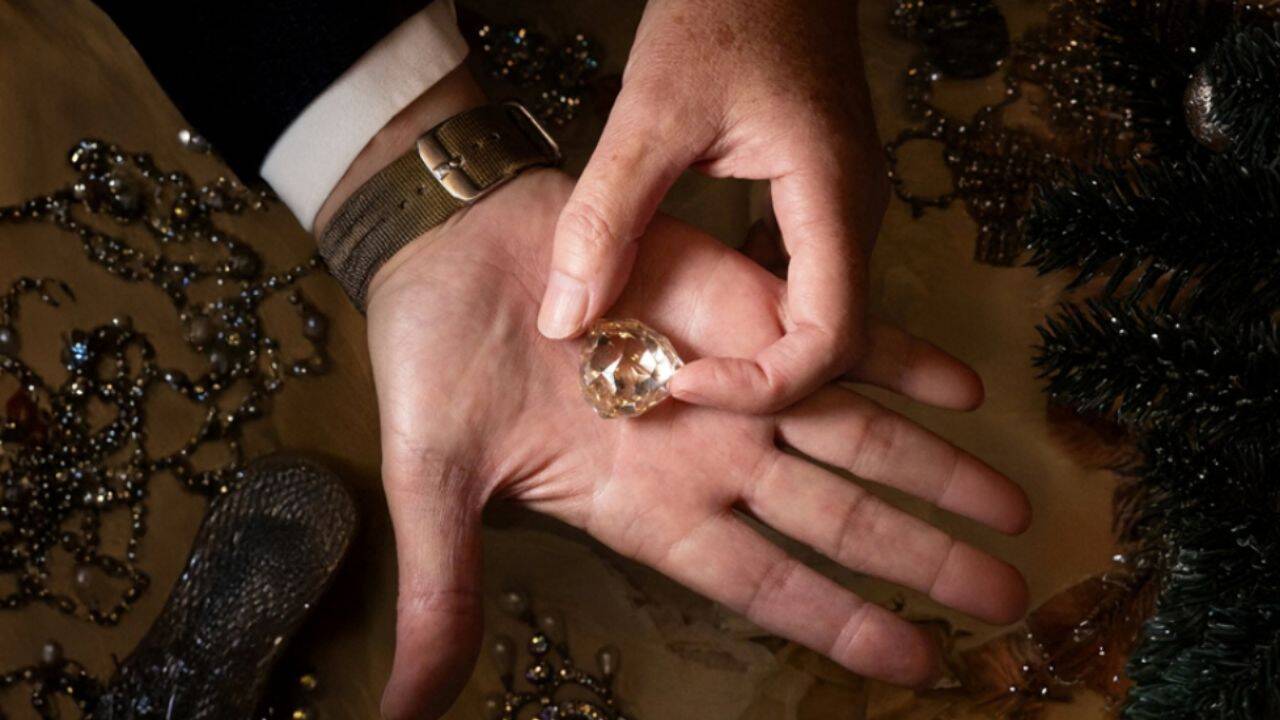
When the Austro-Hungarian Empire crashed to the ground in late 1918, it took down a world of imperial court fashion, centuries of dynasty rule, and one of the largest yellow diamonds in human history.
The Florentine Diamond weighed a massive 137.27 carats. It was a pale, shimmering yellow stone with faint green undertones, cut into a complex double rose style that set it apart from almost every other royal gemstone in Europe. For centuries, it moved through the hands of global power brokers, from Indian trading routes to the Medici family in Italy, eventually landing straight inside the crown jewel vault of the Habsburg dynasty in Vienna.
Then world war happened. The empire splintered. Emperor Charles I packed his family's royal treasures into suitcases, fled across the border into Switzerland, and watched his world turn to ash. Within three years, the legendary gem went completely dark.
For over a hundred years, historians and jewel hunters insisted the stone was chopped up, recut into smaller, unidentifiable stones, and dumped into private markets in North America. But fresh archival evidence and supply chain tracking suggest a different path. The truth behind the lost 137 carat diamond reveals how greed, exile, and international smuggling ring networks wiped out one of the most famous gems in recorded history.
The Journey to Vienna
To understand why this gem matters, you have to look at how it ended up in the Austrian imperial collection. It didn't start in Vienna.
The early history reads like a globe-trotting thriller. According to historical records, the raw diamond originally came from the Golconda mines in India, the same legendary source that gave us the Hope Diamond and the Koh-i-Noor. The raw stone was huge, likely over 200 carats before cut, and eventually made its way into the hands of the Grand Duke of Tuscany.
By the mid-1700s, the Medici line had died out. Francis Stephen of Lorraine, who married the powerful Empress Maria Theresa of Austria, inherited the Tuscan holdings and brought the jewel directly into the imperial treasury in Vienna.
"It was the absolute crown jewel of the Habsburg collection, rivaled only by the Austrian Imperial Crown itself."
The Habsburgs loved this stone. They mounted it into hat brooches, giant court pins, and elaborate display pieces worn during state dinners. Visitors to the Hofburg Palace described it as an unnatural light source, a stone that caught candlelight in a way that modern brilliant cuts simply couldn't replicate.
War, Chaos, and a Flight in the Dark
By 1918, Europe was tore apart by World War I. Austria-Hungary was collapsing from the inside out, crippled by military defeat, starvation, and political revolution.
Emperor Charles I knew his time on the throne was up. Facing execution or exile, he panicked about his family's financial future. He stripped the imperial vault of its private jewels, including the Florentine Diamond, the historic Emerald Watch, and massive strings of natural pearls.
He smuggled them across the border into Switzerland in late 1918, storing them in a Swiss bank vault in Zurich. That move set off a chain reaction of betrayal that ended the gem's public trail forever.
Exile is expensive. Trying to reclaim an empire is even worse. Charles needed serious cash to fund royalist rebellions back in Hungary. To turn the crown jewels into usable money without creating a massive diplomatic crisis, he made a fatal decision.
He trusted the wrong guy.
Count Blankenstein and the Great Heist
Enter Count Bruno von Blankenstein. He was an Austrian nobleman who convinced the exiled emperor that he could safely move the jewels through European financial networks, pledge them as collateral for bank loans, or quietly find ultra-wealthy buyers in South America.
Charles gave Blankenstein access to the Swiss vault in 1921.
That was the last time the emperor ever saw his family's legendary diamond. Blankenstein didn't secure loans or negotiate high-society sales. He grabbed the jewels, vanished into the European criminal underground, and started selling off individual pieces across borders.
When Charles realized he'd been robbed, he tried to raise the alarm, but he had no legal standing. The new Republic of Austria was demanding the return of state property, Swiss authorities didn't want to get involved in royal feuds, and Charles died broke on the island of Madeira in 1922, just 34 years old.
Blankenstein walked away with millions in modern equivalent cash. The Florentine Diamond was gone.
Why Nobody Could Find the Stone
How do you sell a famous 137 carat light-yellow diamond that everyone on Earth can recognize?
You don't. You destroy it.
For decades, the dominant theory among gemologists was that Blankenstein or his fence shipped the diamond to New York or Antwerp shortly after the theft. In those cutting houses, master diamond cutters would have sliced the 137 carat giant into four or five smaller stones.
Cutting a historical diamond ruins its historic value, but it destroys the paper trail. A 30 carat yellow diamond with a modern brilliant cut can easily pass through auction houses without raising suspicion. A nine-sided double-rose cut gem weighing 137 carats screams stolen imperial loot.
Some facts support this recutting theory:
- A series of unusual light-yellow diamonds matching the exact clarity profile of Golconda gems hit the New York market in the late 1920s.
- No raw 130-plus carat light-yellow diamond ever surfaced in public auctions during the mid-20th century.
- Major European gem houses kept quiet, knowing that handling stolen Habsburg property would trigger massive lawsuits from the Austrian government.
The South American Lead That Changed Everything
The recutting story was accepted as fact for nearly a century. But recent investigations into Swiss transit logs and South American banking archives tell a different story.
Blankenstein didn't head straight to the United States. He fled toward South America, specifically Argentina and Brazil, where wealthy exiled aristocrats and post-war tycoons were buying up physical assets outside the reach of European courts.
Customs records from Montevideo and Buenos Aires in the mid-1920s show a massive influx of unmarked high-value gemstones moving through private diplomatic pouches. Researchers tracking the Blankenstein estate discovered that his family held vast, unexplained real estate holdings across South America starting in the late 1920s.
More importantly, rumors persist in the high-end diamond trade that the original stone was never recut at all.
Instead, a private collector in South America purchased the original uncut stone, keeping it hidden in a private vault for decades. If that's true, the Florentine Diamond isn't four smaller gems sitting on engagement rings in Manhattan. It's sitting intact in a private collection somewhere in South America or Europe, waiting for the legal ownership claims to expire.
How Modern Technology Could Prove Its Existence
If the Florentine Diamond is still intact, or even if it was recut into smaller stones, modern gemology can track it down. We don't rely on simple visual inspection anymore.
- Nitrogen Mapping: Golconda diamonds have a specific chemical fingerprint, categorized as Type IIa or low-nitrogen Type Ia. They possess a purity that modern South African or Russian diamonds almost never match.
- Spectroscopic Analysis: Laser spectroscopy can scan a diamond and reveal trace element signatures. If four smaller yellow diamonds carry identical lattice defects and trace element ratios, they came from the same rough stone.
- Photogrammetry Reconstruction: Historians have reconstructed the original 3-D shape of the Florentine Diamond using historic court sketches and photographs. By running spatial analysis on existing large yellow diamonds, software can tell us if a stone was cut from the original Habsburg gem geometry.
What You Should Watch For Next
The search for lost imperial jewels isn't just about old history. It's an active market with millions of dollars on the line.
Keep an eye out for these specific markers in the coming years:
- Major auction house listings: Pay attention when large, antique light-yellow diamonds with "unknown provenance" hit Sothebys or Christies auctions.
- Claims from the Habsburg-Lorraine family: The modern descendants of the Austrian imperial family still track claims regarding stolen royal property.
- Declassified archives: Swiss banking secrecy laws regarding early 20th-century accounts continue to loosen, exposing shipping manifests that were sealed for a hundred years.
The Florentine Diamond disappeared into the chaos of a collapsed empire, but stones of this size don't stay hidden forever. Whether sitting in a vault in Buenos Aires or recut into a ring in New York, the ghost of the 137 carat giant is still floating through the global diamond market.

/cdn.vox-cdn.com/uploads/chorus_image/image/73064899/1255687.0.jpg)