You can't win a war of attrition trading million-dollar missiles against thousand-dollar drones. Yet, that's exactly what the Pentagon and its global allies have been forced to do for years. Burning through a multi-million dollar Patriot interceptor to down a cheap, slow-moving Shahed-type drone is a mathematical nightmare that exhausts stockpiles and breaks defense budgets.
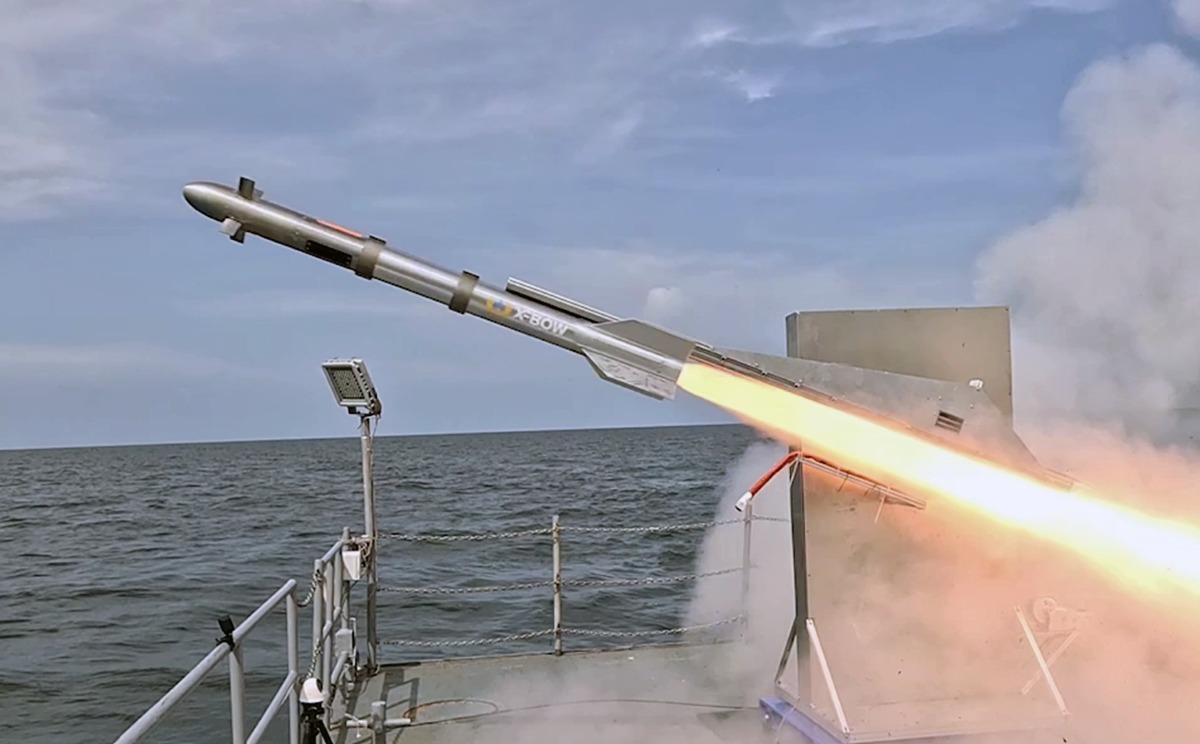
X-Bow Systems wants to end that bad equation. At the Farnborough International Airshow, the New Mexico-based propulsion startup unveiled Buckler. It's a flight-tested, supersonic interceptor designed specifically to knock out Group 3 drones and light cruise missiles. The real kicker? It costs under $100,000 per round. If you liked this piece, you should look at: this related article.
For military planners staring down empty warehouses and surging threat environments, this isn't just another weapon system. It's a complete shift in how the West manufactures and pays for air defense.
Flipping the Economics of Drone Warfare
Group 3 drones—which generally weigh between 55 to 1,320 pounds and fly at medium altitudes—have become the go-to weapon for asymmetric warfare. They're cheap to build, easy to launch in massive swarms, and highly destructive. For another perspective on this event, see the recent coverage from MIT Technology Review.
Up until now, defending against them meant relying on layered architectures that quickly run out of ammo. The US military burned through hundreds of high-end interceptors in the Middle East recently, while annual replacement production numbers crawl along in the double or triple digits. Traditional interceptor production takes too long and costs way too much.
Buckler fills a massive gap right in the middle of this defense crisis. By capping the price tag under $100,000, X-Bow gives commanders a tool to preserve their exquisite, multi-million dollar long-range missiles for high-value threats like ballistic missiles, while assigning these cheaper rounds to routine drone swarms.
The Solid Rocket Motor Bottleneck
If building cheap missiles was easy, someone would've done it by now. The biggest roadblock in American munitions production isn't the software or the guidance fins. It's the solid rocket motor (SRM) supply chain. The United States relies on a highly consolidated industrial base for SRMs, meaning a shortage of propellant or rocket casings instantly freezes missile production across the board.
X-Bow avoids this trap by acting as a vertically integrated manufacturer. They build Buckler's airframe, its solid rocket motor, and the propellant completely in-house.
They rely on their proprietary, automated manufacturing technology—including their patented Advanced Manufacturing of Solid Propellant (AMSP) process. By 3D-printing and automating the production of rocket motors, they strip out the slow, manual labor that spikes the cost of traditional defense procurement. They can scale production up or down rapidly without waiting around for third-party component suppliers.
Moving Past the Concept Stage
A lot of defense startups pitch cheap designs on PowerPoint slides. Buckler is different because it has already flown.
The company's recent successful flight test validated the interceptor's propulsion system and aerodynamic performance in real skies, backed up by extensive static-fire and igniter tests on the ground. It hits supersonic speeds, meaning it can close the distance on an incoming threat far faster than existing low-cost gun-based or electronic warfare systems.
X-Bow isn't operating in a vacuum here, either. Lockheed Martin led a $105 million Series B funding round for the startup, explicitly tapping them to serve as an independent supplier of SRMs for broader defense programs. The Pentagon's demand signal is loud and clear: the Army recently challenged the tech industry to field cheaper interceptors for rapid procurement, and the Air Force is actively hunting for low-cost, ground-based systems that plug directly into existing command-and-control networks. Buckler checks every single one of those boxes.
Next Steps for Defense Procurement
For defense officials and procurement officers looking to integrate these systems into active defensive frameworks, the path forward requires immediate evaluation.
First, military commands need to accelerate integration testing to ensure Buckler interfaces flawlessly with existing radar systems and forward-deployed sensor networks. Second, defense planners must reallocate budget priorities away from solely purchasing exquisite, low-volume platforms and allocate funds toward mass-producible interceptors to build actual battlefield depth. The technology is out of the lab and flying; the next hurdle is getting it into launchers at scale.


.JPG?itok=aauQ_1c_)