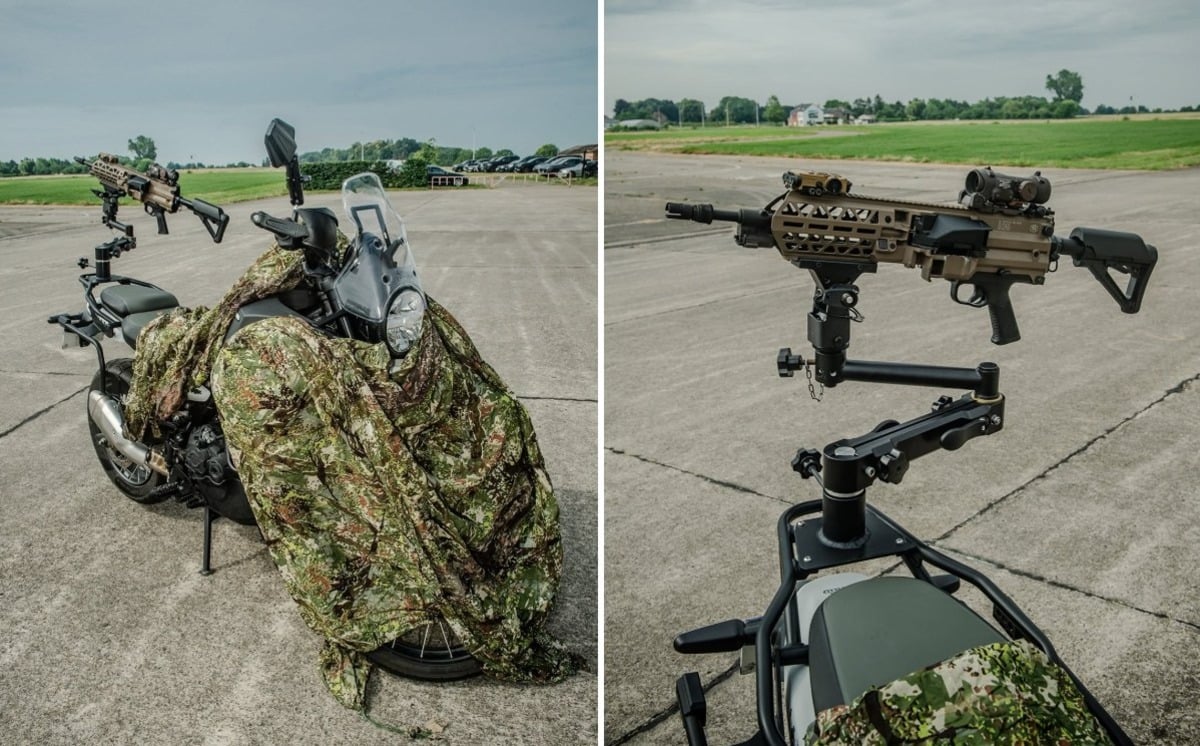
Armies love speed. They also love firepower. Putting the two together usually results in a multi-million-dollar armored vehicle that weighs thirty tons and gets stuck in the mud. That is why a recent presentation by a French defense firm has people talking. They strapped an infantry squad machine gun directly onto a lightweight tactical motorcycle.
It looks like something straight out of a post-apocalyptic action movie. Honestly, it sounds a little crazy at first. Motorbikes offer zero armor protection for the rider. One well-placed round ends the mission instantly. But the reality of modern combat is forcing planners to rethink old ideas.
The defense community is realizing that heavy armor cannot hide from drone surveillance. Heavy vehicles get spotted and destroyed in minutes. A small, fast motorcycle with a machine gun can slip through gaps that a tank would get stuck in. It is a gritty, budget-friendly approach to tactical mobility that makes total sense in today's high-tech warfare.
The Reality of the Gun Mounted Motorcycle
The concept shown off by the French defense company is simple. Take a high-end off-road motorcycle and integrate a stabilized mount for a modern light machine gun on the handlebars or a side framework. This allows a single operator or a two-man scout team to move fast through dense woods, narrow urban alleys, and broken terrain.
They are using weapons that used to require a heavy vehicle mount or a full infantry squad to carry. Think along the lines of high-volume fire weapons like the FN Evolys or similar lightweight 7.62 mm platforms. By mounting this firepower onto a highly agile dirt bike, a scout unit can ambush an enemy and vanish before artillery can lock onto their position.
You cannot fight from the bike the way you would from an armored personnel carrier. That is a common mistake people make when they look at these designs. You don't ride into a hail of bullets blazing away like a movie hero. Instead, you use the bike to get a heavy weapon into a dominant position faster than the enemy expects. You ride, you stop, you suppress, and you move.
Learning From Military History
This is not a new idea. The French military has a weird history of putting heavy weapons on two wheels. Back in the 1950s, French airborne troops deployed the Vespa 150 TAP. That was literally a Vespa scooter modified to carry a 75 mm M20 recoilless anti-tank rifle.
- The Vespa TAP: It carried a massive anti-tank weapon. Troops dropped it via parachute in pairs. One scooter carried the gun, the other carried the ammo.
- The René Gillet Sidecars: Even earlier, during the pre-WWII era, the French military experimented with René Gillet motorcycles featuring mounted 7.5 mm machine guns.
The old Vespa TAP had a major flaw. You could not actually fire the cannon safely while riding the scooter without ruining the frame or crashing. You had to mount the gun on a separate tripod to use it effectively. The modern French prototype solves this issue with advanced materials and dampening mounts. It allows for fast deployment without the need to tear the weapon system down completely just to fire a burst.
Why Speed Beats Armor in Modern Warfare
Modern battlefields are absolutely crawling with small, cheap observation drones. If an armored column moves, everyone knows about it within seconds. Large, heavy vehicles leave massive thermal signatures and visible tracks.
A dirt bike is different. It is small. It is easy to hide under a camo net or a thick canopy of trees. Electric and hybrid military bikes are even harder to detect because they run completely silent and emit almost no heat.
When you mount a high-rate-of-fire machine gun to an agile bike, you give light infantry a fighting chance against heavier forces. A couple of scouts can harass an enemy flank, disrupt supply lines, and run away through pathways that are too narrow for standard trucks. It turns the traditional concept of a military "technical" on its head. You don't need a Toyota Hilux when a rugged dirt bike can do the job with a fraction of the logistical footprint.
The Practical Challenges of Two Wheeled Firepower
Let's look at the downsides because they are significant. Riding an off-road motorcycle through rugged terrain requires immense physical stamina and skill. Now try doing that with an extra fifteen to twenty pounds of weapon and ammunition bolted to the front of your bike. It changes the center of gravity drastically.
Managing ammunition is another massive problem. Machine guns eat bullets fast. A standard 7.62 mm ammunition belt weighs a lot. A motorcycle rider can only carry a limited amount of weight before the bike becomes completely unrideable in deep mud or sand.
Tactical mobility means nothing if you run out of bullets thirty seconds into an engagement.
There is also the safety aspect. If a rider wipes out on a normal dirt bike, they might bruise a leg or break a lever. If they wipe out with a loaded machine gun fixed to the front, the risks of accidental discharge or severe injury increase exponentially. Military units will need specialized training pipelines just to teach riders how to handle the physics of a weapon-mounted bike.
What This Means for Future Squad Tactics
Don't expect these vehicles to replace traditional infantry squads or armored vehicles. They won't. Instead, they will serve as specialized tools for quick-reaction forces, border security, and deep reconnaissance teams.
If you want to integrate this concept into a security framework or understand how tactical doctrine is shifting, keep an eye on how light infantry units use small vehicles. The future belongs to units that can move quickly, hit hard, and remain completely invisible to drone operators.
To see how these concepts fit into broader defense trends, read up on the latest infantry weapon adoptions from events like the Eurosatory defense exhibition. Pay close attention to how lightweight machine guns are being optimized for mobile, decentralized teams. The era of relying solely on heavy armor is drawing to a close, and the machine gun motorcycle is proof that battlefield agility is taking over.