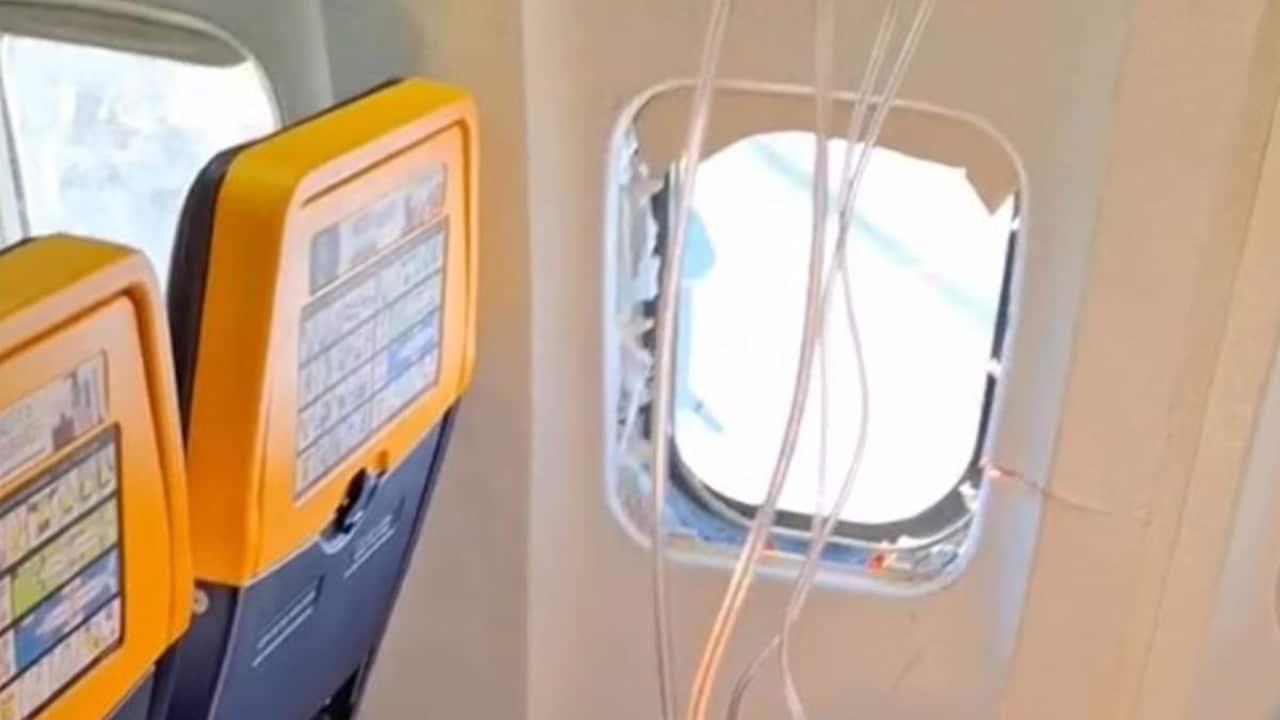
You're cruising at thousands of feet, drifting off to sleep, when a sound like a exploding car tire shatters the quiet cabin. Within milliseconds, the temperature plunges, oxygen masks drop, and the person sitting next to you is suddenly flying sideways, their head and shoulders violently yanked through a broken window into the freezing sky.
It sounds like a Hollywood horror movie, but it just became a terrifying reality for passengers on Ryanair flight FR1879. The Boeing 737-800 was traveling from Thessaloniki, Greece, to Memmingen, Germany, when engine debris broke loose, slammed into a cabin window, and blew it completely out of the airframe over North Macedonia.
A 61-year-old Serbian tourist sitting in that window seat was nearly sucked out into the void. His wife desperately grabbed his legs, anchoring him against the immense physical force of a rapid decompression, while terrified fellow travelers rushed over to drag him back into the cabin.
This isn't just a freak accident. It's a stark reminder of the incredible atmospheric forces keeping your plane in the air, and exactly why your seatbelt needs to stay fastened even when the captain turns off the sign.
Inside the Chaos of Ryanair Flight FR1879
Most of the 200-plus passengers on board the early morning flight were asleep when the engine failure occurred. When the engine debris punctured the fuselage and shattered the window, the sudden drop in air pressure created a violent vacuum.
Eyewitnesses reported a scene of pure pandemonium. The cabin filled with a strong burning smell, masks tumbled from the ceiling, and screams echoed through the plane. For a few frantic minutes, passengers genuinely believed an emergency door had been ripped wide open.
Despite wearing a seatbelt, the sheer force of the rushing air pulled the Serbian passenger's upper body completely outside the aircraft structure. He survived with friction burns and shock, thanks entirely to the fast reflexes of his wife and the surrounding passengers who held onto him until the pilots could emergency descend to a safer altitude. The plane turned back and landed safely in Greece, leaving aviation authorities scrambling to figure out how engine parts could cause such a catastrophic failure.
The Brutal Physics of Rapid Decompression
To understand why this happens, you have to look at the math of high-altitude flight. At a typical cruising altitude of 35,000 feet, the air outside is incredibly thin and freezing cold. To keep you breathing normally, the plane's environmental control systems pump in air to simulate an altitude of around 6,000 to 8,000 feet.
This creates a massive pressure differential between the inside of the cabin and the open sky. Think of a commercial airliner as a giant balloon inflated to maximum capacity. If you poke a hole in that balloon, the air inside doesn't just leak out gracefully; it rushes toward the exit with explosive velocity.
When a window detaches, the cabin pressure instantly tries to equalize with the outside atmosphere. Anything nearby that isn't bolted down gets swept up in that high-speed airflow. The physical drag on a human body in that scenario is immense, easily overpowering a standard seatbelt if the opening is large enough.
Why This Keeps Happening to Commercial Aircraft
While commercial aviation remains incredibly safe, history shows that window blowouts and fuselage breaches are a recurring vulnerability.
- The 1988 Aloha Airlines Miracle: An infamous case of explosive decompression where a massive chunk of the upper fuselage tore away at 24,000 feet. A flight attendant was tragically swept away, but the pilots miraculously landed the open-air Boeing 737.
- The 2018 Southwest Flight 1380 Disaster: This incident closely mirrors the recent Ryanair scare. An engine fan blade broke apart mid-flight, sending shrapnel through a cabin window. A passenger was partially sucked out and unfortunately sustained fatal injuries despite passengers pulling her back inside.
- The 2024 Alaska Airlines Door Plug Blowout: A brand-new Boeing 737 MAX 9 lost a deactivated emergency door plug shortly after takeoff, leaving a gaping hole in the side of the plane. Luckily, nobody was sitting in the immediate adjacent seat, preventing casualties.
In the case of the Ryanair flight, structural fatigue of the window wasn't the issue. The real culprit was an uncontained engine failure. When an engine breaks apart internally, the outer casing is supposed to catch the flying metal fragments. When it fails to do so, those fragments act like ballistic missiles, easily slicing through the thin aluminum skin or acrylic windows of the main cabin.
Your Immediate Survival Guide If a Window Blows Out
If you ever find yourself in a decompression emergency, you don't have time to think. You have to act on instinct.
First, secure your own oxygen mask the absolute second it drops. At high altitudes, the time of useful consciousness—the window where you can still think clearly and function—is less than 30 seconds. Without oxygen, you'll pass out before you can help anyone else.
Second, keep your seatbelt fastened tight across your lap throughout the entire duration of the flight, not just when the sign is illuminated. A snug seatbelt is your primary line of defense against being displaced by a sudden rush of air.
If you see someone else being pulled toward a breach, don't try to stand up completely or put yourself in the direct path of the airflow. Secure your own mask, anchor yourself firmly to your seat structure, and use your combined weight with other passengers to pull them back in from a stable position.
Aviation regulators are currently inspecting the remnants of the Ryanair Boeing 737-800 engine to determine why the containment housing failed. Until those findings are released, your best bet for peace of mind is staying buckled up tight on your next flight.