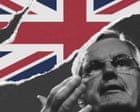
Ten years after the seismic shock of the Brexit referendum, the man who spent four years staring down British negotiators across boardroom tables in Brussels has dropped a political bombshell. Michel Barnier believes the UK could rejoin the European Union and actually get its old opt-outs back.
That means keeping the pound. It means staying out of the passport-free Schengen zone.
It is a staggering claim that flies in the face of standard Brussels orthodoxy, where conventional wisdom dictates that any new applicant must pledge total allegiance to the euro and the bloc's shared borders. Barnier, the EU's former chief negotiator and a former prime minister of France, is tossing out the rigid rulebook just as the UK and Europe approach a decade of separation.
But don't mistake this for a sudden burst of sentimental warmth. Barnier remains as cold, calculated, and deeply critical of the political choices that led to Brexit as he was when he managed the divorce.
The Myth of the Mandatory Euro
Most people assume that rejoining the EU is a done deal for a total loss of British identity. The standard argument from anti-rejoin campaigns is simple: if the UK goes back, it will be forced to scrap the pound, adopt the euro, and dissolve its borders entirely.
Barnier says that is wrong.
Speaking ahead of a major policy conference in London marking ten years since the 2016 vote, Barnier pointed out that the EU is already a multi-speed system. Precedents exist. Denmark has a permanent opt-out from the single currency. Other member states technically owe an allegiance to the euro but have dragged their feet for decades without ever adopting it. Sweden has managed to stay outside the Eurozone since 1995 without any serious penalty.
"I am speaking about Schengen, I am speaking about the single currency," Barnier noted. "There are other member states who are not in them."
If the UK decided to knock on Brussels' door again, everything would be open to a fresh negotiation. While he wouldn't commit to whether Britain could reclaim the massive financial budget rebate originally won by Margaret Thatcher in 1984, he made it clear that the core exemptions that defined Britain’s unique relationship with Europe are not dead and buried.
The Cost of the Great Lie
Barnier hasn’t softened his view on the politicians who engineered the split. He still views the entire campaign as a masterclass in political opportunism, pointing squarely at Boris Johnson. To Barnier, the narrative that Brussels was the root of every British problem was a cynical trick used to seize power in London rather than an honest critique of European governance.
A decade later, the structural fractures in the British economy are hard to ignore. Growth is sluggish. The immigration debate has grown toxic. Labor shortages continue to hobble key industries.
Barnier is careful not to blame every single British crisis on the 2016 exit. That would be too simplistic. Instead, he points out that leaving the single market turned ordinary economic hurdles into mountain ranges.
"It would not be fair to say that the problems of the UK today are due to Brexit," Barnier said. "But what I am sure of is that all these problems are more difficult because of Brexit."
The populist promises made by figures like Nigel Farage have collided with reality. Farage can still win seats, but he can no longer claim that a distant bureaucracy in Belgium is blocking British prosperity. The scapegoats have run out.
Starmer's Red Lines and the Rise of the European Far Right
Back in London, Prime Minister Keir Starmer has been attempting a quiet "reset" of relations with Europe. A summit in Brussels is scheduled for July 22, 2026. But Starmer has drawn strict, unyielding lines in the sand: no return to the customs union, no return to the single market, and absolutely no return to the free movement of people.
To Barnier, this approach is fundamentally flawed. You cannot have frictionless trade if you refuse to let workers cross borders. It is a mathematical impossibility in the architecture of the European single market, where the four freedoms—goods, capital, services, and labor—are permanently locked together.
When asked directly if the UK could secure a deeper, custom-built trade deal while maintaining a ban on free movement, Barnier’s response was an immediate no.
The reason isn't just bureaucratic stubbornness. It is a matter of political survival for the mainstream European center. With France facing a crucial election next spring and nationalist figures like Marine Le Pen polling exceptionally well, Brussels cannot afford to give Britain a special, cherry-picked trade deal. Doing so would hand a massive propaganda victory to domestic populists who want to dismantle the EU from within.
If Britain gets all the benefits of the single market without any of the obligations, French or German nationalists will logically ask why they are paying membership fees and accepting EU rules.
A New Alliance for a Dangerous World
Instead of standard integration, Barnier is pushing for a completely different architecture outside the formal structures of the European Union.
He wants to build a new European council for defence and security. This body would sit completely independent of Brussels institutions, allowing the UK to sit at the table alongside EU states, Norway, and Ukraine.
The world in 2026 is vastly more volatile than it was in 2016. War is on the European continent. Global defense spending is skyrocketing. Barnier's proposal involves deep military cooperation, shared intelligence, and potential joint borrowing to fund massive defense initiatives, particularly in artificial intelligence and next-generation military tech.
It is a recognition that while economic integration is stuck in a political stalemate, security cannot wait.
The Reality of Rejoining
While Barnier's comments offer a massive psychological boost to British Europhiles, the practical path back to Europe is incredibly steep.
First, any single EU member state holds veto power over a new applicant. Spain could object over Gibraltar. France could demand massive concessions on fishing waters.
Second, the British political landscape remains too fractured to handle another generational debate over Europe. Starmer’s cautious approach reflects a deep fear of re-opening the wounds of the last decade.
The immediate next steps aren't a grand re-application process. If you want to track where the UK-EU relationship is actually heading, watch the technical committees during the July 22 reset summit. Look for quiet agreements on veterinary standards, energy grid links, and defense procurement. That is where the real work is happening. The grand political rhetoric of rejoining makes for great headlines, but the future will be built in the boring, unglamorous fine print of regulatory alignment.