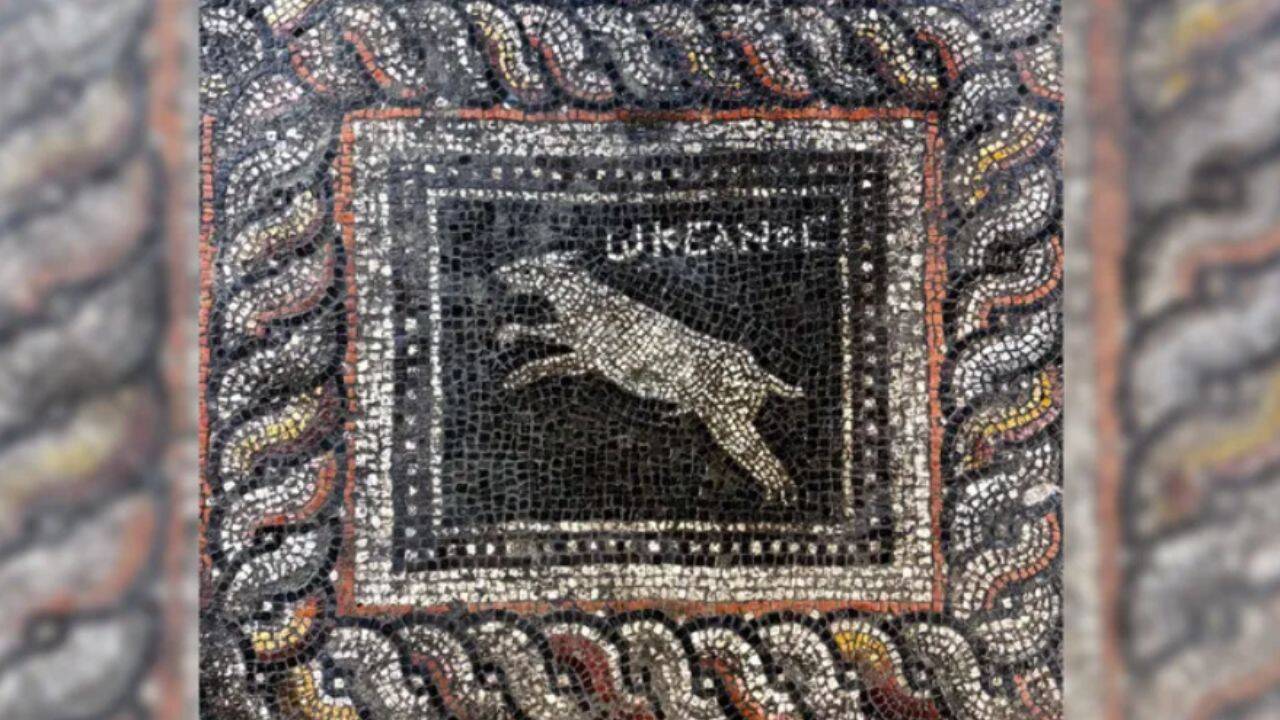
History books usually focus on emperors, wars, and political collapses. They rarely tell you what people called their pets. That changed when archaeologists working on the Aegean coast of Turkey uncovered an ancient Roman floor mosaic featuring two distinct animals with their names spelled out in Greek letters.
The find dates back around 1,800 years to the late second or third century AD. Unearthed in the ancient city of Adramytteion, this luxurious villa floor offers a rare, personal glimpse into daily domestic life during the height of the Roman Empire. You might also find this similar story useful: Why Britain Just Weaponized Trade Against West Bank Settlements.
Inside the Adramytteion Roman Villa
The mosaic was discovered within a sprawling residential complex featuring three main halls, a central atrium, and a sophisticated drainage network. Measuring roughly 16.4 by 11.8 feet, the floor artwork is split into 15 distinct panels arranged neatly across three rows. Most panels depict common motifs like local wildlife, birds, fish, and traditional mythological icons such as a gorgon and a winged horse.
The color palette features white, black, red, orange, yellow, pink, burgundy, blue, turquoise, and green tiles. Yet, two panels immediately capture attention because they break standard artistic conventions by naming specific animals. As extensively documented in latest coverage by The New York Times, the effects are notable.
Emerald the Cat and Ocean the Dog
On the left side of the room, visitors are greeted by a pale-furred cat lounging comfortably on a blue-green cushion. Greek letters above the animal spell out “Zmaragdin,” meaning emerald.
Hüseyin Özgen, head of the Adramytteion research team at Mimar Sinan Fine Arts University, highlights that this feline wasn't depicted as a stray or feral hunter. Its relaxed posture on a plush cushion strongly points to a domestic pet. Özgen suggests the name Emerald might tie back to trading connections with Roman Egypt, where emerald mines operated heavily at the time.
On the opposite side of the room, another panel shows a leaping dog labelled with the Greek letters “Okeanos,” meaning ocean. Given that Adramytteion functioned as a bustling provincial harbour city on the Aegean Sea, the dog's name likely reflected its coastal environment.
Why These Names Matter Today
Most ancient animal depictions in art remain anonymous symbols. Finding specific names like Emerald and Ocean bridges the gap between modern pet owners and ancient households.
Whether these animals were beloved companions or familiar fixtures of the household, their owners took the trouble to immortalize them in expensive, colorful stone tilework. It proves that human affection for cats and dogs spans millennia.
Archaeological work at the site continues to peel back layers of provincial life in Asia Minor. Future excavations will likely reveal more about the wealthy residents who walked across these mosaic floors nearly two millennia ago.