You wake up, look out the window, and notice the sky isn't its usual crisp blue. Instead, it looks like a hazy, milky sheet of plastic. Your throat feels scratchy. Your nose starts running. No, you didn't catch a sudden summer cold overnight. You're breathing in microscopic particles of North African desert sand that just wrapped up a 5,000-mile journey across the Atlantic Ocean.
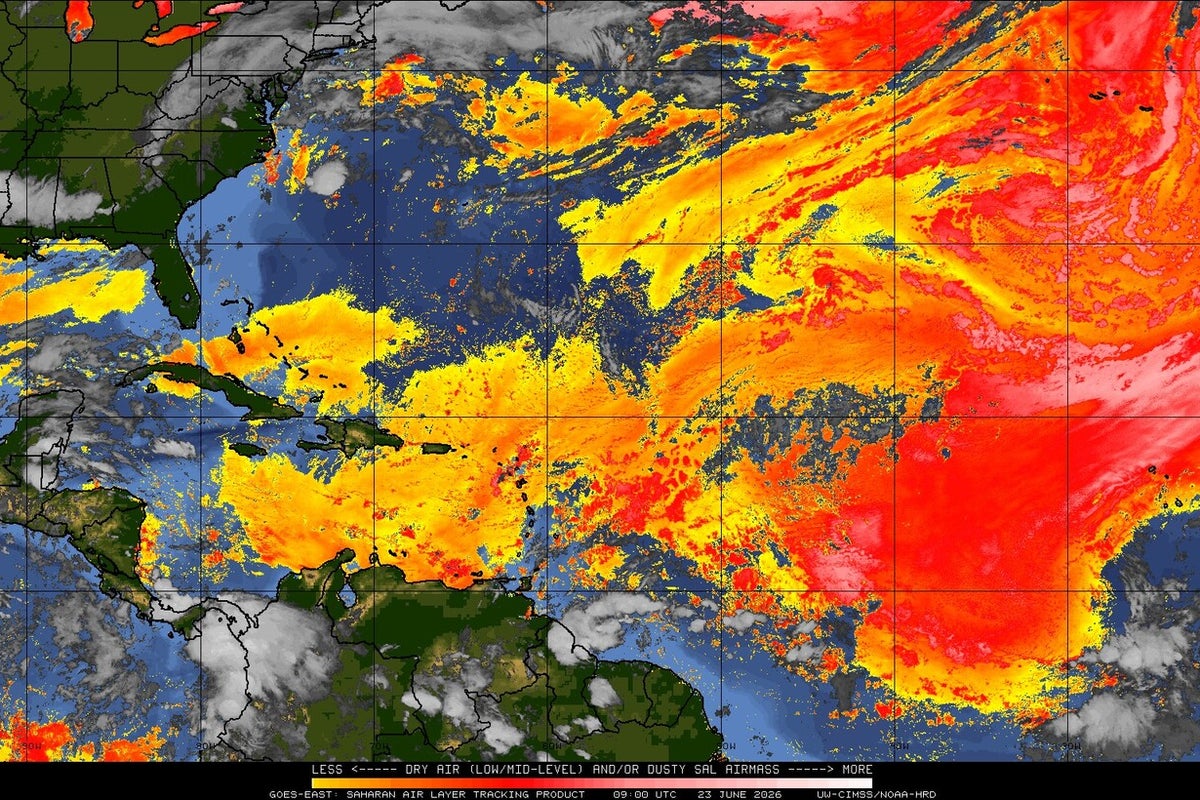
A massive plume from the Saharan Air Layer is sweeping across the Caribbean and engulfing portions of the southeastern United States, with Florida taking the direct hit. Local officials in Miami-Dade County already issued an Air Quality Alert covering inland areas like Miami, Hialeah, and Florida City. The warning is clear: the air outside is getting thick with fine particulate matter, specifically PM2.5 and PM10.
Honestly, it's easy to look at weather alerts and change the channel. Don't do that this week. This specific atmospheric event is colliding with an oppressive summer heatwave, and the combination changes the game for your health, your afternoon commute, and the rest of the 2026 Atlantic hurricane season.
The Science of the Saharan Air Layer
This isn't a freak weather anomaly. It happens every single year. Between June and August, strong winds over North Africa whip up millions of tons of dust from the Sahara Desert, lifting it miles into the sky. This hyper-dry, warm air mass gets caught in the trade winds and marches west across the ocean like a massive atmospheric conveyor belt.
The plume sitting over the Southeast right now is massive. Think of it as a 2-mile-thick blanket of dust hovering roughly a mile above the ground. As it glides over land, those fine minerals—mostly quartz, feldspar, and various clay particles—slowly filter down into the lower air we breathe.
When it rains, water droplets grab these particles on their way down. Once the rain dries on your car or your patio furniture, it leaves behind a distinct, dingy film of tan dirt. You're literally looking at pieces of African topsoil sitting on your windshield.
The Hidden Health Risks Most People Ignore
The immediate instinct during a dust event is to complain about your dirty car or marvel at the deep orange color of the sunset. But the real issue is what these particles do to human lungs.
The air alert highlights PM2.5 particles. These are microscopic bits of dust less than 2.5 micrometers in diameter. To put that in perspective, they're about thirty times thinner than a single strand of human hair. You can't see them, but you can definitely feel them.
Because they're so small, your body's natural defense mechanisms—like the hairs in your nose—can't filter them out. They travel deep into your lungs and can even enter your bloodstream. If you suffer from asthma, bronchitis, or chronic obstructive pulmonary disease (COPD), this week is going to be rough. Even healthy people will likely experience stinging eyes, a scratchy throat, and sinus headaches.
Worse, this dust didn't travel empty-handed. As it drifted across the ocean, it picked up hitchhikers. Researchers have found that Saharan dust plumes frequently carry mold spores, pollen, and airborne bacteria. If your seasonal allergies are suddenly flaring up in late June, the desert is the culprit.
The Silver Lining for Hurricane Season
It's not all bad news. While your lungs might hate the dust, the tropical Atlantic absolutely loathes it. And right now, that's exactly what the Gulf Coast needs.
The region is still cleaning up from Tropical Storm Arthur, which formed near Texas on June 17 as the first named system of the 2026 hurricane season. Arthur brought absolute chaos, dumping up to 20 inches of rain in some areas and spinning up three destructive tornadoes near New Orleans with winds hitting 95 mph.
Hurricanes need three main things to survive and thrive: deep moisture, warm ocean water, and low wind shear. The Saharan Air Layer acts like kryptonite to developing storms because it disrupts all three.
First, the dust cloud is incredibly dry. It basically smothers tropical waves before they can organize, starving them of the moisture needed to build thunderstorms. Second, it comes packed with a strong mid-level jet stream, which creates heavy wind shear. This shear rips apart any violent weather systems before they can converge and grow into full-blown hurricanes.
So while you're trapped indoors waiting for the air quality to improve, take comfort in the fact that the Atlantic basin is staying quiet. The dust is effectively pressing the pause button on the hurricane season for the next week.
Expect Brutal Heat and Surreal Sunsets
If you think the humidity is bad now, just wait. Local meteorologists in South Florida are warning that "feels like" temperatures could easily spike between 105 and 110 degrees Fahrenheit over the next few days.
The dry air mass acts like a lid on the atmosphere. It chokes out the usual afternoon thunderstorms that normally provide a brief, cooling respite from the summer heat. Without those clouds and storms, the sun bakes the ground continuously. The result is an intense, dry heatwave layered over an already stifling climate.
The only visual perk to this entire mess happens twice a day. Because the mineral particles scatter sunlight in a very specific way, they block shorter wavelengths of light like blues and greens. Only the longer wavelengths can punch through the haze. This means sunrises and sunsets over the next few days will look intensely vibrant, casting deep reds, fiery oranges, and dusky purples across the horizon.
What You Need to Do Right Now
Stop treating this like a minor weather quirk. Take a few basic steps to protect your home and your health until the plume moves out later this week.
Run your air conditioning on the recirculate setting. Don't pull in hazy outside air. Check your home's HVAC filter right now. If it's coated in grey grime, replace it immediately with a high-quality filter rated for micro-allergens.
Move your strenuous workouts indoors until the air quality alerts clear. If you absolutely must work outside, consider wearing a high-filtration mask like an N95 to keep those fine mineral particles out of your airway. Finally, keep a close eye on children, elderly relatives, and pets. They suffer the fastest when the air gets toxic.
The dust will eventually pass as fresher marine air moves back into the Southeast by the weekend. Until then, stay inside, keep the windows sealed, and get ready for some wild sunsets.