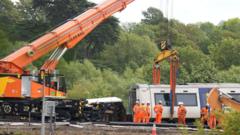
On August 13, 2026, a routine Southern service from London Victoria to Eastbourne turned into a nightmare for 150 passengers. Near Lewes, in East Sussex, the rear three carriages of an eight-coach train left the tracks, toppled onto their sides, and slid down an embankment. Thirty people were hurt. Two suffered serious injuries.
It was the hottest day of the year. Temperatures soared. While investigators from the Rail Accident Investigation Branch (RAIB) are still piecing together the full sequence of events, early findings have zeroed in on a critical issue: a track "irregularity."
The reality of buckling tracks
You might think modern railways are immune to the weather. You’d be wrong. Steel rails expand in extreme heat. When they have nowhere to go, they buckle. This is a known risk, but the images released by the RAIB from the Lewes site show a clear, alarming bend in the track that existed before the accident.
Preceding trains caught the defect on CCTV. Passengers on other services had even reported "rough riding" in the same area days prior. When commuters start complaining about a bumpy ride, it's rarely just an annoyance. It’s often a warning sign.
The embankment near the crash site is composed of clay. Clay is notorious for shifting when moisture levels fluctuate. While there is no current evidence of a massive embankment slip, we know the ground there isn't perfectly stable. When you combine climate volatility with aging infrastructure, the safety margin narrows drastically.
Why the recovery process takes so long
You might be wondering why it takes over two weeks to fix a section of track. After all, we live in an era of rapid logistics. The answer lies in the site's geography. The derailment occurred near a Site of Special Scientific Interest (SSSI). This isn't just a stretch of dirt; it's a protected ecosystem.
Recovery teams can’t just roll in with heavy machinery and crush everything in sight. They have to use rail-mounted cranes to lift the overturned carriages with extreme precision. The complexity of the extraction, combined with the need to preserve evidence for the ongoing investigation, means the line won't fully reopen until September.
It’s a massive logistical hurdle. It’s also a necessary one. If we rush the recovery, we risk losing the "black box" data or the physical evidence of the track failure that we need to prevent this from happening again.
Lessons for the future
This wasn't an isolated incident. Within 24 hours of the Lewes crash, another train derailed in Wickford, Essex. While nobody was hurt in that second incident, it confirms a pattern. The UK rail network is struggling to handle the thermal stress of modern heatwaves.
We need to be honest about the state of our infrastructure. Mitigation efforts—like painting rails white to reflect heat or implementing temporary speed restrictions—are stopgaps. They don't fix the underlying issue of climate adaptation.
If you travel frequently, you should pay attention to these early warnings. The next time you notice a consistent "bump" or "shudder" in a specific section of your commute, don't just ignore it. Report it. Use the operator's feedback channels or reach out to local transport watchdogs. You aren't just being a "difficult" passenger; you are part of the safety loop.
The investigation into the Lewes crash will likely drag on for months, perhaps a year or more. The final report will almost certainly point to a combination of environmental factors and maintenance oversights. Until then, the focus must shift from merely "getting things moving again" to a fundamental audit of how our tracks handle a changing climate.
Infrastructure resilience isn't just about big projects; it’s about acknowledging that the environment we built for fifty years ago isn't the one we’re living in today. Watch how the rail operators respond in the coming months. They have a lot of work to do.