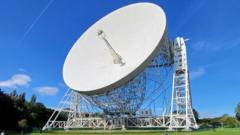
You have probably seen the headlines. The iconic Jodrell Bank Observatory, home to the massive Lovell Telescope in Cheshire, is facing a stark reality. UK Research and Innovation recently announced plans to pull its annual funding of roughly £2.8 million by March 2028.
People are asking what this means for British science. They want to know why a giant metal dish built in the 1940s still commands attention today.
Let us clear up the confusion. Jodrell Bank is not just a rusty relic from the space race. It is a working powerhouse of modern radio astronomy.
What Jodrell Bank Actually Does
Founded in 1945 by Bernard Lovell, the site changed how we see the universe. Back then, optical telescopes were the only game in town. Clouds got in the way. Daylight ruined observations. Lovell realized you could listen to invisible radio waves echoing from deep space.
Today, the observatory anchors e-MERLIN. That is a network of seven radio telescopes spread across the UK, operated by the University of Manchester. Together, they act like a virtual telescope hundreds of miles wide.
Astronomers use this setup to study pulsars, map star formation, and track cosmic phenomena. Just recently, researchers proved the Lovell Telescope could track space debris. That capability grows more vital every day as low Earth orbit fills with commercial satellites.
The Funding Crisis Explained
Why cut a UNESCO World Heritage Site? The Science and Technology Facilities Council claims escalating operational costs and tight budgets forced their hand. They argue that money must shift toward newer international projects, like the Square Kilometre Array being built in South Africa and Australia.
Scientists are furious. Figures like Professor Brian Cox have slammed the decision as hasty and short-sighted. Nearly 3,000 scientists rely on this network. Twenty-eight jobs at the Cheshire site hang in the balance.
Without replacement funding from private donors, industry partners, or government intervention, scientific observations will stop on April 1, 2028.
Why Losing It Hurts UK Science
You cannot just turn off a facility like this and expect to turn it back on later. If the funding dries up, specialized engineering talent walks away. Decades of institutional knowledge vanish.
The visitor centre will likely stay open for its 125,000 annual tourists, but a silent dish loses its soul. It becomes a museum piece rather than an active window into the cosmos.
The next two years will determine its fate. Watch how the University of Manchester and local leaders handle the scramble for alternative cash.
UK's iconic Jodrell Bank telescope faces axe in science cuts
This video details the breaking news regarding the recent funding cuts and the looming threat facing the Lovell Telescope.