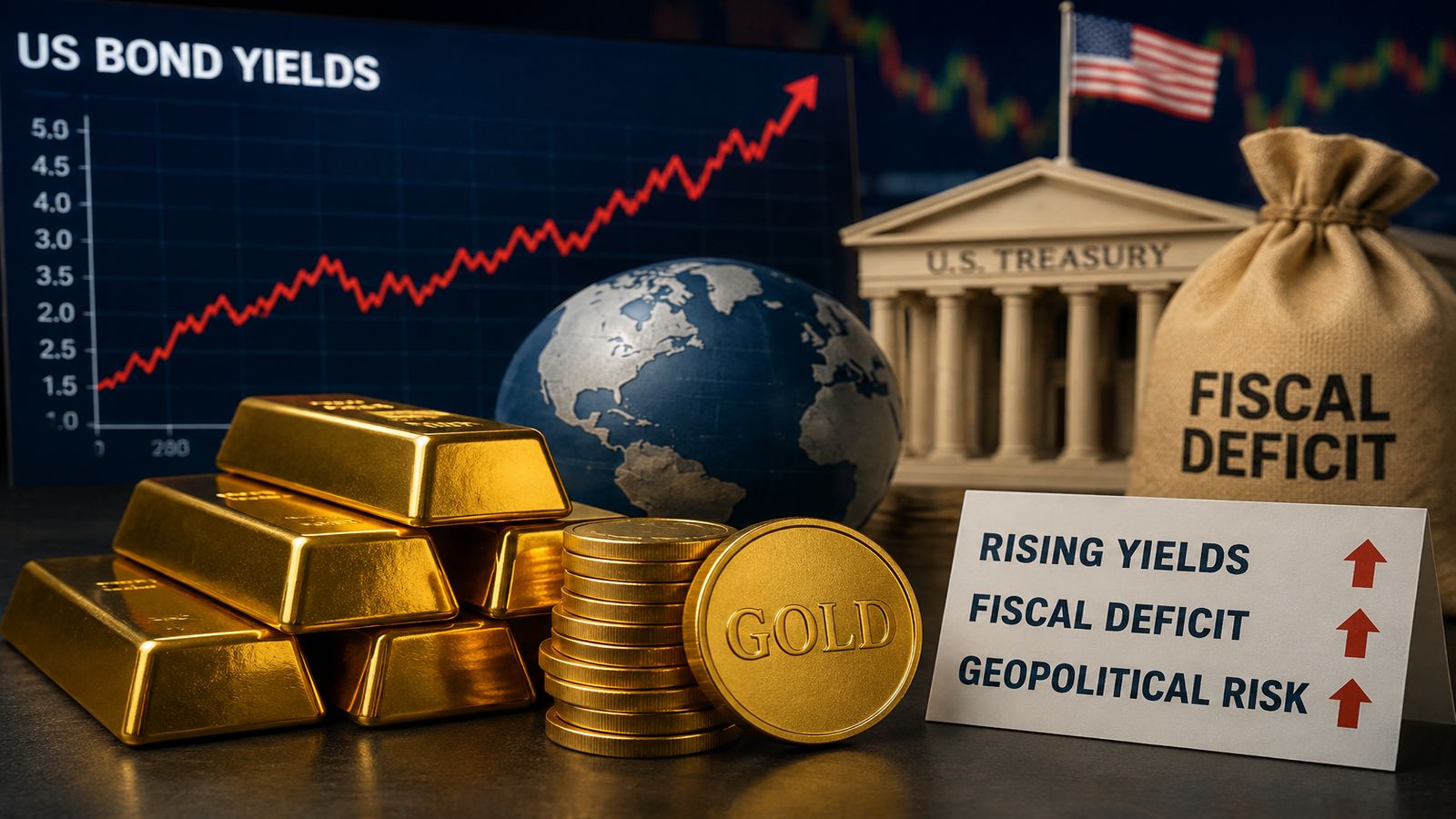
Most investors have been taught a simple rule: when bond yields rise, sell your gold. The logic is straightforward enough. Gold pays zero interest. Why hold a lump of metal when you could collect a guaranteed five percent from a U.S. Treasury? It makes sense on a spreadsheet.
But markets rarely follow a clean, linear path.
Arvind Sanger of Geosphere Capital has been highlighting a shift that many professionals keep missing. We aren't in a normal environment anymore. The old playbook—where gold and bonds trade in a predictable, inverse relationship—is fraying at the edges. When you see bond yields climbing alongside gold prices, it’s not an anomaly. It’s a warning sign.
The fiscal reality check
The primary driver for this new reality is the growing concern over fiscal sustainability. When yields on long-term U.S. debt rise because investors are worried about the government's ability to manage its debt pile, the "risk-free" label on those bonds starts to look a bit shaky.
Think about the math. If a bond's yield reflects a premium for fiscal risk—essentially the fear that the debt burden is becoming unmanageable—it doesn't just act like a standard fixed-income instrument. It starts acting like a vote of no confidence. Gold thrives in that specific kind of doubt. It doesn't care about the Federal Reserve's rate decisions as much as it cares about the long-term value of the currency used to buy it.
When you see yields rising because of massive fiscal deficits rather than robust economic growth, gold stops being a "non-yielding asset" and starts being a hedge against a debased financial system. That’s why keeping it as a core holding isn't just sentimentality. It’s tactical.
Crude oil and the geopolitical tax
You can't talk about portfolio protection without looking at energy. The Strait of Hormuz isn't just a stretch of water; it’s a choke point for the global economy. As Arvind Sanger has noted in his analysis of the Middle East, the risk premium on oil is always there, even when the market tries to look past it.
If you're betting on Indian equities or other emerging markets, you are essentially betting against a massive supply shock in the energy sector. If shipping costs spike because of regional tensions or if crude production faces legitimate disruptions, that "tax" flows directly through to inflation.
Gold acts as the ultimate shock absorber in that scenario. Unlike stocks, which get slammed by high energy costs that eat into margins, gold tends to hold its ground when the news turns dark. If you’re exposed to cyclical sectors, you need that anchor.
Why the old correlation is breaking
Investors often get tripped up by relying on historical correlations that don't apply to the present. Between 1976 and 2024, the correlation between bond yields and gold was largely negative. People point to that chart and think it’s a law of nature.
It isn't.
There have been specific periods—like the late 1970s or the post-pandemic inflationary spike of 2021—where both gold and interest rates surged. Why? Because the market became terrified of inflation. When the "real rate" (the nominal yield minus inflation) stays low, gold doesn't care that the headline yield is moving up. It keeps winning because the dollar is losing its purchasing power faster than the bond is paying its interest.
Acting on the data
If you’re managing your own portfolio, don’t treat your gold allocation as a "buy and forget" item. Treat it as a structural necessity. Here’s how to handle it:
- Stop looking for the "perfect" time. If you wait for bond yields to collapse before buying gold, you’ve already missed the point. You own gold precisely for the times when yields are acting strange and the fiscal outlook is cloudy.
- Focus on real, not nominal, returns. If you’re getting a 4.5% yield on a bond but inflation is projected to be 4%, you’re barely keeping your head above water. In that environment, a non-yielding asset like gold doesn't have a high "opportunity cost." It has a low one.
- Monitor the debt-to-GDP conversation. The U.S. federal interest expense is hitting record highs. Every time that number hits a new milestone in the headlines, pay attention to the price of gold. That’s the real benchmark.
Ultimately, you don't need gold to "beat" the market every single year. You need it to be there when the rest of the portfolio starts looking like a house of cards. Keep your core exposure, ignore the daily fluctuations in bond yields, and focus on the fiscal fundamentals. That’s how you protect what you’ve built.