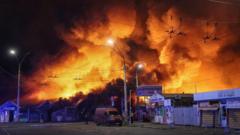
The skies over Eastern Europe rarely stay quiet for long. Recent waves of aerial strikes have once again turned residential neighborhoods into frontlines, leaving civilian casualties mounting on both sides of the border.
When air raid sirens wail through cities like Kryvyi Rih, Sumy, and Zaporizhzhia, the reality of modern attritional warfare hits home instantly. Five people lost their lives in Russia's southwestern Rostov region alone during a massive overnight exchange involving hundreds of drones and ballistic missiles. Meanwhile, Ukrainian strikes deep inside Russian territory continue to target logistics hubs and industrial centers, bringing the physical weight of the conflict directly to the Russian public.
The Human Toll Behind the Statistics
Numbers on a screen rarely capture the disruption. A missile strike doesn't just damage infrastructure; it shatters daily routines. In Kryvyi Rih, a sudden missile impact claimed two lives and injured over a dozen others. In the southern Zaporizhzhia region, a direct hit on a family home killed a man and a woman who thought they were far enough from the trenches.
We are seeing a grim pattern. Civilian areas absorb the blow whenever air defense systems intercept incoming payloads overhead, sending debris crashing into apartments and private yards.
Shifting Tactics in the Air War
The nature of these aerial campaigns has evolved. Ukraine has dramatically scaled up its long-range drone capabilities, pushing hundreds of unmanned aerial vehicles across the border to pressure Russian logistics, energy grids, and retail distribution warehouses like Wildberries.
On the other side, Moscow relies heavily on persistent missile barrages and drone waves to degrade urban centers and psychological endurance. Ukrainian President Volodymyr Zelenskyy noted that air raid alerts have become an endless fixture of daily life as military commands on both sides try to outpace each other's defensive shielding.
What Comes Next
As long as neither side can secure a decisive battlefield breakthrough, these tit-for-tat aerial exchanges will likely intensify. The international community watches closely, but on the ground, survival dictates the hours. Prepare accordingly if you are monitoring regional security or managing logistics in affected zones. Stay alert to early warning systems, keep emergency channels open, and factor ongoing airspace closures into any regional transit plans.
Five dead in Moscow region as Ukraine continues warehouse strikes
This video provides an on-the-ground look at the recent wave of drone strikes hitting the Moscow region and the resulting security response.
http://googleusercontent.com/youtube_content/1