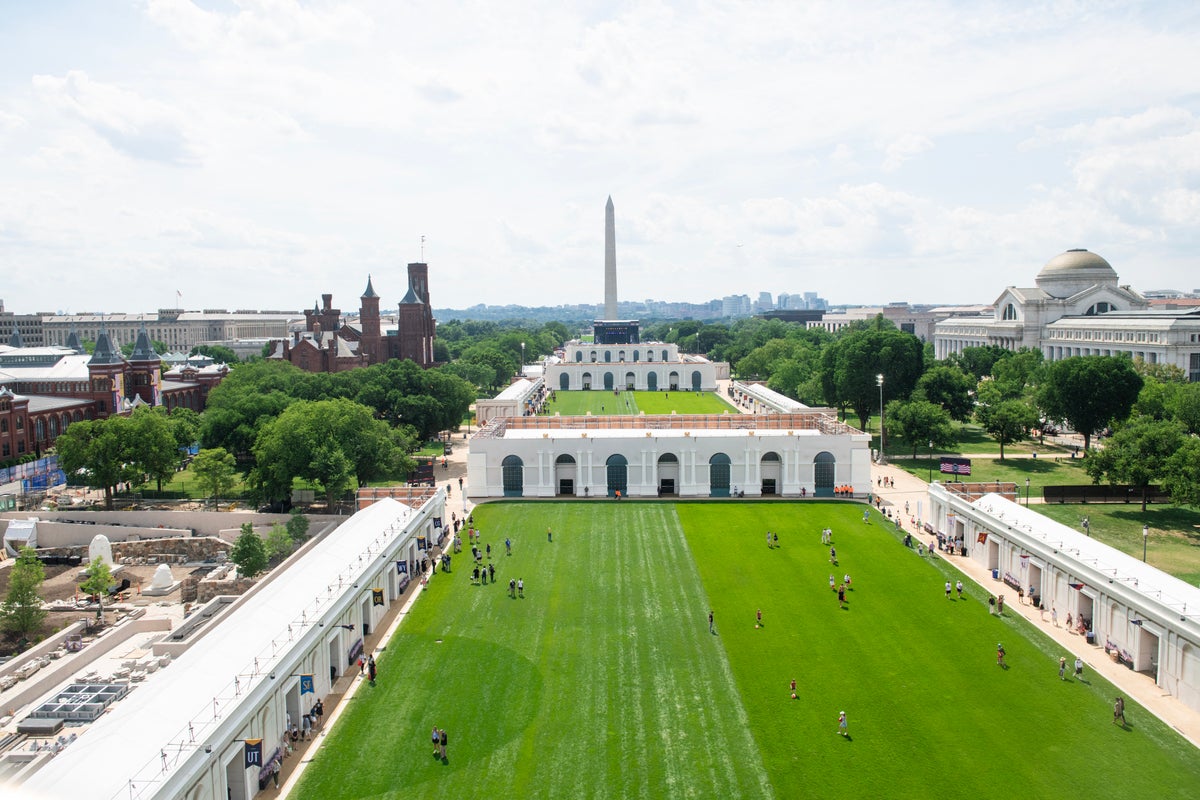
The camera angle can trick you for a second, but it cannot hide an empty National Mall.
Donald Trump wanted his highly promoted Great American State Fair to serve as a massive, historic celebration kicking off America’s 250th anniversary. Instead, the opening of the 16-day event turned into a glaring lesson in the limits of cable news spin. While on-air personalities talk about huge crowds, independent lenses and raw aerial shots reveal a vastly different, much quieter reality on the grass. Meanwhile, you can explore other events here: Why Europe Can't Handle The Summer Heatwave.
If you watched the early primetime broadcasts, you heard talk of thousands of patriots gathering in Washington, D.C. Network hosts hyped up the event for hours beforehand, promising a massive kickoff rally. But when the actual live feeds cut to the ground, the illusion fractured.
The crowd didn't just look thin. It looked entirely detached. To understand the complete picture, check out the excellent article by USA.gov.
The Spin Versus the Wide Shot
Cable news networks have mastered the art of tight framing. If you place a camera low to the ground, aim it upward, and pack a few hundred people closely together in a single designated area, the resulting shot feels packed.
That is exactly how the opening night kicked off. Hosts stood in front of tightly grouped pockets of supporters, while commentators spoke broadly about an overwhelming turnout.
But independent journalists and local news crews didn't stick to the scripted angles. Wide-angle photos and videos quickly flooded social media, showing massive gaps of green grass extending across the National Mall.
NBC News estimated the actual opening crowd at just over 1,000 people. To put that in perspective, The Washington Post noted that the audience thinly covered an area smaller than typical summer outdoor movie screenings in the city.
The visual disconnect was stark. While network voices insisted the Mall was overflowing, background B-roll showed a handful of attendees wandering past largely vacant state exhibits. Outside the small cluster near the main stage, the scene looked less like a historic national gala and more like a local park on a slow Tuesday afternoon.
Why the Freedom 250 Headliner Lost Momentum
The fair was not originally supposed to be a standard campaign rally. The initial concept for the Freedom 250 celebration focused on a bipartisan, nationwide festival featuring state booths, cultural exhibits, and a lineup of prominent musical acts.
The trouble started when the event became heavily politicized. Once it became clear that the celebration would center primarily around a single political figure rather than a broad national theme, multiple scheduled musical artists pulled out of the event entirely.
Faced with a collapsing entertainment lineup, Trump decided to insert himself as the primary headliner, promising "the Greatest Rally, EVER."
It did not deliver. Observers on the ground reported that the president appeared visibly frustrated by the lackluster turnout. Rather than his typical hours-long energetic performance, he wrapped up his remarks in less than 30 minutes.
Even more telling was the behavior of the attendees who did show up. Observers noted streams of people actually walking away and exiting the Mall right in the middle of the speech. The energy was low, the humidity was high, and the massive, roaring stadium atmosphere the organizers expected never materialized.
Before leaving the stage, Trump even made an explicit plea to the crowd regarding the upcoming July 4 events. He told the audience to make sure people show up, stating that if there are even two empty seats, the media will report that he failed to fill the venue.
The Logistics Breakdown Behind the Empty Mall
Turnout was only part of the problem. Visitors who actually made the trip to the National Mall encountered a series of operational mishaps that quickly became fodder for online mockery.
- Power Outages: Multiple state exhibition booths suffered sudden electrical failures during the opening days, leaving interactive displays dark.
- Melted Vendors: The sudden technical issues and lack of infrastructure left food vendors struggling, with ice cream trucks and food stalls forced to close early.
- Billboard Errors: Promoters managed to misspell key promotional text on a massive regional billboard directing traffic to the fair, drawing immediate viral ridicule on social media.
- Flag Controversies: Local reports surfaced regarding the appearance of controversial historical flags at certain booths, sparking immediate political infighting among organizers.
When you mix technical failures with a highly partisan atmosphere, you alienate the average tourist. Families looking to celebrate America's history don't want to walk into a politically charged environment plagued by broken infrastructure. They simply stay away.
The Limits of the Media Reality Machine
This entire episode highlights a growing challenge for political media operations. For years, tight camera angles and aggressive on-air messaging could successfully dictate the narrative of an event to millions of viewers at home.
That strategy fails when the event occurs in an open, public square like the National Mall. Anyone with a smartphone can stand on the steps of the Lincoln Memorial, take an unedited photo of the landscape, and post it online instantly. You cannot claim an area is packed when public webcams show wide-open fields of grass.
The reality distortion machine works well inside closed arenas where access is strictly controlled. Out in the open air of Washington, D.C., the cameras simply won't lie.
If you want to track how the attendance numbers shift as the event approaches the actual July 4 holiday, keep an eye on independent, live-streaming public architecture cams focused on the Mall rather than the curated feeds of partisan networks.