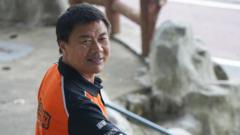
When you order food on an app, you don't think about the person on the electric scooter rushing to your door. You just want your meal hot. But in China, one of those riders just did the unthinkable. Wang Jibing, a 56-year-old delivery courier, won the Lu Xun Literary Prize, one of China's most prestigious literary honors.
He didn't win a gimmicky internet award. He won a prize named after the father of modern Chinese literature, traditionally reserved for elite, professional academics and career authors. He did it by typing verses into his phone while waiting for elevators, idling at red lights, and resting between grueling shifts in Kunshan, Jiangsu province.
This isn't just a feel-good story about an underdog. It marks a massive structural shift in who gets to control the cultural narrative in a country where the gig economy keeps major cities running.
The Poetry of Algorithm Oppression
Wang Jibing became a delivery rider in 2019 when he was 50 years old. He was the oldest guy at his station, facing an invisible whip: the delivery app's algorithmic countdown.
The turning point came during a nightmare delivery in 2019. A customer entered the wrong address. Wang spent hours wandering through three different residential buildings, climbing 18 flights of stairs. When he finally handed over the food, the customer berated him for being late. He faced financial penalties from the platform for the delay. On his bike ride home, furious and exhausted, he wrote a poem on his phone called Man in a Hurry.
The poem went viral on Weibo in 2022, clocking millions of views because it captured the exact flavor of modern urban anxiety.
His award-winning collection, Low Flight (sometimes translated as Low Altitude Flight), takes this raw reality and scales it up. Wang didn't just write about his own sore legs. He interviewed over 140 delivery workers and surveyed 60 more to capture the collective weight of an entire industry.
Cracking the Elite Literary Bubble
For decades, mainstream Chinese literature functioned like a strict pyramid. The state-backed China Writers Association largely recognized professional, university-educated elites. Blue-collar workers were written about, but they rarely held the pen.
Wang's win disrupts that entire ecosystem. He dropped out of school at 14, did stints as a construction laborer, a sand dredger, and a scrap collector. He's a grassroots writer who lived the hardships firsthand.
"Not every pair of wings can fly straight into the clouds. A flight close to the ground is still a flight." — Wang Jibing
The literary establishment couldn't ignore the depth of his work. Cultural scholars note that this signals a structural shift from elite grand narratives to the unvarnished stories of the working class. Wang wasn't the only one either. The latest prize cycle also nominated Chen Hui, a woman who has run a vegetable and general goods stall in a wet market for 18 years, for her sharp, observant essays.
Why the Rider Refuses to Quit His Job
You'd think winning a massive national prize and scoring an upcoming US book translation with Chax Press would mean quitting the e-bike. It doesn't. Wang instantly went back to delivering food after the announcement. He intends to keep riding until he turns 60.
He is surprisingly candid about his fame. He openly admits that a lot of the praise he receives stems from the "delivery rider poet" label rather than the pure mechanics of his text. People read his work with sympathy or pity, which makes him cautious. He stays on the road because the street is his inkwell. If he isolates himself in a comfortable office, the connection to the silent majority disappears.
The Real Takeaway For Creators
Wang Jibing's achievement destroys the ultimate excuse used by aspiring writers worldwide: "I don't have the time or the perfect environment to create."
If a 56-year-old man can write 6,000 poems on a smartphone touch screen while fighting city traffic and delivery deadlines, your lack of a quiet office or a fancy laptop doesn't matter.
Stop waiting for a stretch of uninterrupted free time or a burst of magical inspiration. Pay attention to the friction in your daily routine. The frustrations, the repetitive tasks, and the brief interactions with strangers are your best material. Write on your phone during your commute. Use your real, messy life as the foundation. True creative authority comes from noticing the world exactly where you stand, even if you are flying close to the ground.


