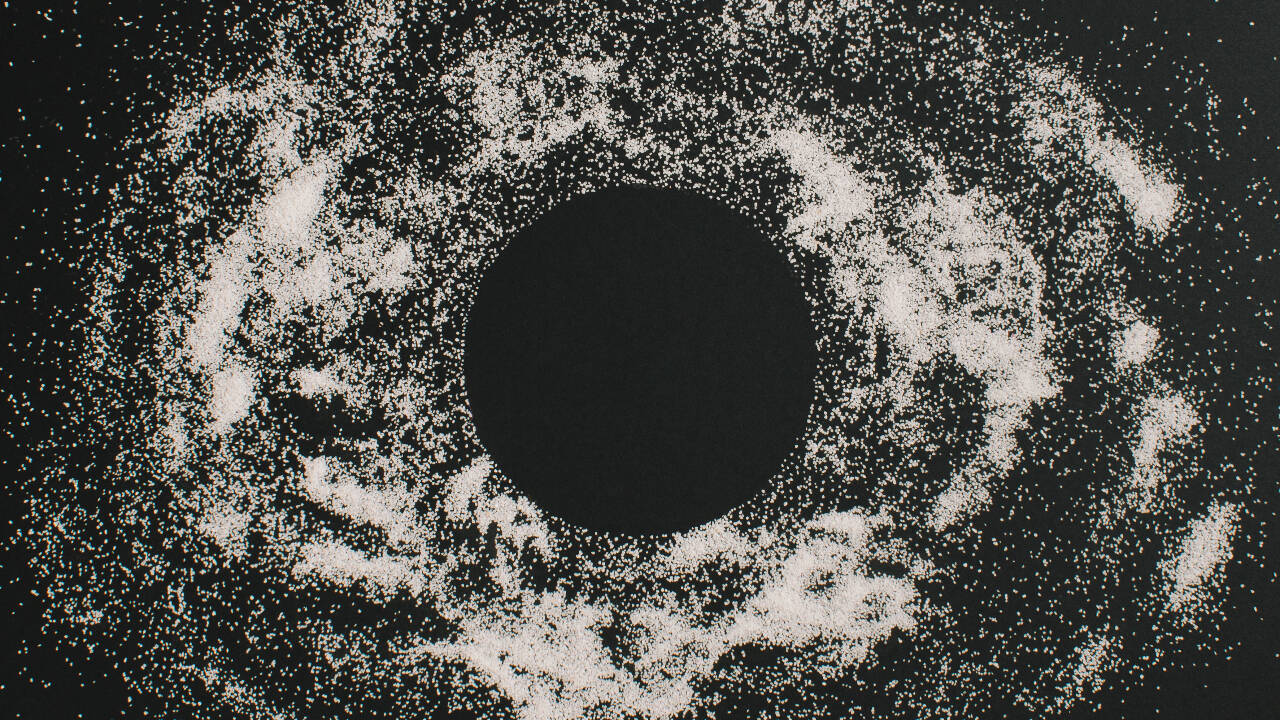
If you had to guess where the ingredients for life originated, a freezing cloud of toxic cosmic gas 26,700 light-years away probably wouldn't top your list. Yet, astrochemists just confirmed that the interstellar cloud G+0.693-0.027—floating right near the center of the Milky Way—contains metric tons of erythrulose.
Erythrulose is a natural four-carbon sugar found in raspberries. On Earth, it's famous for giving berries their sweet kick and helping sunless tanning lotions react with skin cells. In deep space, however, its presence shatters a long-standing mystery about how life managed to spark on a primitive, rocky planet.
The discovery isn't just a fun piece of trivia for astronomers. It alters the timeline of biology itself and suggests that the fundamental building blocks of life don't wait for planets to form. They're built in the freezing void long before a star ever ignites.
The Origin Story Problem That Kept Astrochemists Up at Night
For decades, origin-of-life research hit a stubborn brick wall. We know that living organisms require sugars. Sugars form the structural backbone of RNA and DNA, and they act as the primary energy fuel for cellular metabolism. But when scientists tried recreating early Earth conditions in labs, they kept running into the same roadblock: primitive Earth simply couldn't produce enough complex sugars on its own.
The chemical reactions on a young, violent Earth were too chaotic, yielding only trace amounts of the monosaccharides necessary to kickstart biology.
This sparked a fierce debate. Did life's chemistry synthesize locally in early tidal pools, or was Earth pre-seeded with organic matter from deep space?
We got hints of the latter when space missions analyzed meteorites and samples from asteroids like Ryugu and Bennu, turning up traces of ribose and glucose. But finding sugars inside an asteroid still left a gap. Did those sugars form inside the warming asteroid as it zipped around our solar system, or were they present in the raw dust cloud before our solar system even existed?
The detection of interstellar erythrulose gives us a clear answer: the sugars came first.
How Astronomers Found a Tiny Sugar Molecule 26,000 Light-Years Away
You can't scoop up a bucket of interstellar gas to test it in a beaker. Instead, a team led by Dr. Izaskun Jiménez-Serra at Spain’s Center for Astrobiology pointed two massive radio telescopes—the Yebes 40-meter and the IRAM 30-meter—toward the galactic center.
Molecules in space aren't static. They tumble and vibrate, emitting faint radio waves at precise frequencies. Every molecule has a distinct spectral fingerprint. By sifting through the radio noise from the molecular cloud G+0.693-0.027, the team matched 12 distinct emission lines directly to the laboratory fingerprint of erythrulose ($C_4H_8O_4$).
 Interstellar Dust Grain (Coated in Ice)
 ┌───────────────────────────────────────────────┐
 │  Glycolaldehyde (2 Carbons)                   │
 │        +                                      │
 │  Ethylene Glycol (2 Carbons)                  │
 │                                               │
 │  [ Driven by UV Radiation & Cosmic Rays ]     │
 │                        │                      │
 │                        ▼                      │
 │  Erythrulose (4-Carbon Interstellar Sugar)    │
 └───────────────────────────────────────────────┘
What makes this finding wild is the temperature of the cloud. At -250°C, chemical reactions should theoretically grind to a halt. Yet, cosmic rays and ultraviolet radiation hit icy dust grains, forcing two simpler two-carbon molecules—glycolaldehyde and ethylene glycol—to fuse together.
Instead of building molecules one carbon atom at a time like scientists previously assumed, space chemistry takes shortcuts. It snaps pre-built chemical blocks together like LEGO bricks.
Why Erythrulose Is a Game-Changer for Astrobiology
Erythrulose isn't just any molecule. It's an astrochemical milestone for three critical reasons:
- It's the first true sugar detected in the interstellar medium. While simpler precursors like glycolaldehyde were spotted decades ago, erythrulose is a genuine monosaccharide.
- It's a non-cyclic molecule with 14 atoms. That makes it the largest non-ringed organic molecule ever discovered in interstellar space.
- It exhibits chirality. Chirality means a molecule has "handedness"—left-handed and right-handed structural versions, much like your left and right gloves. Life on Earth is exclusively picky about chirality, utilizing left-handed amino acids and right-handed sugars. Finding chiral molecules in deep space proves that nature’s preference for handedness might be baked into the universe before biology even enters the picture.
More importantly, erythrulose interacts with other prebiotic compounds to produce threose, a sugar widely believed to be the backbone of TNA—a primitive precursor to RNA.
During the Late Heavy Bombardment roughly four billion years ago, a relentless rain of comets and asteroids slammed into the young Earth. Researchers calculate that between 500,000 and 50 million tons of erythrulose were delivered directly to Earth's surface during this period.
Earth didn't have to invent life’s raw materials from scratch. The universe delivered them pre-packaged.
What This Means for Finding Alien Life
If complex sugars assemble naturally inside dark, frigid gas clouds, then the chemical recipe for life isn't a rare fluke unique to our solar system.
Every star system that condenses out of an interstellar cloud inherits millions of tons of biological starter kit. Planets forming around distant stars don't start with a blank slate; they're bombarded with the same sugars, amino acids, and nucleobases that landed in Earth's primeval oceans.
This shifts how we evaluate exoplanets. Instead of asking whether a distant world has the luck required to generate life's building blocks, astrobiologists now know the raw ingredients are essentially everywhere. The question becomes purely about the planetary conditions: does the world have liquid water, an atmosphere, and enough stability to let that cosmic starter kit cook?
Practical Takeaways for Space Enthusiasts and Researchers
If you're following the search for extraterrestrial life, here is how to track this ongoing paradigm shift:
- Follow Next-Gen Spectroscopic Surveys: Look for upcoming data releases from ALMA (Atacama Large Millimeter/submillimeter Array) and the James Webb Space Telescope. Now that astrochemists know four-carbon sugars form easily on dust grains, they are actively hunting for five-carbon sugars like ribose—the exact backbone of RNA—in interstellar space.
- Monitor Sample Return Missions: Keep an eye on future asteroid and comet sample collection projects (like Japan's MMX mission to Phobos). Comparing the sugar composition of pristine space rocks with interstellar cloud data will confirm exactly how much chemical processing happens inside meteorites versus the open void.
- Re-evaluate Habitability Models: Keep in mind that "habitable zone" definitions are expanding. It's no longer just about a planet's distance from its star; it's about the organic richness of the parent molecular cloud that birthed the system in the first place.